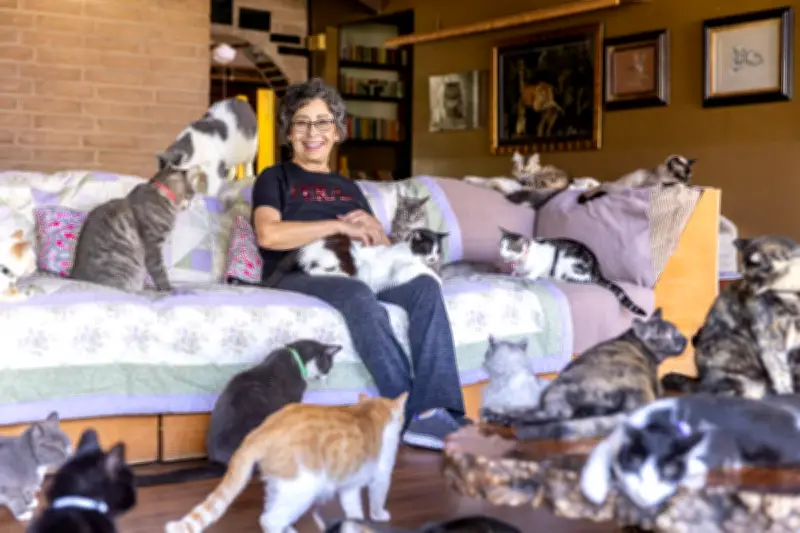
To support 700 cats, you need roughly 1,350 pounds of dry food per week, 1,000 cans of wet food, 600 pounds of litter, 60 rolls of paper towels, nine gallons of laundry detergent, six gallons of dish detergent, 200 large trash bags, and 400 kitchen trash bags. These are numbers Lynea Lattanzio knows by heart. As the founder and director of The Cat House on the Kings in Parlier, California, the largest no-cage, no-kill cat sanctuary in the state, she has helped care for 44,000 cats over 33 years. She even sold her 1973 Mercedes 450SL and two-carat diamond wedding ring to fund the sanctuary.
People may think she is crazy, and she would agree. On paper, Lattanzio is a certified 'crazy cat lady.' A self-described masochist, she revels in the ridiculous. But crazy is a pull for some; her story is well-loved, with people traveling across the globe just to see the sanctuary. This might be JD Vance's worst nightmare. Believing the Democratic Party's downfall is being a 'bunch of childless cat ladies with miserable lives,' Vance fears a country run by crazy cat ladies. If only. Today, Lattanzio cares for 700 cats and governs them benevolently with good housing, unlimited food, and free healthcare. America could never.
The History of Cats and Women
Cats have long been associated with women and with suspicion toward women who fall outside social norms. Centuries ago, cats were linked to witchcraft, becoming symbols of the supposedly dangerous, unruly woman, often unmarried and living alone. The stereotype evolved rather than disappeared. By the late 19th century, women devoted to cats were increasingly portrayed as eccentric or unstable. Rosalie Goodman, a New Yorker in the 1870s, may have been one of the first documented 'crazy cat ladies.' Dubbed 'Catty Goodman' by neighborhood children and described by the press as a 'cat hoarder,' Goodman was portrayed as deranged. In 1872, the New York Times published an article titled 'Cats and Craziness,' opening with a comparison between cat owners and 'lunatics.'

The caricature remains remarkably durable: middle-aged, unmarried, childless, middle class, lonely, eccentric, or bitter. Some know her as Eleanor Abernathy, the crazy cat lady from The Simpsons; others encountered versions of her in sitcoms and popular culture long before that. Lattanzio meets the cliches: she has gray curly hair, an affinity for cat T-shirts, but no children. She is outspoken, funny, and blunt, and her voice rasps as she spews 10 thoughts a minute. She once said she would rather have hundreds of cats than another man.
How Lattanzio Became a Cat Lady
How Lattanzio became a cat lady is simple. When she was a child, her father brought home a rabbit one Easter. It stayed with the family for years, until it began eating plants from the garden. Her mother, without telling her, gave it away to a classmate. Desperate for an update, Lattanzio asked her classmate about it. Turns out the family ate the rabbit. From then on, she knew animal welfare was her calling. Later, there was her divorce. A bad one. Bad enough to make her buy a home with six acres of land as a single woman and later wonder why she did that. This land later turned into The Cat House on the Kings.
Thus, out of human pettiness, the shelter was created. When you walk through The Cat House on the Kings, you are followed by a minimum of 10 cats. You take a seat and two have already jumped into your lap, the others lounging near your feet or sitting on the bench with you. Cats are chilling on the walls, on the built-in cat trees. It is surprisingly quiet, except for the low rumble of collective meows and purrs. The once six acres have doubled to 12. You would expect a smell, but there is none. The property is beautiful: rolling hills of vibrant green grass, treelined walkways, the flowing Kings River. Numerous buildings each have their own purpose: the main house with a fish pond, kitty garden, and wood stove; the Sadie Malone senior center for older cats; ICU units with on-site veterinarians. Cats can stay their whole lives, but the goal is to place them in loving homes.

The Dislike of Cats Is the Dislike of Female Autonomy
'Cats and women share a place in history,' said Irina Frasin, an anthrozoology researcher at the Romanian Academy in Bucharest. 'They are not completely domesticated. They are more independent than dogs, and that unruliness and unsubmission to human rule is what ties the history of cats and women together. Because women were also perceived as beings to be tamed and kept under control.' In ancient civilizations, cats were sacred. Chinese mythology placed cats in charge of the world and Li Shou, a fertility cat goddess, as their leader. The well-known Japanese maneki-neko figure represents the goddess of mercy. Ancient Egyptians had Bastet, a half-cat, half-human goddess of domesticity and fertility, and Sekhmet, the lion goddess of war and healing.
Felines equaled feminine power, but this was reworked in the Middle Ages. Amid the ongoing hysteria of witchcraft, Christian Europeans crucified anyone suspected as antagonists of the church. Those targeted were 'disobedient' women and their cat 'familiars.' A smidge of socially unacceptable behavior, and they were burned at the stake. 'You have all these characteristics of women embodied in cats that were once worshipped by ancient societies become flaws under patriarchy,' Frasin said. 'Because strong women were to be suppressed in that time.' Animal behavior specialist Steve Dale named a myth that dates back centuries: cats sucking the breath out of babies. These conspiracies only grew. Black cats have been associated with witchcraft, bad luck, and evil spirits. In 1233, Pope Gregory IX issued the Vox in Rama, claiming black cats were the reincarnation of Satan, leading to their mass extermination. This stereotype still affects them today: black cats have the lowest adoption rates and highest euthanasia rates. The 'crazy cat lady' is simply a quirky repackaging of misogyny. The dislike of cats, Frasin said, is the dislike of female autonomy.
Modern Cat Ladies: Embracing the Label
Liz Richter often finds herself giving her dates an ultimatum: me and my cats or nothing. With blue eyes, blond hair, and an extroverted personality, she is a gem. Her lack of dating success comes partly from her cats. Many men do not take her up on the package deal. 'There have been plenty of men on dating apps who ask questions and I am like, 'Yeah, I have three cats,' and they will unmatch with me,' Richter said. 'It is the whole cat lady stigma.' She attributes the weird reactions to immaturity. 'I think the idea of being independent as a woman is scary for men,' she said. Her three cats, Stevie, Joplin, and Millie, got her through her divorce. 'When I was going through divorce, I had amazing support from friends and family. But at the end of the day, I go home to my cats.'
Dennis Turner, an animal behaviorist at the University of Zurich Irchel, has studied human-cat relationships for over 40 years. 'Cat owners are quite often less depressed, less fearful, and more extroverted,' Turner said. 'Both the presence of a cat and the interaction with a cat reduced negative moods significantly.' And the effect is particularly strong on women: 'We found that a cat has the same positive effects on women as a male partner. But for men, a female partner has a stronger positive effect on their moods than a cat.' Richter loves her cats. 'There is something about the calmness of my cats that is just really relaxing,' she said. 'Especially through hard times, it is consistent. Cats protect our emotional state.'
The Rise of the Cat Guys
In one of Turner's studies, cats were released into a room of people. Without intervention, cats showed no gender preference. But when humans interacted, cats reacted differently. 'Men tend to interact with cats sitting on a sofa or in a chair,' Turner said. 'Women go down on the floor and interact with the cats on their level. That is a significant difference and cats like that.' Women also vocalize more with their cats, and cats vocalize more with women. Cats have a matriarchal society, Frasin explained: male cats typically do not raise kittens; instead, it is a network of mother, aunts, and grandmas. Behavioral similarities help explain the bond between cats and women. Unlike dogs, which easily show affection, cats are more independent and require time to develop trust. Women often resonate with cat behavior, while men associate with dogs. In a study comparing moods, 'dog people scored higher on warmth, liveliness, rule consciousness, and social boldness compared to cat people. Cat people scored higher on general intelligence, abstraction, and self-reliance,' Turner said.
The 'crazy cat guy' has taken off in the past decade, one of the first being Cat Man Chris, a YouTuber and father of Cole and Marmalade. Chris Poole has been uploading cat content since 2013. He calls himself the 'human servant' to his felines. His morning routine: wake up, feed his six cats, then two outside ones, then drive around to feed feral colonies, averaging 40-50 cats a day. 'To save them and bring them to a safe place and earn their trust and get them healthy and eventually find them home, that is a pretty cool feeling,' Poole said. He has not seen a difference in how people treat a man with cats versus a woman. The lack of hate he has gotten is telling, as women in similar positions have received plenty. Liz Richter got several strange comments online. The difference is that 'crazy cat lady' is a systemic perception of women. Women and cats share more than history: they share oppression.
A Man and a Love Story, After All
Despite the stereotype, Lattanzio is in a relationship with a man named David Anderson. They were on the same dive team as teenagers and roomed together in college. Both married other people, but life happened, and they eventually found their way to each other. During an interview, Anderson sat quietly in the background, listening to every word. When asked why she does the tedious work, Anderson answered: 'Lynea loves cats. She loves everything about them. Her favorite thing is to see a cat run across a lawn and climb a tree.' 'It is just something that is important to me and makes me smile,' Lattanzio said, her eyes sparkling. 'When you take a cat that is almost dead and bring it back to full health and help get it adopted, that really warms your heart. It is fulfilling.'
The two live in a house across the street from the sanctuary. In the backyard is a Japanese botanical garden they built together. With them live their three personal cats: two of Anderson's, one Lattanzio's, a Bengal that 'hates the world.' At the edge of the Kings River, there is a bench Lattanzio calls her favorite spot. A plaque reads: 'In Memory of Poppy Burger / Our Friend, Our Guardian Angel / 2013.' Burger was a close friend and important to the Cat House's creation. Buried at the foot of the bench is Poppy's 15-year-old cat. Lattanzio sits here as the sun sets. Behind her, cats run through the hills, climb trees, nap in branches, perch on roofs. Alive, breathing the air of the pocket she carved, Lattanzio listens to the scampering legs, the running river water, and the walls that have seen it all.