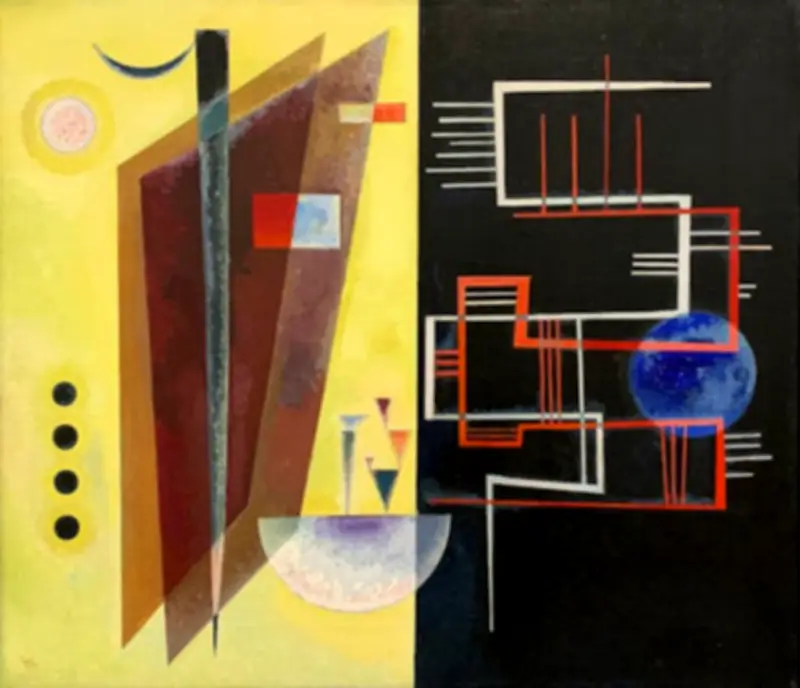
Wassily Kandinsky's Inner Alliance (1929) hangs in the public domain, a relic of a bygone avant-garde. But what does the 'avant-garde' look like today? Two new novels offer starkly different answers.
Giada Scodellaro's Ruins, Child and Anna Poletti's Hello, World? are vastly different books. Scodellaro won the 2024 Novel Prize; her book weaves together Black feminist poetry, theory, and prose. Poletti's novel is a queer erotic introspection, delving into domination and submission. Stylistically, thematically, and in ambition, they share little. Yet both abandon traditional narrative mechanisms, favoring fragments over conventional chapters and paragraphs.
Experimental Approaches
Because of this experimental bent, these books might be called 'avant-garde.' The term originally referred to soldiers scouting ahead of an army. In the 19th and early 20th centuries, it described writers and artists working in uncharted mental spaces, often aligned with progressive politics. Neither Ruins, Child nor Hello, World? attempts such a gesture. Scodellaro's novel explores 'lateness'; Poletti's uncovers bonds that make personal progress fraught. Both dwell in political melancholy, prioritizing survival and care over revolution. If these are the radical novels of the 2020s, they raise a key question: what does the avant-garde look like today?

Hello, World?
Anna Poletti, an Australian queer feminist media-studies scholar based in Utrecht, has endorsements from Chris Kraus and McKenzie Wark. Hello, World? follows Seasonal, a genderqueer academic who moves to the Netherlands. After a breakup, they undergo a katabasis into deeper sexual drives. The book compares itself to Pauline Réage's The Story of O and the Marquis de Sade's work, exploring Seasonal's dominant/submissive relationship with Laszlo, a self-exiled Hungarian.
Kraus calls the book 'radical,' and it does depict a hidden relationship. Poletti examines kink culture's ethics, built on structured violence. But the fragmentary approach, moving between vignettes and text messages, avoids intense moments, stopping short of the erotic interior. The real subject is the relationship's modulations as each character avoids tipping from domination to exploitation. Seasonal muses on trauma, troubled when Laszlo uses violent language. Neither escapes their cultural conditioning.
Hello, World? charts virgin waters in its exploration of trauma and violence. Seasonal is complex: theoretical about relationships but garbled on art and politics, discarding a partner who won't have sex, dedicated to pleasure in Sadean fashion. This portrait uncovers aspects of sexual liberation. Seasonal's embrace of identity politics leads to sympathy with Viktor Orban's nationalism. For all its rejection of the Enlightenment, kink from abuse is separated only by rational consent. Seasonal's pursuit of sexual freedom makes them the sort of person they reject. As a diagnosis of the politics of self, it works, but it's not avant-garde or radical. Its circulation may be limited to media-studies circles.
Ruins, Child
Like Hello, World?, Ruins, Child is a novel of fragments, but arranged differently. It tessellates texts from Black poetics and radicalism: August Wilson, Toni Cade Bambara, Derek Walcott, Zora Neale Hurston, Langston Hughes, June Jordan. Art, architecture, music, and film references are woven in. The cover is a Lorna Simpson collage; collage describes the novel. The narrative is based on Bannu Cennetoglù's HOWBEIT, a video-art project with 128 hours of footage from 2006-2018. The setting recalls 'The Hill,' a figure of suburban ghettoization in Wilson and Bambara. Characters dialogue with Bambara's The Salt Eaters (1980), which the novel remixes.

The novel assembles these parts into a puzzle: six characters watch footage from earlier lives. Women live in a crumbling apartment tower, shunted by a neglectful government. They watch past selves prepare for a carnival, trade boyfriends, and endure Vonetta's endless pregnancy. Reality stretches across decades; time and place are often indeterminate. Events seem near-future, with infrastructure eroding and seasons giving way to extremes. But this is not about the future; it's about what has been lost. Scodellaro draws on architects Peter Eisenman and Elisa Iturbe's theory of 'lateness' in architecture. Instead of building something new, the novel picks up pieces. Vonetta, the eternal mother, laughs at those wanting to 'live in the near future,' suggesting 'the mother does not aim for this, she does not think about being avant-garde.'
Walter Benjamin mused that ruins call for critics to make them whole, reviving the ideas and dreams before destruction. Ruins, Child brings together nearly a century of Black radical writing in a gesture of salvation, dwelling in moments of allegiance and solidarity that allow the oppressed to survive in a crumbling world.
Inwards and Backwards
Poletti's hello, world? reflects cynicism about the progressive project; Scodellaro's novel rejects being 'avant-garde.' Neither has eyes on the artistic or political horizon. They turn inwards and backwards, explaining failed liberation or saving what they can as the world hurtles to oblivion. Both are conservative postures. These ways of adapting may have contributed to our present. There is easy melancholy in dwelling on personal politics' contradictions and stooping to retrieve relics of the past.
Scodellaro's book is a wonderfully wrought collage; its clever construction rewards close reading. Poletti's has less to offer, though it carries lessons in its slippery portrait of Seasonal. Neither is utopian, because neither believes in politics. That our boldest books are restrained and intimate rather than forward-looking and activist is a telling fact about literature in the mid-2020s.