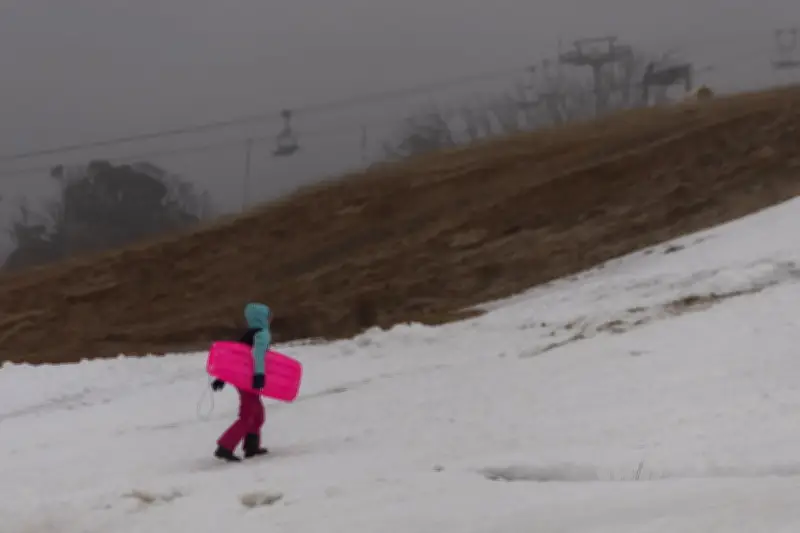
Tourists at Perisher in the Snowy Mountains, NSW, witnessed snow flurries just in time for the ski season opening, but experts warn that the outlook for the rest of winter is less promising. The Bureau of Meteorology has forecast below-average snowfall for alpine regions this winter, with El Niño expected to bring hotter and drier weather.
El Niño and Climate Change Impact Snowfall
Jonathan How, a senior forecaster at the Bureau of Meteorology, explained that the combination of a dry and warm outlook with El Niño does not favour good deep snow cover for skiers. “It tips the odds against a good season because of less rainfall and high temperatures. That’s a bad combination,” he said. The bureau’s long-range forecast suggests below-average snowfall for Australia’s alpine regions, with the possible exception of Mount Mawson in Tasmania, while both maximum and minimum temperatures are expected to be above average.
How noted that while long-range forecasts cannot predict day-to-day weather systems, winter storms will still occur. However, forecasts for next week indicate daytime temperatures up to 10C, which may cause the snow to not stick around very long. Skiers are advised to be ready to respond to winter storms when they arrive.

Snow Depth Decline and Future Projections
Climate scientists have long predicted that Australia’s alpine areas will get warmer, challenging ski resorts. Observations already show declining snow depths. Two years ago, scientists from the Australian National University and University of Innsbruck used the SkiSim2 model to assess the impact of greenhouse gas emissions on 11 major ski resorts. Ruby Olsson, an ANU researcher, said the model showed that the average resort season length would drop by 15% to 17% by 2030. While resorts use snowmaking technologies to supplement natural snowfall, warmer temperatures make adaptation harder. “There is a stark difference between emissions scenarios. The more we reduce emissions, the cheaper and more effective adaptation will be,” Olsson said.
Dr Andrew Watkins, a research associate at Monash University and former head of climate prediction at the bureau, noted changes in snowfall patterns. “We’re getting fewer regular top-up snowfalls and more falling in bigger dumps. Climate change loads the dice for less snowfall, and El Niño loads the dice for a shorter season. The killer for snow is warm rain events, which bring spring rain instead of spring snowfall.” He added that El Niño’s drier air and cooler nights could benefit snow-making.
Skiers and Industry Adaptation
Professional freestyle skier Mia “Miff” Rennie, who has a season pass at Perisher, has observed a “drastic” drop in snowfall and season length over the past decade. “It’s deeply concerning. It’s black and white for me. We need to stop fossil fuels and use renewables to have these winters and seasons,” she said. Despite concerns, she remains excited for the coming season and hopes everyone can experience winter magic.
Josh Elliott, chief executive of Snow Resorts Australia, acknowledged that alpine conditions have always varied, and resorts are accustomed to planning for a wide range of weather outcomes. Snowmaking has been part of the industry for over 35 years, with some resorts investing in next-generation all-weather snowmaking systems that can produce snow at temperatures up to 20C above zero. “No industry can predict conditions decades into the future. The key question is whether it continues to adapt and evolve, and Australia’s alpine sector has demonstrated a long-term commitment to doing exactly that,” Elliott said.