Renters could be forced back into share houses or even home with Mum and Dad due to looming rent rises, with one expert predicting there’s a limit to how many more increases landlords can inflict.
Amid fears that rents will rise due to the government’s planned changes to negative gearing and capital gains tax for landlords, there are warnings that there’s “a ceiling” to how much renters can take.
Cotality research director Tim Lawless told news.com.au that he wasn’t sure that many renters had the capacity to pay more than they are already being forced to spend.

“I think landlords will try to put rents up,” he said.
“Whether the market can actually tolerate it or not is a completely different question.
“The rental market in May had a record low vacancy rate, 1.5% on our numbers, so that’s an equal record low.”
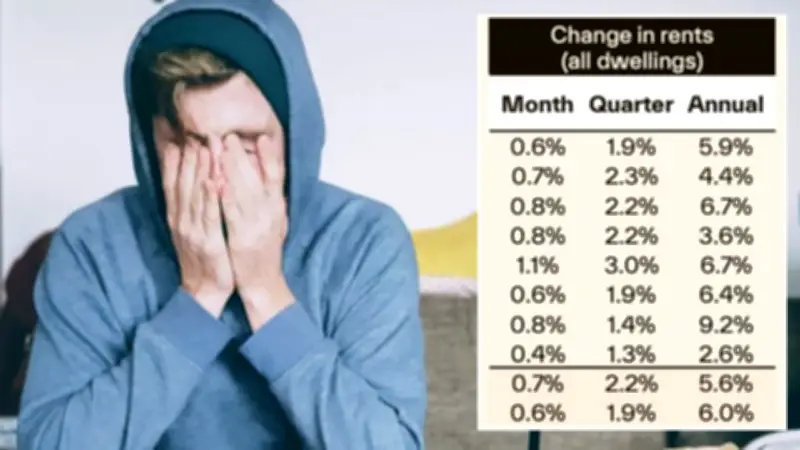
Median weekly rents across Australian capital cities rose 5.7% over the past year to a national median of $692, with Darwin recording the strongest annual growth at 9.2% and vacancy rates tightening in most markets.
Combined capital city rents have surged from around $470 per week in early 2016 to $724 by March 2026, with regional rents also climbing sharply since 2021.
But Mr Lawless said he questioned whether further rental hikes can be sustained.
“I just wonder, though, I mean, how much more can renters pay that they don’t have a lot of elasticity in their ability to pay more, so renters can’t go to the bank and get a loan to pay rent, right, like you can get to buy a bigger and better home,” he said.
“So I think within with renters already dedicating about a third of their incomes of their pretax incomes towards paying rent, there’s probably a ceiling that becomes evident on how much renters can actually pay.
“From there you’ll find even with vacancy rates very tight, rental demand will need to restructure in some shape or form, probably through the formation of larger households, more multi-generational households, more group households, younger folks staying in the family home for longer.
“Tenants really trying to maximise their tendencies by putting more people on the lease, legitimately or illegitimately.
“So I think that’s probably the more likely scenario, rather than rents rocketing higher. I just can’t see how renters can pay more than what they currently are, materially, at least.”
According to Cotality, the total number of rental listings nationwide was around 18 per cent below its five-year average at the end of March. Sydney and Melbourne listings were even lower, at 27.4 per cent and 21.0 per cent, respectively.
Sydney remains the most expensive, with the median rent climbing by 5.9 per cent to $824/week in March 2026. In contrast, Melbourne’s median rent was the lowest of the mainland capitals at $632/week.
Currently, rents are rising at about 6 per cent per annum, but that’s nowhere near record highs.
“If you go back to, you know, when, when migration rebounded back into Australia, overseas borders reopened, and so forth, rental growth was quite a bit stronger, it was getting up in double digits per annum. But a lot of that was driven by the unit sector that was playing catch-up because it was quite weak through the pandemic,” he said.
“I think you know, rental growth annually holding at around 6 per cent seems more likely to me, but it’s, it’s a pretty hard one to predict.
“I could be completely wrong, and renters will pay more, but I think it’ll be an interesting one.”
Recent national polling suggests 47 per cent of Australians believe the government’s negative gearing changes will push rents up faster.
The survey was commissioned by Fair Go Australia, a nonpartisan campaign run by Australian founders, employees, and investors who oppose the capital gains tax changes.
Among Gen Z and Millennial respondents, 36 per cent and 40 per cent, respectively, expected rents to rise as a result of the changes.
The Albanese Government claims that changes to negative gearing and capital gains tax will result in only a net rent increase of about $2 a week.
Just 12 per cent of respondents believed rents would fall or rise more slowly as a result of limiting negative gearing to newly built homes, with 23 per cent expecting little impact either way.

While the changes aim to make home ownership more affordable for first-home buyers, polling suggests younger voters are sceptical.
However, one in three voters – 33 per cent- strongly supports or supports the negative gearing changes.
Labor frontbencher Mark Butler has warned landlords have “no basis” to hike rents right now based only solely on the changes to negative gearing and CGT, given that existing rental properties will not be impacted by the reforms.
“I’m not sure people will be particularly shocked that the real estate industry, for example, is very happy with the status quo,” he said.
“They don’t want to see change. What a surprise that they’ve got some modelling that indicates the government should do absolutely nothing.”
He claimed there was “no basis” for rent increases purely as a result of the tax changes, given that existing landlords can keep negative gearing.
“That is the bedrock of the private rental market right now, so there is no basis or all of those properties, and there are hundreds of 1000s of them, no basis at all for any rental increase for them,” he said.
“But having said that, officials say going forward, there’ll be a modest impact on rents of about $2 a week.
Master Builders Australia, the Property Council of Australia, and the Real Estate Institute of Australia have now produced new modelling backing the status quo and suggesting the real figure is five times that amount.
It finds rents will increase beyond the budget’s $2-a-week modelling, rising to $3 a week in 2026-27 ($142-a-year) and $9-a-week in 2029-30 ($477 a year).
Once again, that’s not a prediction that rents will not rise well beyond those figures, but that the portion related to the changes will be $3 a week, rising to $9 a week by the end of the decade.