Country Diary: A Close-Up View of a Shimmering Beauty
Bridport, Dorset: The female in my garden has been a glittering presence of late, but soon she will return to the river to breed.
The beautiful demoiselle (Calopteryx virgo) is aptly named. This loveliest of damselflies is on the wing now across south-west England and Wales, fluttering like a falling scrap of metallic paper among the vegetation.
One of only two species of damselfly with coloured wings, the males have blue bodies and dark-sheened wings while females are green with contrasting tan wings. But such a plain description does not begin to capture their true appearance.

In the last few days, a female has been twirling and shimmering in the garden. She might have emerged miraculously from our tiny, dank pond but – as demoiselles prefer running water – it is almost certain she came from the nearby River Brit.
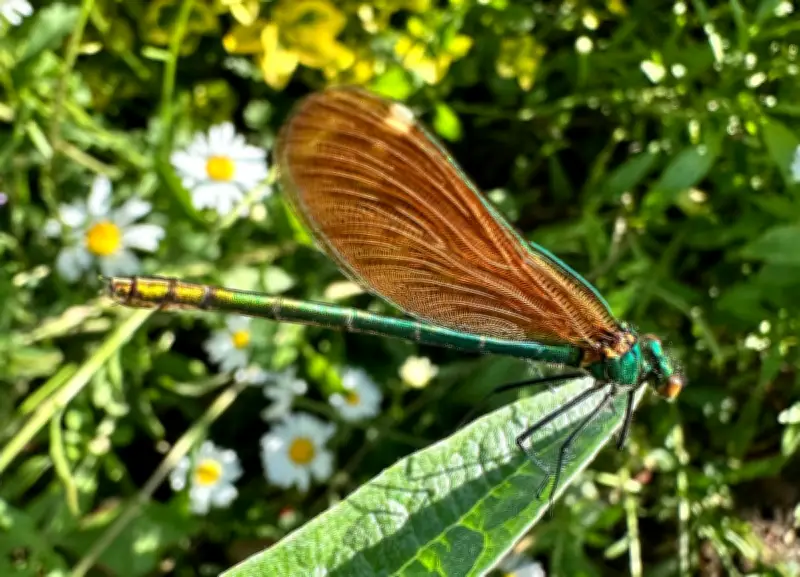
She rests for a moment on the pointed tip of a cardoon leaf with her long, slim, segmented abdomen tilted up, a counterbalance to the armoured nugget of her thorax. Her shining body is an iridescent mix of emerald, gold and bronze, like a tube of glitter. A fuzz of microscopic hairs haloes her head.
Her wings – she has four – are folded together at an angle jutting above her back. They are the colour of autumn bracken, with veins in flowing, feathered lines, the edges touched with a thin lick of turquoise. The rounded ends riffle and stir against each other even while the rest remains motionless. Her deep-green legs are long, sharply angled and softly barbed.
Adult females live away from water, returning to breed. When ready, she will visit the tangled riverbanks where males have established their territories. If a female passes by, they rise in a courtship flight, displaying wings so dark they look almost black until the light catches them and they shift to cobalt blue.
Like all damselflies and dragonflies, demoiselles mate head to tail, forming a heart-shaped wheel which may last for several minutes. Afterwards, the female uses her ovipositor to stab the fertilised eggs into the stems of water plants.
While the eggs will hatch within weeks, the nymphs spend two years underwater developing through a dozen larval stages. Voracious predators, their presence is an indicator of water quality. Seeing the adults flittering and glistening is a reassuring pleasure.
Under the Changing Skies: The Best of the Guardian’s Country Diary, 2018-2024, is available now at guardianbookshop.com.