
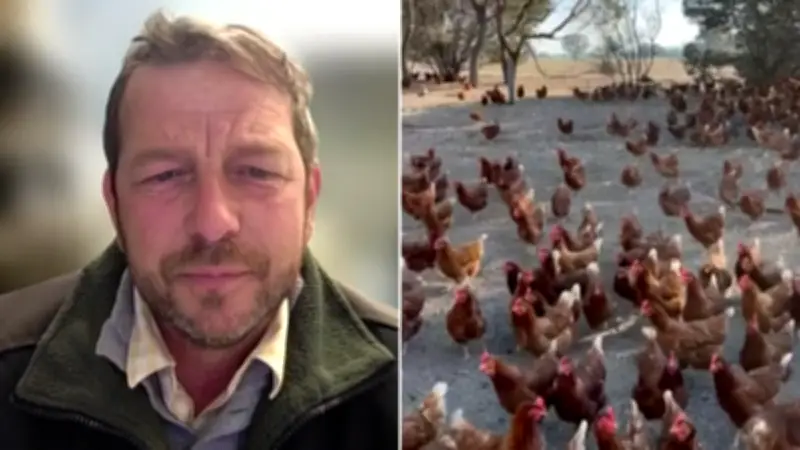
Colin Ford, a poultry farmer from Albany Farm Fresh Eggs, has expressed deep concern after a second case of the highly pathogenic H5N1 bird flu strain was confirmed in wild seabirds on Western Australia's south coast. The detections, both near Esperance, have triggered immediate lockdowns across the state's poultry industry, even though no commercial flocks have been infected.
Second Detection Heightens Alert
The latest case was found in a northern giant petrel, following an earlier confirmation in a brown skua from the same region. Authorities have urged the public to avoid sick or dead birds and report sightings to the Emergency Animal Disease Hotline. More than a dozen reports of sick or dead birds have been received, but there is no evidence of infection in poultry or agricultural production systems.
Immediate Response by Farmers
Ford acted swiftly after being alerted by authorities on Friday. “We got advice on Friday afternoon that they’d found this bird flu in Esperance, so we took the decision straight away that when the birds came in Friday night, we wouldn’t lose them out on a Saturday morning,” he said. Although the infected birds were found about 500 kilometres from his Albany farm, Ford's operation is among the closest poultry sites to the detection zone.

“I’m very concerned,” Ford admitted, but noted that “it’s just under surveillance, there’s no outbreak.”
Industry-Wide Lockdown
Major producer Inghams Group announced precautionary measures across all its WA sites. “This includes the implementation of a complete lockdown, preventing all non-essential access, across all the company’s WA farms and processing operations,” the company said in an ASX statement. Inghams is also seeking a regional housing order from the federal government to keep free-range poultry indoors. “Should this be enacted, an exemption order from the Australian Competition and Consumer Commission is in place to protect the continuation of free-range product supply and labelling,” the company added. Inghams, which has breeder farms and a grower network in Muchea, Gingin, and Mogumber north of Perth, continues to supply the Australian market as usual.
Preparedness and Response
Ford emphasised that the industry had long anticipated the arrival of H5N1. “It wasn’t a case of if it comes into Australia, it’s when, and one of the most likely causes was coming from south onto the south coast. Unfortunately we’re in ground zero on the south coast,” he said. He praised the industry's preparedness, noting that “the response has been amazing really.”
Despite the heightened alert, authorities stress there is no evidence of infection in commercial poultry. The public is advised to avoid contact with sick or dead birds and marine mammals and to report any sightings to the hotline.