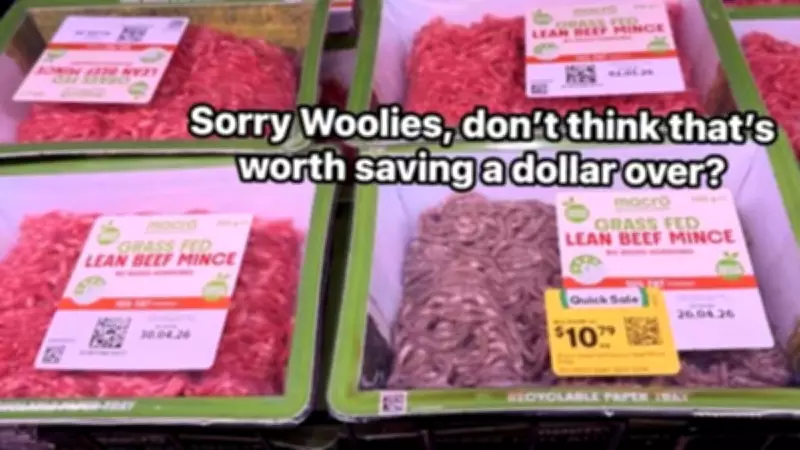
A supermarket giant is at the centre of a fierce online debate about food safety after shoppers reacted to a discounted pack of mince that appeared to be a light brown-grey colour.
The image, shared on social media, shows multiple trays of lean beef mince from Woolworths lined up in a fridge. While most of the mince appears bright red, one tray stands out for its dull grey tone and markdown price from $13 to $10.79 with a “quick sale” sticker.
The text over the picture reads: “Sorry Woolies, don’t think that’s worth saving a dollar over?” The sentiment was echoed by some people but also quickly challenged by others.

“Grey meat — yuk!” one person wrote, while another questioned: “How can they even sell that?” Other comments were more blunt, with one person claiming it “looks like that expired two days ago” and another calling it “disgusting” and “already rotten”.
But not everyone was convinced there was anything wrong with the mince. “You should be more worried about meat that DOES NOT change colour,” one person said. “It’s only a bit of oxidation. I’d be more worried if it wasn’t greying that close to its use-by date,” another person added. “It is quite common. Still safe to use if stored correctly and used by the expiry date.”
Others said the markdown itself was the bigger issue, with the mince reduced by $2.21, or about 17 per cent. “I’m more interested in the fact of just how small the ‘discount’ is,” one person commented.
Experts say the colour, while off-putting to some people, is not necessarily a sign the meat has gone bad. According to food safety guidance, the bright red colour shoppers associate with “fresh” mince comes from a pigment called myoglobin reacting with oxygen. Over time, the oxygen in the packet is used up and the meat naturally turns grey.
“In short, though, greyness of meat is not directly related to food safety so much as it is related to meat age and (thus) quality,” University of Tasmania food safety expert Tom Ross said. He noted older mince may also contain higher levels of spoilage bacteria, which don’t necessarily make people sick but can affect smell, texture and overall quality.
“And, certainly, when you see old mince (reduced in price for quick sale) next to fresh mince, it’s not a compelling argument,” he said. “If, however, you’re going to use that mince in a bolognese sauce or a burger pattie it probably doesn’t matter. But you’d likely need a bigger mark-down to convince buyers.”
Woolworths said the supermarket had strict processes in place to maintain quality standards. “We take food safety very seriously and have strict cleaning and food management standards,” it said. “Quality checks are undertaken to test the temperature, product composition and seal integrity of each batch of Woolworths mince produced.”
Supermarket mince is packaged in a controlled environment with a mix of oxygen and carbon dioxide, designed to maintain its red colour and extend shelf life. Food authorities also note mince can appear grey underneath the surface even when fresh, and may “bloom” back to red when exposed to oxygen again. Products are typically marked down in-store based on stock levels and expected demand, while shelf-life testing is used to determine the “best before” date applied to meat products.
When it comes to choosing mince, Ross said shoppers should focus less on colour and more on whether packaging is intact and the product has been kept properly chilled below 5C. Guidance from the NSW Food Authority advises shoppers to handle mince carefully, as it has a shorter shelf life than whole cuts due to its larger surface area. Consumers should pick up meat last when shopping so it stays cold, choose packs that are well sealed with no tears or excess liquid, and refrigerate it promptly. Mince should be cooked thoroughly to at least 71C all the way through, as colour alone is not a reliable indicator of doneness. If meat has an obviously sour or “off” smell or feels tacky, it may be spoiled and should not be used.