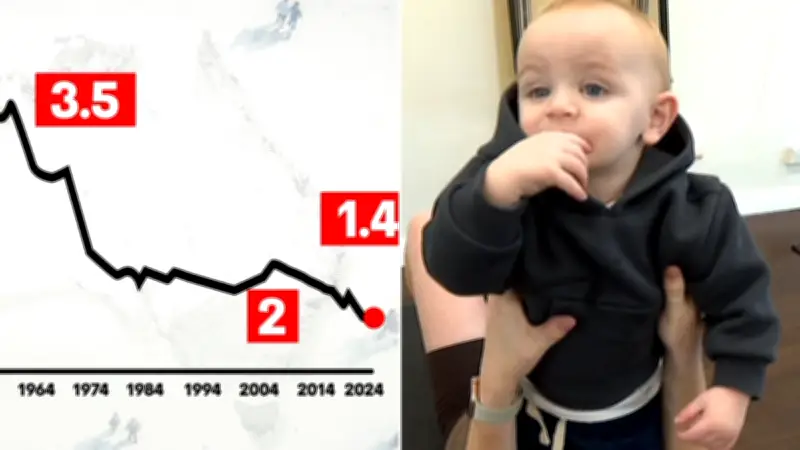
Australia’s fertility rate has plummeted to its lowest level in history, dropping to just 1.48 births per woman, as families struggle with the cost of living and delay having children.
The dramatic decline comes even as the nation’s population surged past 28 million this month, with experts warning of a looming economic crisis as fewer children means fewer future taxpayers to support an ageing population.
The fertility rate peaked after the Second World War during the baby boom, when diggers returned home and the rate hit 3.5 births for every woman of childbearing age. It fell after the introduction of the contraceptive pill in 1961, before then-Treasurer Peter Costello famously implored Australians to have “one for your wife, one for your husband and one for the country.”

That resulted in a slight jump back above two, the replacement rate for each parent. But now the slide is back on, with the rate sitting at just 1.48.
Australian couples are now having children at well below the replacement rate.
Reasons Behind the Decline
“It feels like we’ve hit rock bottom,” Australian National University demographer Liz Allen said. “We’ve hit the lowest rates in our history.”
Couples are delaying children, with the average age of mothers rising from 25 in 1971 to 32 in 2024. A standard IVF cycle can cost around $12,000, putting parenthood out of reach for many.
Some Australians are choosing not to have children at all.
“I saw what the traditional life looked like and I decided it just wasn’t for me,” Tanya Williams, author of A Childfree Happily Ever After, told 7NEWS. “I think it’s just been a really great thing for women in general to know that they have got a choice.”
Those who do have children are having fewer. The number of single child families has doubled in the last 40 years and now represents 15 per cent of families.
“I’d love to have a third in this climate,” mother Gabby Campbell said. “Probably not though. It’s too expensive.”
Economic Implications
Finance expert David Koch concurred. “It’s understandable when people say, ‘gee, we can’t really afford to have an extra child’ because the sacrifices of having it on your lifestyle and your household finances can be just so large that people don’t want to make those decisions,” he said.
The implications are stark. “A low fertility rate means that an ageing population runs out of taxpayers to support that ageing population,” Koch continued.
“I’m concerned from a human perspective of what some are calling a human catastrophe,” added Allen.
Immigration has helped boost overall population numbers, but experts warn that without migrants, combined with an ageing population and low fertility rate, Australia will have to sacrifice economic growth.
“If we don’t have migrants and continue with the ageing population and low fertility rate, we will have to sacrifice — overall as a country — economic growth,” Koch said. “That’s your lifestyle.”
The fertility crisis is part of a broader series of population pressures facing Australia which 7NEWS will examine over the coming week, including towns growing too fast, housing shortages, and the challenge of caring for an ageing society while the nation drowns in debt.