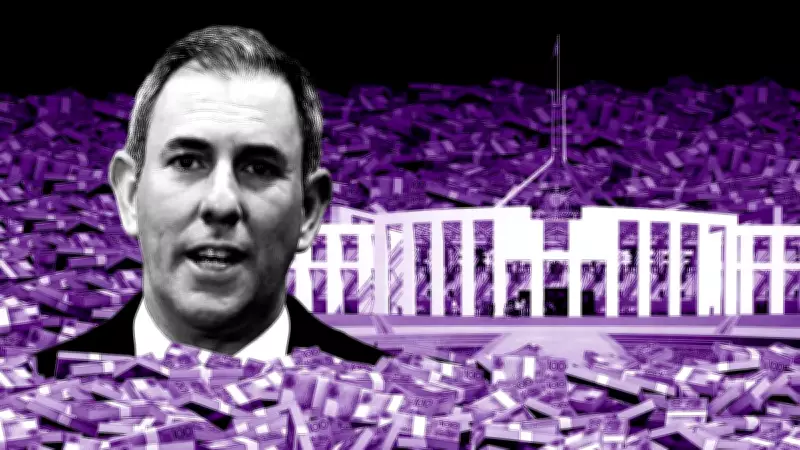
RBA Governor Contradicts Treasurer, Links Government Spending to Inflation and Rate Rises
In a significant development this week, Reserve Bank of Australia Governor Michele Bullock has directly contradicted Federal Treasurer Jim Chalmers, explicitly linking government expenditure to persistent inflation and the central bank's decision to raise interest rates. This statement represents a clear challenge to the government's economic narrative and places renewed pressure on fiscal policy makers.
Deflection Versus Economic Reality
When faced with uncomfortable economic truths that contradict their preferred narrative, politicians often resort to a familiar toolkit: deflection, obfuscation, discrediting critics, denial, and spin. This week, Treasurer Jim Chalmers employed these tactics in an attempt to avoid responsibility for the financial pain inflicted on Australian home loan borrowers following the RBA's latest interest rate increase.
Dr Chalmers has consistently argued that private sector activity, not public sector spending, is the primary fuel for inflation. This position has been maintained despite both headline and underlying inflation measures remaining stubbornly above the Reserve Bank's target band of 2-3 per cent.

The RBA's Unambiguous Economic Assessment
On Friday, Governor Bullock provided a starkly different assessment. She outlined the fundamental relationship between government spending and inflationary pressures, acknowledging that fiscal policy played a direct role in the central bank's decision to lift the cash rate.
"Government spending is part of total spending and total aggregate demand in the economy, so it, along with private spending, contributes to aggregate demand," Ms Bullock stated. "And so to the extent that aggregate demand is above aggregate supply, which we think it is, that's contributing to inflation. That's why we've decided to raise interest rates."
Ms Bullock further warned that additional rate increases remain a distinct possibility. "If we need to put up interest rates to slow the growth in demand, in aggregate demand, then that's what we will do," she cautioned, signalling the RBA's readiness to take further action if inflationary pressures persist.
A Shift from Reluctance to Factual Acknowledgement
Governor Bullock's forthright comments marked a notable shift from her position earlier in the week. On Tuesday, when questioned by journalists about the connection between government spending and inflation, she had declined to comment on fiscal policy matters. By Friday, her stance had evolved into one of clear, factual acknowledgment.
"Well, it does as does private. It's part of aggregate demand," she said, making it unequivocally clear that government spending decisions directly affect interest rate settings. "Mathematically, you're right. Public demand expenditure and private sector, all of that adds to demand. That's logical. It's mathematical. That's what happens."
Ms Bullock emphasised the objective nature of this economic relationship. "It's factual. It's not an opinion. It's not a judgment, it's a fact. That's all it is."
The Interconnected Nature of Public and Private Demand
The RBA Governor also highlighted the complex interplay between government expenditure and private sector activity. She confirmed that government spending often manifests within private demand figures, as some private economic activity is fundamentally reliant on government contracts, subsidies, or direct transfers.
Citing examples like the now-discontinued electricity rebates, Ms Bullock explained, "What it often does is it transfers money to people, and it gives them money to spend." This mechanism demonstrates how fiscal policy can indirectly stimulate private consumption, thereby adding to overall aggregate demand pressures.
Fiscal Context and Political Responsibility
The debate occurs against a specific fiscal backdrop. Treasury forecasts indicate Federal Government spending is projected to reach 26.9 per cent of gross domestic product in the 2025-26 financial year. Excluding the extraordinary COVID-19 pandemic period, this would represent the highest level of government expenditure as a proportion of GDP since 1986.

As the public face of monetary policy, Governor Bullock bears the responsibility of explaining the causes behind the mortgage pain experienced by Australian households. Her latest comments provide that explanation with unprecedented clarity, directly implicating government fiscal decisions.
Meanwhile, Treasurer Chalmers has shown a pattern of being eager to claim credit for positive economic developments while being reluctant to acknowledge responsibility for negative outcomes. Governor Bullock's statements this week represent a comprehensive evisceration of the government's preferred economic narrative.
The conclusion is now inescapable: government spending is a key driver of current inflationary pressures, and by extension, the interest rate increases that are squeezing household budgets. The responsibility now falls squarely on the government to formulate and deliver an effective policy antidote to address this fundamental economic challenge.