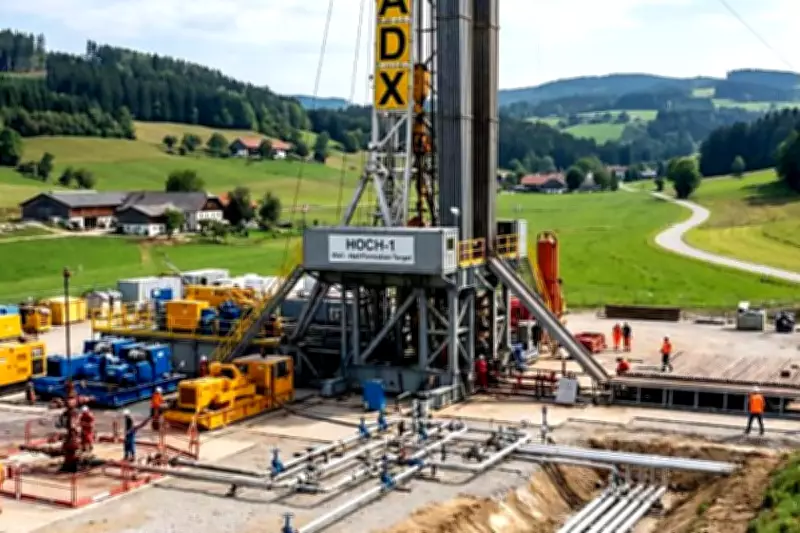
ADX Energy has fired up fresh drilling momentum at its HOCH-1 shallow gas well in Upper Austria, punching down to 398 metres after sidestepping early subsurface setbacks.
The stage is now set for a swift sprint to total depth, with the bit chasing the high-impact Miocene gas sands, backed by up to 17.3 billion cubic feet (Bcf) of gas of prospective upside.
Spudded on April 16, the well is currently cutting through an 8.5-inch hole section after confronting a troublesome shallow gravel zone that triggered mud losses at about 100 metres. Instead of a temporary patch-up, the company pivoted to a more permanent solution, redrilling a wider 12.25-inch hole and locking in a 9⅝-inch casing to seal off the problem zone, restoring drilling rhythm and operational control.

With the curveball now cleared, operations have shifted back into high gear, targeting the first casing point at roughly 430 metres before installing 7-inch casing and drilling deeper to a planned 1,430 metres. The program is running on a tight timeline, with total depth expected within about seven days, followed by rapid wireline logging, reinforcing the play’s fast-turnaround profile.
The drill bit’s main target is the Hall Formation, a Miocene-aged sandstone system known for delivering strong, steady gas flows. High-resolution 3D seismic has mapped a clean stratigraphic pinch-out trap, sharpened by Class 3 amplitude versus offset (AVO) anomalies that act as direct hydrocarbon indicators. The well is homing in on the elevated crest of the structure, where a three-way dip closure and up-dip seal have combined to concentrate potential hydrocarbons.
The scale of the target adds further punch. ADX has defined a mean prospective resource of 8.0 Bcf, rising to 17.3 Bcf in the high case, with seismic suggesting the central zone may link to a broader northwest extension. That potential connectivity could unlock additional recoverable volumes. Meanwhile, nearby analogue wells, which flow up to 9 million cubic feet per day, have underlined the reservoir’s production pedigree.
HOCH-1 is the first of three shallow gas prospects to be drilled in Upper Austria. Two additional gas prospects are permitted for drilling in 2026. While HOCH-1 leads the charge to unlock shallow gas in northern Austria, ADX is already lining up its next shots, with the GOLD and SCHOE wells set to spud next as part of a broader 2026 multi-well campaign across its expanding ADX-AT licence footprint.
Although each target is a technically independent trap, meaning success or failure at one does not dictate the fate of the others, strategically they move as a pack. The clustered model has been built to drive scale and slash costs, unlocking shared pipelines and processing options. Success is likely to set the stage for streamlined, staged development, all underpinned by a nimble, cost-conscious approach where speed to market could rival scale.
Beyond its shallow prospects, the company already has proven, deeper hydrocarbon credentials at its Welchau-1 discovery in Austria, where testing flowed gas to surface alongside condensate, flagging a liquids-rich system with serious scale potential.
Notably, the broader backdrop adds real bite to the story. Europe is doubling down on domestic energy supply, which has led to firmer gas prices and immediately improved the economics of near-field discoveries that can be plugged straight into existing infrastructure. In ADX’s case, HOCH-1 sits just 2 kilometres from open-access pipeline networks, with scope for a nearby gas processing hub to anchor a cluster-style development. Add in shallow drill depths and strong flow potential flagged by nearby analogue wells and the setup screams fast-track tie-ins and rapid monetisation if the bit hits pay.
With drilling back on track and the next casing milestone closing in, HOCH-1 is shaping up as a pivotal piece in ADX’s European gas puzzle that could ignite a run of swift follow-ups across the broader portfolio if the sands deliver.