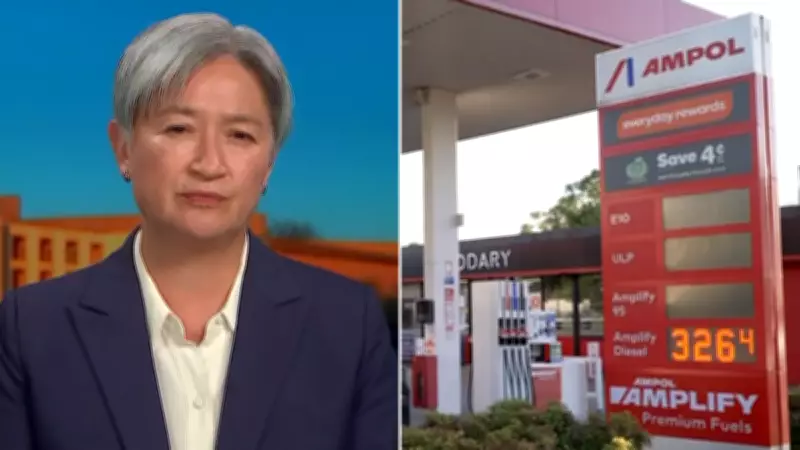
Australian Fuel Prices Face Prolonged Uncertainty Amid Middle East Ceasefire
Australians may experience extended fuel price volatility, even if a ceasefire in the Middle East is maintained, according to Foreign Minister Penny Wong. She highlighted that supply chain disruptions and significant infrastructure damage in the region will continue to affect fuel costs for consumers.
Confusion Over Strait of Hormuz Status
Uncertainty persists regarding the operational status of the Strait of Hormuz, a critical global oil shipping route. Iran has asserted that the strait remains closed, while the United States contends that maritime traffic has resumed. This discrepancy adds to the complexity of global fuel supply chains.
Penny Wong emphasized the fragility of the ceasefire, stating, "We've got a long way to go. Not only is the ceasefire fragile and it has to hold, even if we see a successful negotiation, we've still got a lot of disruption in the system." She pointed to the supply gap from the strait's closure and regional infrastructure damage as key factors driving price pressures.

Government Efforts to Stabilise Supply
Behind the scenes, the federal government is actively working to secure fuel supplies. Prime Minister Anthony Albanese is engaged in discussions in Singapore, Australia's largest petrol supplier. Meanwhile, Foreign Minister Wong has been in talks with Korea, Malaysia, and Japan to bolster energy partnerships.
The government has also enhanced Export Finance Australia's capabilities to assist private suppliers in securing additional fuel resources. These measures aim to mitigate the impact on Australian consumers.
Industry Perspectives on Price Relief
NRMA Spokesperson Peter Khoury provided insight into potential price reductions, noting that real relief depends on a permanent ceasefire. "If the wholesale price falls, which we hope it will start to do at the end of this week, early next week, we should start to see some falls at the bowser in a couple of weeks or less. It will take months to get back to where we were before the war," he explained.
Ceasefire Challenges and Regional Stability
The ceasefire is already under pressure, with Australia joining international partners in urging its extension to Lebanon. Israeli strikes in the area risk undermining the agreement. Wong warned, "If Israel and Hezbollah don't observe the ceasefire, it risks the ceasefire across the region."
Negotiations between the United States and Iran continue, with a reported 10-point proposal described by US President Donald Trump as "workable." However, Wong cautioned that the final agreement is unlikely to mirror Iran's initial position, stating, "I doubt that what Iran has put out is going to demonstrate what the final plan will be. This is a negotiation."
Wong reiterated Australia's focus on stabilising fuel supply and protecting consumers from further price hikes. "All I can speak to is what we want: we want the ceasefire to hold, including in Lebanon; we want the strait opened, and we want the world to work to restore stability to energy markets and fuel markets, and we want Australians to not be punished at the bowser for the ceasefire not holding," she concluded.