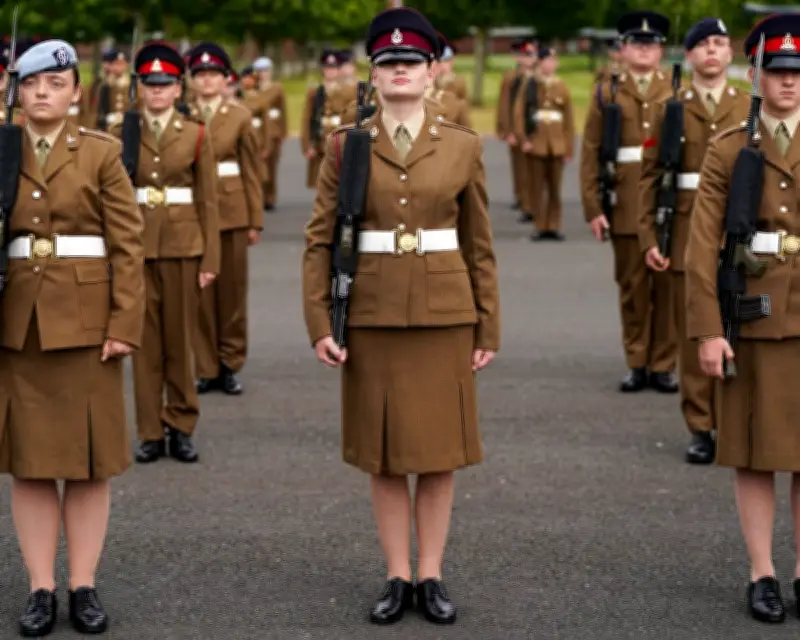
Junior soldiers at the Army Foundation College in Harrogate take part in their graduation parade during August 2024. Photograph: Ian Forsyth/Getty Images
Young people looking for employment should “really seriously take a look at the armed forces,” according to veterans minister Louise Sandher-Jones. With over 1 million 16 to 24-year-olds not in education, employment, or training (Neets), the bleak job market is well known. However, not everyone agrees that the military is the solution.
Personal Stories and Perspectives
Alexandra Williams, from rural Lincolnshire, studied law at a university in Manchester. Initially intending to become a lawyer, she was early on led to believe that would be impossible. “One of my lecturers was like: you’ve got no contacts, you’re not going to get anywhere,” she says. Seeking opportunities, she joined the local University Officer Training Corps, an army reserve unit that exclusively recruits university students. There, she took on extra responsibilities alongside regular combat training, such as running social media accounts, helping with recruitment, and doing press work with Soldier Magazine.

“Most people leave uni and they’re struggling to get jobs,” says Williams. Now, at 24, she is starting a career in PR and says she wouldn’t have succeeded without her army experience. She maintains her military connection as a combat medic in the army reserves. For Williams, options were always open to maintain a civilian life while developing her interest in the armed forces. However, various peace organisations have expressed concern that the military is preying upon young people with fewer options.
Criticism from Peace Groups
Emma Sangster, a coordinator at Forces Watch, an organisation campaigning against militarism in civil society, is part of 13 peace groups that recently petitioned ministers to rule out conscription—a threat that for the first time in generations seems “very real.” Sangster spoke of a growing sense of an economic draft in the UK, or “conscription by poverty.” “I suppose it feels inevitable that the plight of young people would be seen as an opportunity for the military,” she says.
Sangster contextualised Sandher-Jones’s comments to the Telegraph as part of a broader push by the Labour government to recruit. Last year, the Ministry of Defence pledged £70m to expand the Cadet Force by 30%; this February, it announced it would place military personnel in jobcentres to recruit for the army, aiming for tens of thousands of new recruits.
High Drop-Out Rates
Jim Wyke from the Child Rights International Network called the idea that army recruitment—approximately 10,000 under-25s every year—could dent youth Neet figures “ludicrous.” He notes that in the under-18 category, recruitment to the army is a net generator of Neets because the drop-out rate is so high—about 30% in 2022-23 at the Army Foundation College in Harrogate, where junior soldiers train, compared with 6-15% for under-18s in civilian further education.
“The data shows that [recruiting more under-18s] is not the solution. It won’t make a damn bit of difference anyway, and if they did it, it would still lead to worse outcomes for under 18-year-olds compared with civilian alternative routes,” said Wyke.
Youth Perspectives
Will O’Donnell, a final year SOAS student studying politics and international relations, agrees. In light of how “cooked” his generation is, with fewer than 10,000 graduate jobs available for close to a million university leavers, he says army recruitment “doesn’t plug the gap at all.” “Seeing our friends in the years above struggle in the job market, there is a real sense of doom and gloom about where our career prospects lie. This is a much bigger problem than simply telling people to join the military,” he added.