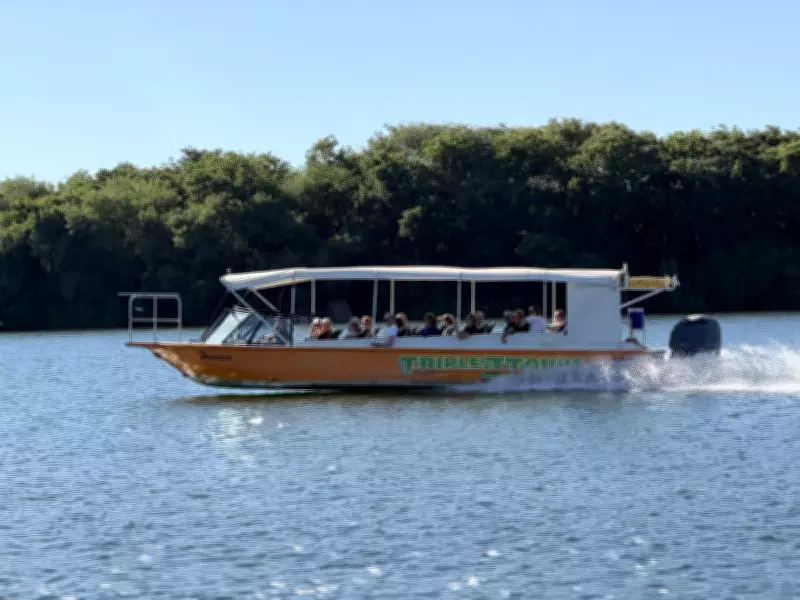
When Triple J Tours was sold in April 2026, Jeff Hayley planned to spend his retirement in Margaret River. But here he is, back under the Kimberley sun, greeting me at Kununurra Airport.
After 38 years building and sharing incredible knowledge of the East Kimberley, and the Ord River environment in particular, retirement didn't suit Jeff, it seems. And the East Kimberley has a strong draw.
Jeff is back at the company which he helped to start in May 1988 (he's one of the triple Js), and at the helm of one of the boats he largely designed specifically for the trips Triple J Tours runs from the Lake Argyle Dam back down the upper Ord River, across Lake Kununurra to the town of Kununurra itself.

He arrived in Kununurra in 1985 to be a postmaster, but explored the Ord River in a small boat and thought maybe it would work running tours.
Triple J Tours also has buses, and guests are usually driven the 70km from Kununurra to Lake Argyle to join a boat for the 55km river trip back.
And I am here with 55 readers, who have joined us for our Kimberley Wild Weekend. We put it together with our friends at Holidays of Australia, flew up on a chartered plane, and have stayed at Emma Gorge Resort and, last night, at Lake Argyle Resort, after an excellent sunset dinner overlooking the lake.
Jeff Hayley explains the geography
The boat we are now on comfortably holds the 40 of us, with the rest on a companion boat. It has good shade and a toilet, and is quiet and well laid out. Its hull sucks air underneath to cushion it, so it rides softly and economically, and the boat has very low wake, so there is less disturbance for the riverbanks.
But, with three 300hp outboards on the back, there is plenty of grunt to run with, against and across the current caused by the outflow of the dam.
This is a vibrant river system with a strong, steady flow of water. That comes from Lake Argyle, which usually holds about 20 times as much water as Sydney Harbour — 10.7 billion cubic metres of water. At the moment, after a good monsoonal wet season, it is probably about twice that, for while the lake usually covers about 980 square kilometres, in flood that can stretch to more than 2000 square kilometres.
It is all held back behind the Lake Argyle Dam (or Ord River Dam) wall, which was built between 1969 and 1971, and opened in 1972, creating Western Australia's biggest freshwater reservoir.
The water then pours in a controlled torrent down the Ord River to keep Lake Kununurra at a constant level behind the Diversion Dam, near the town. That water is used to irrigate crops. The area has fertile black soil, and is currently mostly growing cotton.
Lake Argyle water being released through the dam
Kununurra, 3300km from Perth by road, was gazetted in 1961 as the new town for this Ord River irrigation project.
Jeff has already stopped the boat, letting it drift in the current, on this river that he knows like the back of his hand, to share facts and stories about this incredible place. But he pulls up to the bank for what he calls his geography lesson, pulling down a map and pointing out the lake, the dams, the town, the irrigation area, and cleverly, simply explaining the story of this place.
He also explains the thriving river environment that we are in now is caused by this whole project. Before that, much of this would have been sandy riverbed, in the dry season, with permanent pools only in the deepest spots. They are still where some of the biggest examples of the 26 fish species in the river lurk. Locals know that, and drop weighted live fish baits or lures into them.
And there are locals in this river on this not-too-hot Sunday, with a top of about 30C. Two boats have pulled up on a beach-like nook in the river, and I can smell the families' barbecue. Kids are in and out of the water.
That is, of course, despite this part of the river having the highest concentration of freshwater crocodiles (Crocodylus johnstoni) in the world. But they are mostly small, thin-snouted fish eaters. They don't see us as food, Jeff says.

Though, if interfered with, they can react and have sharp teeth. On May 2, a freshwater crocodile attacked and injured a man while he was swimming in Lake Argyle. Three people who tried to help him were also bitten. St John paramedics took the man to Kununurra Hospital and the others were treated at the scene.
Despite this, the annual Lake Argyle Swim went ahead two days later, with 400 swimmers in the water on a modified course.
The crocs' body temperature is about 32C, Jeff says. The water temperature at the moment is about 29C, so they will stay in it. When it drops to 21C, they come out to warm up. When the water is warmer than 32C, they get out to cool off.
Jeff has now pulled up at a colony of flying foxes. He explains there are two types — microbats and megabats. Microbats use echolocation, a form of sonar, to navigate and hunt. Megabats, like these black flying foxes (Pteropus alecto), have keen eyesight. When it's pitch black, with no moon, they won't fly. But on bright nights, they have a 60km range looking for nectar and fruits, Jeff says.
He backs the boat back into the current and skilfully navigates tight turns in the river. He sets the boat up, shoots through, drifts it out and sets it up for the next. On open sections, the boat can cruise between 55 and 65km/h with those Yamaha 300hp outboards.
Jeff's knowledge is encyclopaedic. Whatever he's asked, he has an accurate and simply explained answer. Have you ever considered a jet boat? asks one passenger.
Jeff smiles, nods his head a little, then takes up the answer. I remember that when Triple J Tours began, it was with jet boats. Jeff had been fishing off the west coast and had experience of them from that. I could write a book about this, he smiles. The first boat we had, had a 300hp Cummins inboard. You lose 30 per cent of your power with a jet. And it didn't suit the Ord River, with its weed. I'd be over the side three or four times a trip to clear it from the intake, he says.
We stop for lunch at Echo Point — a prepared spot with permanent tables and benches, shade and toilets. Jeff quickly swings out cool boxes full of our fresh lunch. He sets up a hot water urn, mugs and tea and coffee. It's a fast, slick set-up. Jeff isn't just a consummate professional skipper and guide, he is massively experienced at looking after guests with care and humour.
He has been awarded the FACET Golden Guide award (by the Forum Advocating Cultural and Eco-Tourism), and was a board member of the Kununurra Visitor Centre from 1992 to 1996, rejoining it in 2014 and later serving as treasurer until 2020. He was a founding member of the Skal International Club and a key contributor to Kimberley Toad Busters, an initiative dedicated to controlling the spread of cane toads.
Triple J Tours is now owned by the G'day Group, its first acquisition of a dedicated touring operation. But Jeff Hayley, who I've known for well over 20 years, is back as a boat and bus driver and guide. He's back on the river he knows and loves.
Thank goodness retirement didn't suit him, I think. Thank goodness Jeff Hayley is back in the Kimberley.
triplejtours.com.au
Get the latest news from thewest.com.au in your inbox. Sign up for our emails.