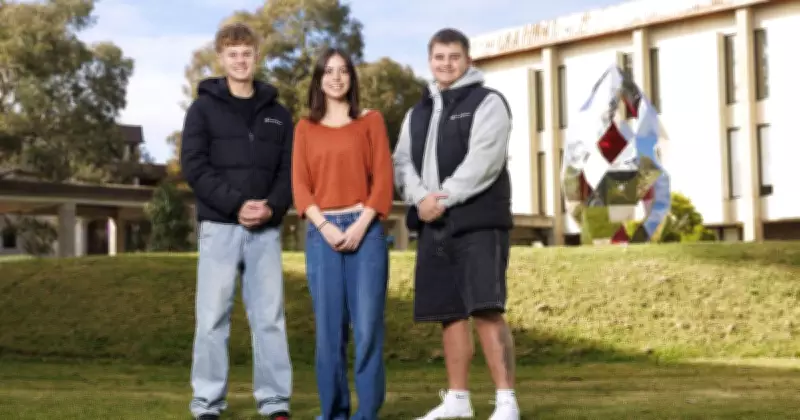
Kai Buchanan was not considering university as an option after high school, but a university scholarship has changed his mind.
He completed a school-based apprenticeship with Indigenous Allied Health Australia and was encouraged to apply for the new Snow Scholarships at the University of Canberra.
"I didn't really think I would have the smarts for university," he said.

"But with all the support ... and finding out more details and benefits, it's what really pushed me over the edge to actually think uni can be doable for me."
Mr Buchanan is part of the first year of Snow scholars, a program open to ACT and regional NSW students who are facing barriers to higher education.
Mr Buchanan is studying a bachelor of exercise physiology, sport has always been a big part of his life and he hopes to take these skills back to the First Nations communities he was raised in.
"Seeing the negative sides of our community's health, that has been a major factor in motivating me to pursue this," he said.
While working in his apprenticeship, he said it was refreshing to see other Indigenous people working in the health sector.
"It gave me a real-world experience of the health challenges people face every day," he said.
Mr Buchanan said his entry into university is not traditional, but the connections to the other 17 snow scholars have helped when the transition was challenging.
The scholars live on campus and have access to a study room and kitchenette, they study together and have become friends.
Tali Adams said this was a key part of settling into university life.
She has four housemates who are also part of the program and are living together on campus.
Studying occupational therapy, there are other scholars in the health fields who have studied for their anatomy and physiology unit together.
"It's the hardest one, so it's good we're all doing it together," she said.
Ms Adams has always wanted to go to university, but she did not complete her ATAR in school and her apprenticeship conversion score was not enough to get into an occupational therapy degree.
"I did placements with health professionals .. and I found [occupational therapy] was the most interesting," she said.
"The process to get into uni was quite tricky .... I thought about not doing uni until the scholarship, then stuff just fell into place."
Michael Casey said the support from the program has helped him settle into university and his bachelor of built environment, architecture and interior architecture.
The architecture studies combine his love for art, a passion for creating accessible spaces and his work in holiday and weekend programs for primary-aged students with moderate to severe disabilities.
His work and experience with people close to him who have had lifelong disabilities and injuries from accidents have also inspired his work and study.
A Duke of Edinburgh's Award participant, volunteering and community work are also important and were part of his application for the Snow scholars.
Students in the scholarship can receive up to $30,000 a year for living expenses, on-campus accommodation and additional academic and leadership support.
Mr Casey said the scholarship helps him balance the intensive degree while also having time to volunteer and work, especially as architecture is a long program with expensive materials.
"The scholarship allows me to be close to everything so I can maximise my efficiency," he said.
In 2026 there were 240 applicants to the scholarship program and applications are open for the 2027 round until July 12.
About 16 scholars are chosen each year based on leadership potential and commitment to social purpose, a quarter of students will be First Nations backgrounds.
The scholarship program is a joint partnership between UC and the Snow Foundation's $20 million support.
The scholarship ties into a concerted effort from the university to open its doors to as many students as possible, from all different backgrounds and ages.
Vice-chancellor Bill Shorten often remarks he is running a university where people are the opposite of elitist and stuck-up.
Programs to accelerate prior learning recognition and solidifying the fast tracked program between UC and the Canberra Institute of Technology have been a part of this.