
There is an old Marxist (Groucho, not Karl) saying about refusing to join any club that would have you as a member. Simeon Barclay takes that idea one step further in his work, because he knows that even if the club would have him, he would never be truly accepted anyway. He calls his show in Southampton "a lament of sorts, to access and loss." It comes just a few weeks after he was nominated for the Turner Prize, and it is a damn fine argument for why he should probably win it.
An Exhibition About Exclusion
This is an exhibition all about exclusion, about trying to fit in but never quite managing. It is razor-sharp, funny, pop-cultural, obtuse conceptual art about growing up black in Britain, about trying to make it and knowing you are bound to fail, because the system is geared towards failure.
The entrance to the space is flanked by two crappy white PVC doors adorned with stencils of Imperial Guards from Star Wars. They stand there, staunchly keeping you out, but those doors do not go anywhere. It is an illusion of power.

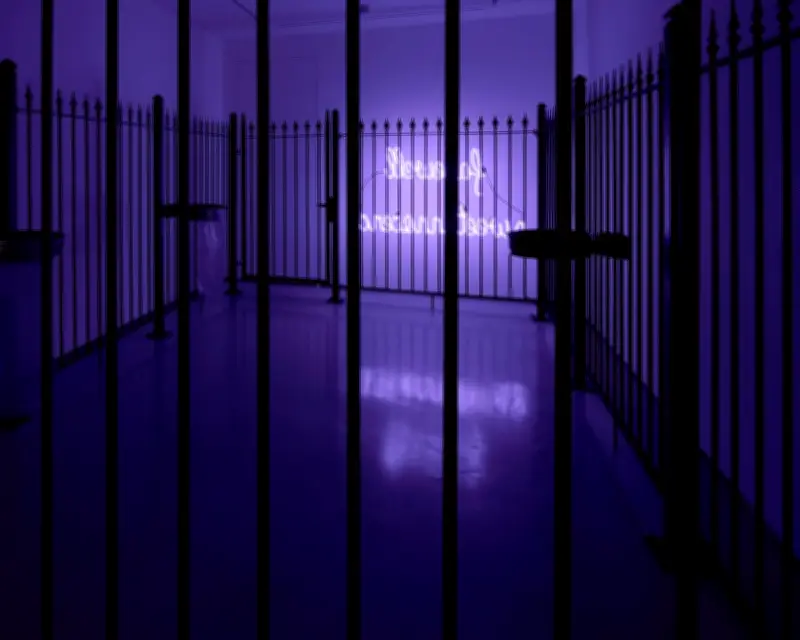
There are barriers in the middle of the main gallery, a locked enclosure you will never get into. Inside, there is an empty bin and taxidermy pigeons, grotty little city survivors – it is a grim urban smoking area in which you are not allowed to smoke. Tatty old mountain bikes are locked to a bike rack in the corner of the space, wheels nicked, frames dented, but still safely chained up. Bus seats, covered in rubbish and crushed cans, are pinned to the wall, too high up ever to sit on. This is crap modern Britain, a country where even the things that do not work are designed to keep you away.
Football, Windrush, and Failed Heroes
Half and half football scarves with former Manchester United and Everton striker Romelu Lukaku's face on them hang from a ceiling fan. Here is this child of immigrants who was held up as a future footballing icon, who moved to the Premier League and represented his country at the highest level. But he was still never good enough, he was still too slow, too big, too mercurial, too foreign, too black ever to really be celebrated as a true athletic idol.
And that is the point. This is a show full of references to cinema, football, and music, but also to Windrush, to guys coming over here, buying nice suits (like the one Barclay has had made out of bus seat fabric here) and trying to fit in, but always falling short.
There is a ripped, sagging parachute hanging from the ceiling in the next room, a sort of flaccid failure of masculine ideals. Then in the corner of the final space, Barclay has wedged a giant inflatable Donald Duck, leaving only his enormous legs poking stupidly into the room. Everywhere here, heroes are undermined, hopes are dashed, and doors are slammed shut.
Dense References and Intentional Distance
The issue with Barclay's work here and in previous exhibitions is that its references are so dense and overlapping, and so uncontextualised, that they could easily go right over your head. You could come out of this show with no clue why he has put himself on the cover of Vogue and pinned it to the wall. It holds you at arm's length. For the most part, I think that is a shame. The ideas are so good that visitors should be given the tools to grasp them.
But equally, maybe you are meant to feel only partly included in this. Perhaps that sense of "do I belong here, do I get this, am I part of this story?" is totally intentional.
As much as I dislike the work that got him nominated for the Turner Prize – performance poetry with improvised jazz, no thanks – it holds some clues about how to approach this show, and Barclay's work more generally. It is not a linear narrative; it is a kind of visual poetry, a scattering of ideas for you to navigate and decode. Once you do that, you will find he has painted a witty, sad, smart portrait of a Britain built on migration and complaining, a land of gates and barriers, heroes and idiots, a place where, deep down, no one really fits in.
Simeon Barclay: Farewell Sweet Innocence is at John Hansard Gallery, Southampton, 6 June to 29 August.