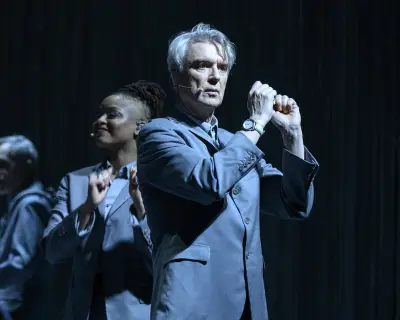

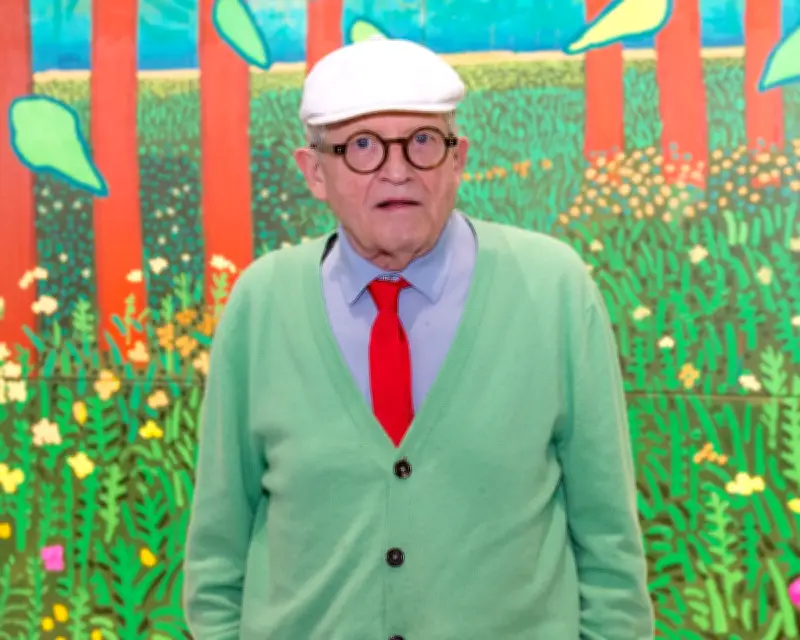
David Hockney, the revolutionary British painter who cast a transformative gaze across 20th-century art, has died at the age of 88.
A Life in Art
Born in Bradford in 1937, Hockney was the fourth of five children in what he described as a 'radical working-class family.' His parents nurtured his early artistic talent. He studied at Bradford College and sold his first painting—a portrait of his father—for £10 at the Yorkshire Artists Exhibition in 1957.
As a conscientious objector, he completed national service as a hospital orderly before enrolling at London's Royal College of Art in 1959. There, he quickly gained a reputation as a unique talent with a rebellious streak. His refusal to paint a life drawing of a female model nearly prevented his graduation; he instead submitted Life Drawing for a Diploma, depicting a muscular male figure from an American physique magazine. He also declined to write a required essay, believing his artworks alone should be assessed. The RCA bent its rules to award him the diploma.

Pop Art and California
Hockney made his name as a pop artist during the swinging 60s, best known for his swimming pool paintings that defined the Los Angeles aesthetic. Works like A Bigger Splash and Portrait of an Artist (Pool With Two Figures) captured hedonistic scenes of love, lust, and loss beneath sun-soaked skies.
His 1961 painting We Two Boys Together Clinging, inspired by a Walt Whitman poem, signaled his willingness to challenge conservative society. Later works, such as Cleaning Teeth, Early Evening (10pm) W11 (1962), depicted gay life with an honesty at odds with a Britain where homosexuality was criminal until 1967.
With his signature bleach-blond hair, round spectacles, and dangling cigarette, Hockney became a fixture on the 60s party circuit in London and the US, socializing with Andy Warhol, Ossie Clark, and Dennis Hopper. Despite his bohemian lifestyle, he maintained a strong Yorkshire work ethic, continuing to create even after a stroke in 2012 temporarily impaired his speech.
Mature Works and Records
After moving to Los Angeles in the mid-60s, his more restrained works garnered acclaim for conveying deep emotions. Man in Shower in Beverly Hills (1964) marked his shift toward realism. In November 2018, his 1972 masterpiece Portrait of an Artist (Pool With Two Figures) sold for $90.3 million at Christie's, a world record for a living artist at the time. The Guardian's Jonathan Jones described it as 'a calm distillation of love and sorrow.'
Photocollage and Later Experiments
While working on LA paintings, Hockney accidentally discovered photocollage, or 'joiners,' by assembling Polaroid photographs. These portraits, including those of his mother and art dealer John Kasmin, showed cubist influences reminiscent of his idol Picasso.
In later years, he experimented with set and costume design for operas and ballets, and embraced technology such as photocopiers, fax machines, printers, and the iPad. He created digital paintings that he emailed to friends, stating, 'I'm interested in anything that makes a picture.'
Personal Life and Controversies
An avid smoker, Hockney defended cigarettes as beneficial to his mental health, calling the UK's 2007 smoking ban 'the most grotesque piece of social engineering.' He moved back to Yorkshire from Los Angeles in 2005. In 2013, his 23-year-old assistant Dominic Elliott died after consuming household drain cleaner and recreational drugs; a coroner ruled misadventure. Hockney considered giving up art, unable to draw after Elliott's death.
He reportedly turned down a knighthood several times and declined to paint the Queen. In his 2001 book Secret Knowledge, he challenged established thinking about Old Masters' techniques, both enraging and captivating critics.
'Teaching people to draw is teaching people to look,' he told the Yorkshire Post in 2018. His art profoundly shaped how we view the 20th century, though he remained present-focused: 'I live now. It's always now,' he told the Guardian in 2015.