What do our reading choices say about us? When teaching creative writing and literature classes, I always ask my students about their favourite genres and current reading in the first week. It is a good way to get a sense of their interests, gauge how they will respond to set texts, and get them thinking about the kinds of projects they want to work on.
There are always a few students who will sheepishly admit to not reading any fiction at all, and I'll happily talk to them about comic books, television shows and video games. This exercise often leads to some interesting conversations across the class, where students start to connect over their favourite authors and share recommendations.
Very occasionally, however, someone will mention a book or an author that will give me pause. I still remember a moment from my second year of teaching when a student casually mentioned that they were reading The Turner Diaries, an infamous work of white nationalist speculative fiction, because they were 'just curious' about it. I didn't press them further and the student never expressed any extremist views in class or in their writing. In fact, they were unfailingly thoughtful and respectful. I couldn't see any evidence that this uncomfortable reading choice reflected anything about them as a person, and there are valid reasons to be curious about a book like The Turner Diaries and the warped viewpoint it presents. But it still made me feel a little cautious, in a way that I couldn't entirely shake.

The idea that reading - and reading fiction in particular - has a formative effect on character is generally well accepted. The books we choose to read are assumed to shape our outlook and identity, or at least reflect our values in some way. Many of us have probably slid over to a host's bookshelves at a party and attempted to discern something about their personality and interests from the titles. But what was once a deeply personal activity has started to feel a lot more public. Online subcultures like Bookstagram and Booktok encourage readers to circulate and share their preferences and opinions. Platforms like Goodreads and The Storygraph allow us to follow the reading goals and experiences of friends and strangers. The once unremarkable habit of pulling out a book in a café or on public transport has now been dubbed 'performative reading', leading to a host of call-out and parody videos.
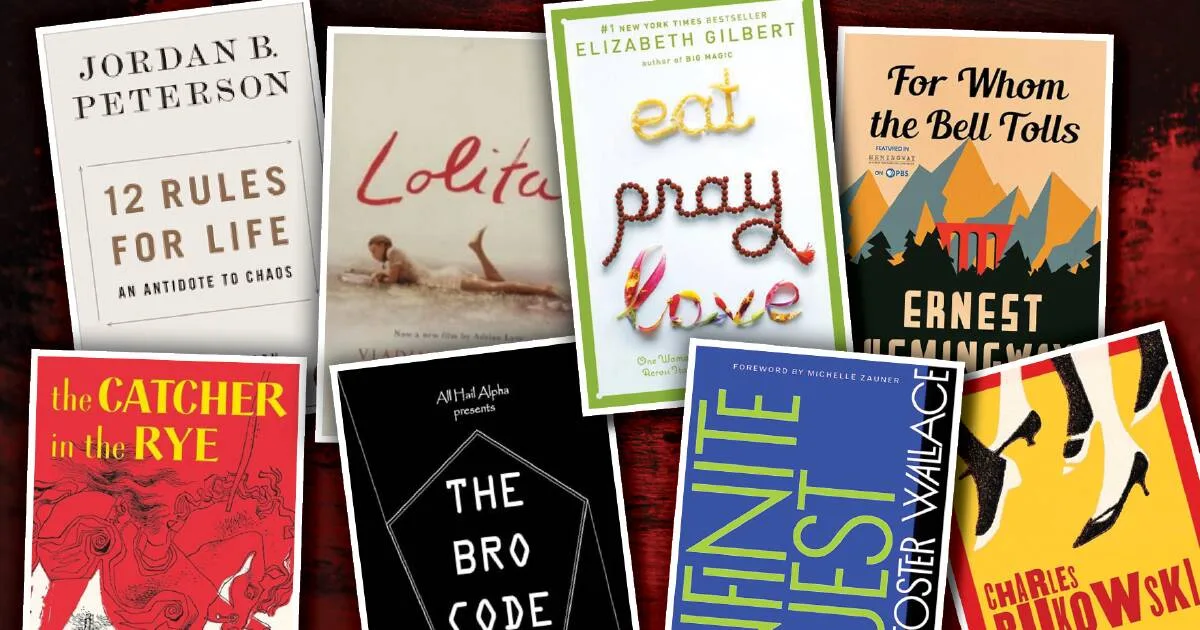
What and where we individually choose to read now seems subject to greater scrutiny. As reading becomes an increasing public act and reading identities are more extensively and visibly 'performed', we may become reasonably concerned about what our reading expresses about ourselves. Are there books that we are proud to display and identify with? Or books that we dread being caught with in public? Lists of supposedly 'red flag' books have been circulating for a while now, the idea being that someone's bookshelf may reflect something problematic in their personality. These might range from very obvious red flags like Mein Kampf or The Turner Diaries to works that might indicate incompatible values or outlooks, most often particular genres of self-help, finance, religious or diet books, or contentious authors like Jordan Peterson and Ayn Rand. Some familiar classics and contemporary literary titles can also be taken as a warning of a particularly 'toxic' reader.
This last category is invariably the most interesting. It is usually associated with male readers, in particular, and certain titles and authors get frequent mentions. Audiences are jokingly advised to block, ghost or run from men with too many Ernest Hemingway or Charles Bukowski titles on their shelves, which may be an indicator of a particularly noxious brand of hypermasculinity. An interest in Vladimir Nabokov's Lolita often shows up as a red flag, though this tends to assume that a reader will be sympathetic to the perspective of the narrator Humbert Humbert, rather than horrified by it. Fans of Fyodor Dostoevsky often get stereotyped as humourless and self-serious, which, while possibly true, unfairly overlooks just how funny Dostoevsky can be. Anyone who lists David Foster Wallace's Infinite Jest as their favourite novel may be dull or pretentious, or just unlikely to ever shut up about having read Infinite Jest.