In a memorable scene from Jean-Luc Godard's 1964 film Bande a Part, the young protagonists sprint through the Louvre, leaving puzzled art lovers and angry guards in their wake. The moment feels impromptu and genuinely disruptive, yet Godard's camera deliberately pauses in front of Jacques-Louis David's Oath of the Horatii, an icon of the French Revolution. This is 1960s Paris, a place where young radicals mock high culture in a carnival that begins with running in the museum and culminates in the streets of 1968.
Julio Le Parc's retrospective at Tate Modern plunges you into that same 1960s Paris, and it is riotous good fun. It takes a lot to get me off my contemplative pillar and physically interact with art, but I was soon pushing buttons and spinning paintings. Marcel Duchamp called one of his late works Priere de Toucher (Please Touch), which would have made an excellent title for this show. Please touch these artworks, make them do things, let them do things to you. One of the simplest pieces, Pattern to Manipulate, is a disc painted with a black and white abstraction. A red arrow on the wall indicates which way to spin it, and when you do it fast, the black and white becomes pure white.
Not subtle, but perhaps Le Parc and the avant-garde bande a part he belonged to, a seven-member movement called GRAV (Groupe de Recherche d'Art Visuel), were tired of subtlety. Le Parc, born in Argentina in 1928 and who died on 30 May this year, said that when he first moved to Paris in 1958, he was oppressed by the silence and lifelessness of its museums and galleries. GRAV aimed to fill them with noise and action, to subvert high culture with democratic play. They saw this as an act of revolution, the liberation of everyone's true creativity, much like running through the Louvre.

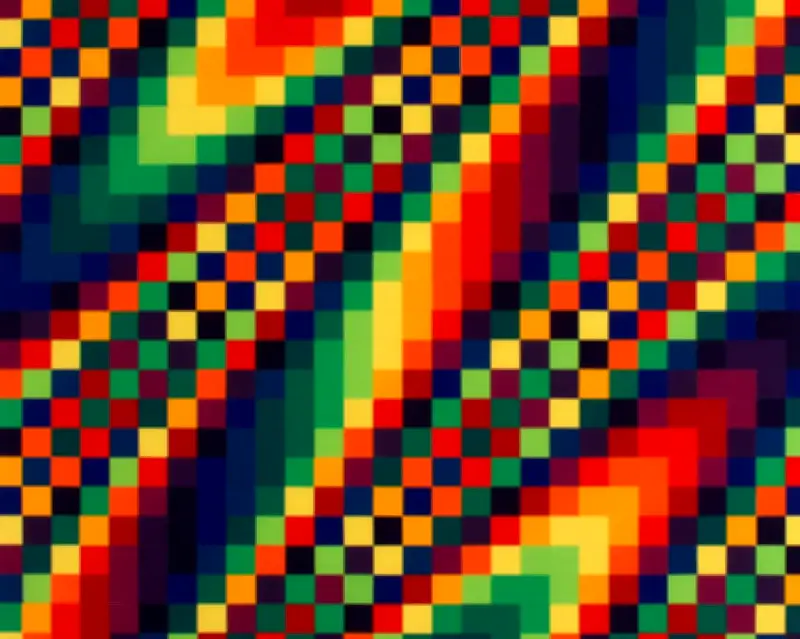
It is as if Bridget Riley had grown weary of composing her optically confounding art and decided to open a funfair. In the late 1950s, Le Parc experimented like her with geometrical paintings that appear sombre in their relentless modernism until you begin to see them warp and shimmer. Shapes multiply and then vanish before your eyes. This is the same principle as Riley's Op Art, making you question your perceptions and realise that our sense of reality is a fragile illusion.
However, such cerebral games were not radical enough for GRAV. They wanted to involve the onlooker physically as well. In Le Parc's 1966 Screen with Reflective Blades, a square red canvas is hung, corner upward, behind a series of mirrored slats so that every shift your body makes changes the painting in endlessly morphing, jagged kaleidoscopic illusions. Ensemble of Eleven Surprise Elements from 1967 is even purer joy. You stand before shelves and recesses displaying random objects: bicycle spokes, a fanbelt, geometric cutouts, wobbly platters. Then you press buttons to make each element judder or swing with comic rattling, rasping, banging noises. Is it art? If so, art is a big joke. Enjoy yourselves, says Le Parc, laugh and play!
Yet he is a paradoxical artist. His throwaway gags and anarchist gestures seem to belong, forever young, to the 1960s, but he can also create transcendent, stupendous beauty. The button I pressed most frequently animated what looks like a bunch of unfurled toilet rolls falling in strips from the wall across the gallery floor. Motionless, it could be a parody of a wall-hanging by American post-minimalist sculptor Robert Morris, but switch it on and a giant fan blows the strips towards your face, and you seem to be standing before an incensed giant squid whose tentacles, lit from below, form sublime raging shadows on the ceiling.

He works miracles in light, creating impossible spatial illusions. Of course, they are not miracles. In Continual Light with Four Forms in Contortion, you can see clearly, as he intends, how bendy, reflective metal strips move in a wave-like undulation between two lamps to warp light in expanding and narrowing patterns, mystifying yet materialist. Le Parc was a pioneer of the kind of spectacle it is all too easy to create today with a much wider arsenal of mind-blowing technologies. I started to feel a bit of overkill in his late work Blue Sphere, a vast room-filling planet of blue dangling shards and lights that creates shimmering ethereal patterns on the walls. If it were a painting, you would call it easy on the eye.
That is the trouble with art. It may set out to change the world, as Le Parc and his friends in GRAV did, but ends up as entertainment. This is a very enjoyable exhibition, but its revolutionary impulse gets lost in the light. It makes you think of an artistic manifesto that is the opposite of angry: Matisse's much-quoted comment that he wanted his work to be a soothing, calming influence on the mind, something like a good armchair. Nothing wrong with that. Julio Le Parc wanted to change the world but instead designed a new kind of armchair. At Tate Modern, London, 11 June 2026 until 3 May 2027.