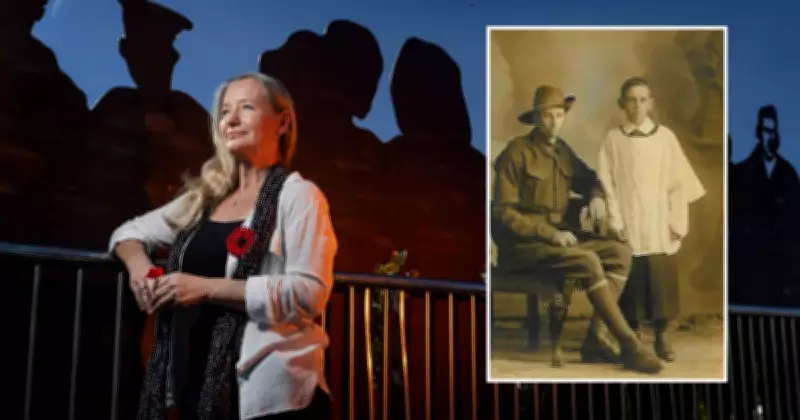
A Newcastle woman has journeyed halfway across the globe to honour a relative whose life was tragically cut short during World War I.
Heather Campbell, 62, never had the chance to meet her great uncle, Eustace Clavil Peverell, but she hopes that, in some way, he knows he has never been forgotten.
"He never got a chance to come home and marry, fall in love, have his own children, meet his nephews, nieces and grandchildren," Ms Campbell said.

"Even though we didn't know you, you're still a part of the family, you're still a memory," she added.
Eustace Clavil Peverell was just 24 years old when he succumbed to wounds sustained in Ypres, Belgium, during the Great War.
To pay her respects, Ms Campbell joined the Mat McLachlan Battlefield Tour to Europe, arriving in time for Anzac Day. Her primary goal was to visit her great uncle's final resting place at the Westhof Farm Cemetery.
"It is time for me to do my pilgrimage for my great uncle and for my family," she said.
Ms Campbell first learned of her relative's wartime death during her high school years.
"Nobody really talked about the war back then, our parents were all just pre-war or post-war babies and our grandparents definitely never mentioned it," she recalled.
It was only in the past two years that she began delving into her great uncle's story, aided by research conducted by another uncle.
"There are so many things that are being unearthed, we never had access to photos, information and old documents before," she said.
Mr Peverell enlisted in the Australian Army in 1915 at the age of 22, serving as a driver with the 13th Australian Field Artillery Brigade. His role involved transporting ammunition and supplies to the front lines.
He was the eldest of seven children.
On December 11, 1917, while his unit was stationed in the Ypres Salient battlefield, he was struck by shell fragments. The shrapnel caused severe chest wounds, and he died the following day, Ms Campbell explained.
"He went off to war when my pop, his brother, was only 10 or 11 and then he didn't come home," she said.
"He was young, really no more than a boy, just starting out his life in Randwick in Sydney."
After her great uncle's death, Ms Campbell said his mother, her great-grandmother, faced great difficulty in retrieving his personal belongings from the battlefield. She paid three shillings to obtain photographs of his gravestone and scans detailing his personal effects, which were shipped aboard the SS Barunga in 1917. Tragically, the ship was sunk, and all those precious items were lost at sea.
"She was robbed of what tiny, little piece of him was left," Ms Campbell said.
"When I read that, I had to go back and look twice, it is just horrific."
Now approaching retirement, Ms Campbell hopes to delve deeper into her family history and genealogy.
She had long considered visiting her great uncle's grave, but decided that this Anzac Day felt like the right moment. She noted that only two other family members had been able to visit the site since his burial in 1917.
"I just went ahead and said, stop thinking Heather, and get up and do it," she said.
"Anzac Day is a celebration of our history, it's honouring generations passed, and our veterans that are still serving in the armed forces."