Why do we find things beautiful? More precisely, why do some paintings of coloured dots in rippling patterns inspire in me something like revelation? The idea that beauty is the feeling you get when encountering truth is unfashionable in the arts, but lingers in the sciences. The physicist Paul Dirac once proposed that it is more important that a formula is beautiful than that it can be proven: when a perfectly beautiful theory produces results that cannot be real, he argued, then we should not discard the theory but reconsider what is real.
Since the 1970s, Terry Winters has been rebuilding that bridge between art and science. Taking inspiration from disciplines including botany – his early paintings, particularly, evoke sprouting pods and tangled roots – engineering, computer modelling and cybernetics, his paintings might be understood as diagrammatic approximations of the patterns that govern everything from the division of cells to the constellation of stars. If every era has to renew its standards of beauty to reflect new understandings of how the world is constructed, then Winters comes as close to providing that model as any living painter.
Mathematical Inspirations
These eight new works take their titles from the language of geometry and mathematics: Area, Array, Field, Locus, Point, Scope, Sequence and Set. Each is composed of overlapping patterns that pull each other out of shape according to invisible laws of attraction and repulsion. Field is indicative: on a sooty pink ground, a dense grid of dusty blue cells bends inwards like a trampoline beneath a bowling ball, while an intersecting arrangement of larger circles swells outwards. The disorienting effect of this push-pull is exaggerated by an optical illusion, created by ragged phosphorescent orange haloes around the blue circles, that makes them appear to be craters sunk into the crust of paint. You have to walk up to the surface to be reassured that it is flat.

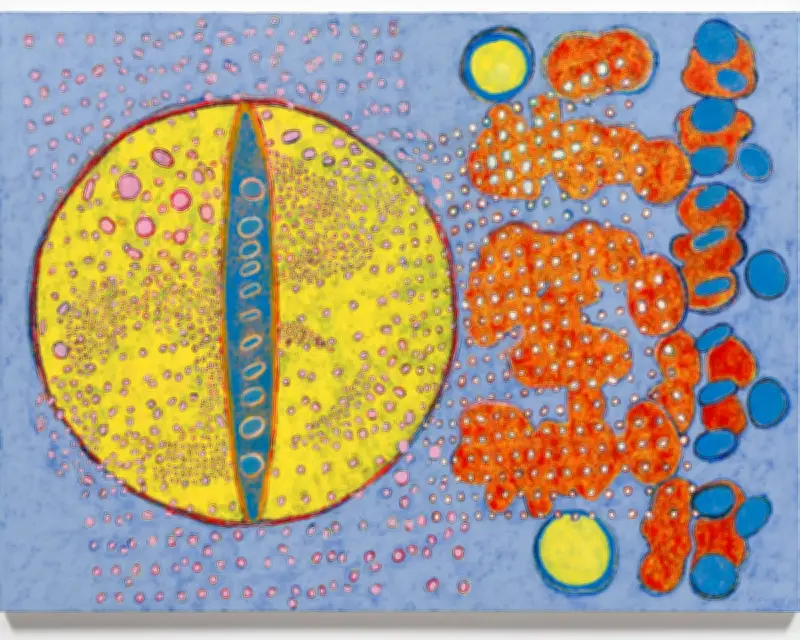
Point shows a teeming landscape of cells bulging outwards at the centre, as if a scum of frogspawn had been skimmed off a pond and placed under a paperweight microscope. In Sequence, a storm of pink interference skims through a yellow circle split like a brain into hemispheres, while a nebulous weather system sweeps in from the right. In Scope, vaguely symbolic arrangements of freshwater blue and desert orange nodules move across the familiar circle-within-a-square geometry of Leonardo’s Vitruvian Man. Where that famous demonstration of sacred geometries exudes stillness and calm, the systems that run through Winters’ worlds are wild and strange. Here, as much importance is given to the subjective factors of perception and consciousness as the objective principles of logic and proportion.
Sensory Pleasures and Optical Illusions
All of this should not distract from the pure sensory pleasure afforded by these pictures. In Locus, another optical illusion seems to lift the red edge of the painting off the canvas like a clumsy wooden frame, squeezing the pockmarked sphere at its centre so that it balloons outwards, threatening to burst. The same cadmium red, so sandy that the pigment seems barely to have been suspended in oil, turns carmine pockets into rock formations that climb off the surface of Set. These sleights of hand evoke the more secular movement of op art, in which patterns are manipulated to exploit the idiosyncrasies of human perception rather than to uncover deeper truths. Which begs the question: is this all just a conjuring trick?
There is something magical about these works. Even though Winters is generally credited with having extended the lineage of modernist American painting into the present, his practice is in this sense pre-modern. In its rejection of the idea that art should be separated from science, it resembles the Renaissance attitude according to which painting is no less a tool for understanding the world than mathematics, and magic is just the name for things we don’t yet understand. His commitment to synthesising diverse spheres of knowledge, his alchemist’s commitment to materials, and his sheer technical ability certainly mark him out in a scene recently overwhelmed by chancers and charlatans, bandwagoners and snake-oil salesmen. That his work is enjoying a revival might be taken as an encouraging sign.

Dirac, incidentally, was proved right. He formulated a theory that was so beautiful it couldn’t possibly be wrong, even though it implied the existence of phenomena that everyone agreed must be impossible. He stood by it, and a few years later, someone else discovered anti-matter. Winters’ paintings likewise offer a flash of those secret patterns that underpin the physical world, and which science has yet to illuminate. Which is to say, they’re beautiful.
Terry Winters: Along the River is at Modern Art, London, until 11 July.