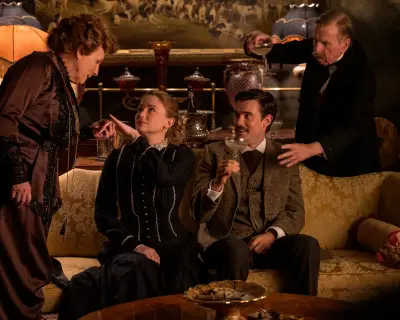
For Jilly Cooper devotees, a motley band that unites me with Queen Camilla and Joanna Lumley, Ian Rankin and ex-footballer Tony Adams, it has been the best of times and the worst of times. The television adaptation of Rivals has shown the world what some of us knew all along: Cooper's stories are life-affirming, wise, and hysterically funny. But the worst of times came when Cooper's unexpected death last year cut short her late-life renaissance.
The first half of a blissful second season of Rivals comes to a climax this week. Six heavenly hours on the sofa follow the professional rivalries and personal dramas of a hard-drinking bunch of 1980s telly executives as they bomb along Cotswold lanes blowing Silk Cut smoke through open windows, or pogo to Nena's 99 Red Balloons on sticky pub carpet while knocking back tequila shots. Rivals has reminded us that good television can be fun.
A Golden Age of Bleakness
A golden age of television has given us modern masterpieces, but the payoff for artistic quality has been that prestige viewing has become mostly bleak. Adolescence was utterly harrowing. Baby Reindeer was a tough watch. Even The Bear and The Pitt are stressful. Life in Rutshire offers television as it used to be: a naughty, indulgent treat.

Delicious Villains and Adorable Heroines
The villains are delicious, the heroines adorable, the minor characters full of juice. David Tennant, as the awful Lord Baddingham, eats steak with a vindictive relish that makes Hannibal Lecter look like a vegetarian. Nafessa Williams, playing glamazon American executive Cameron, is as bewitching as she is terrifying, smirking in her Yves Saint Laurent and Azzedine Alaia skirt suits like a high-maintenance assassin. Gary Lamont as gentle Charles Fairburn, tormented by passion for his closeted lover Gerald, is a life raft of sweet tenderness in the shark pool of Corinium TV HQ.
Nostalgia for Simpler Times
The through-line of Rivals on screen is nostalgia for life before we overcomplicated everything. When wellness wasn't even a word, and a dented biscuit tin full of custard creams and jaffa cakes was the heart of every kitchen. When a glow-up meant electric blue mascara and most of a bottle of Elnett rather than lip fillers and lash extensions. For bone-rattling cars and deep shagpile carpets, an absurd but essentially benign England of velvet alice bands and The Birdie Song, of eating vol-au-vents and drinking snakebite.
Sex as Its Own Language
And sex. So much sex. In the shower, under a desk, against antique mirrors, in the stables. Cooper, as her literary agent Felicity Blunt said recently, understood that sex is its own language. There is grimly funny bad sex as well as hot sex, but in contrast to the sensationalised kink of Euphoria or the pay-to-play sex of Margo's Got Money Troubles, bonking in Rutshire is mostly for the enjoyment of everyone involved. There is an admirably equal-opportunities nudity policy on screen, with at least as many thrusting bottoms as bouncing boobs. The best sex, the swimming pool scene that matches Leo and Claire making eyes through the fish tank in Baz Luhrmann's Romeo + Juliet for unabashed feels, is had not by any pin-up but by Danny Dyer's bashful rough diamond Freddie and his downtrodden, cardi-wearing middle-aged lover Lizzie.
A Far, Far Better Place
Rivals reminds us that while class and money have always been thorny, there was a time not all that long ago when inequality meant Freddie's wife Valerie being sniggered at for saying dessert instead of pudding, rather than the 157 richest people in the country having wealth equivalent to 22% of GDP, as outlined by the Equality Trust this week. In Rutshire, posh people are ridiculous (my name is Muffy, short for Caroline). And not even all that rich compared with modern Britain of the haves, the have-nots, and the have-yachts. Hands up, Guardian reader, if you were secretly rooting for dastardly shagger and world-class charmer Rupert Campbell-Black to retain his seat as a Tory MP in episode 3. Yeah, me too, and I work here. In the Jillyverse, the brutal divisions of modern life disappear in a puff of cigar smoke. It is a far, far better place we go to when we go to Rutshire.