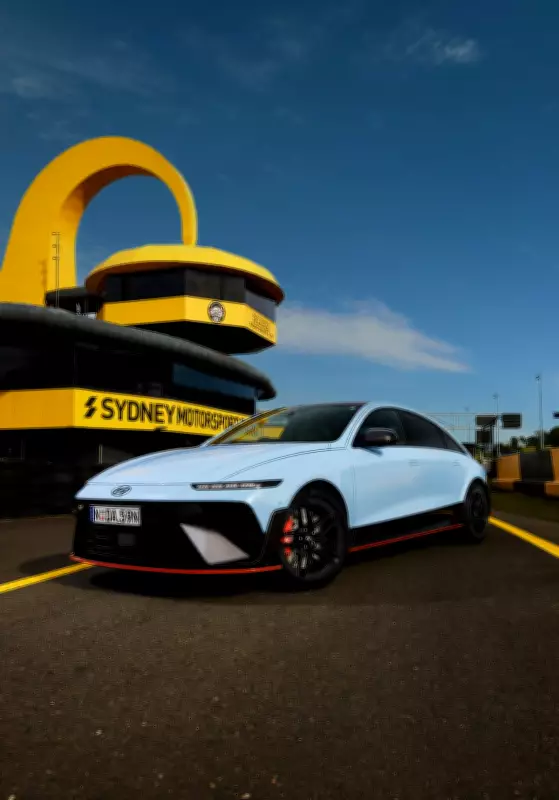
Hyundai launched its high-performance Ioniq 6 N electric sedan last week with hot laps at Sydney Motorsport Park followed by a 250km day drive through the Central Coast hinterland, with stops at Mooney Mooney Point and the Trading Post in Laguna for coffee.
I linger a little too long looking out over the Hawkesbury River and miss lunch back at the hotel in Blacktown. "See the houseboat there," a local tells me, pointing across to the opposite bank. "You can rent one, it's idyllic, secret fishing spots and secluded beaches, all to yourself." I wish! But back to the track — and hot laps are not for the faint-hearted.
On the Track with a Rally Legend
We're out on the 3.93km Gardner grand prix circuit, a world-class FIA category 2 hot mix bitumen track named after motorcycle champion Wayne Gardner. First, rules: no drifting and electronic stability control stays on. I go out with Chris "Atko" Atkinson, Australia's most successful rally driver. "Relax. Breathe. Let the car do the work," he tells me, guiding the steering wheel as I take the first turn at 130km/h — in spite of myself.

The golden rule is a light touch (no white knuckles, please). It may seem counterintuitive, but this helps you make smooth, precise inputs that keep tyres within their optimal grip range. "Most people steer too aggressively and push the brakes too aggressively," he says. "What you don't see with a good driver is the little inputs that allow them to do a lot. At the moment we're trying to get the concepts together — basically the racing lines, the right feeling, the right inputs. When we have that, we start on improving speed. It's like walking a tightrope . . . and we're not on it yet."
With Atko behind the wheel, we do 235km/h coming down the main front straight — just shy of the Ioniq 6 N's maximum 257km/h speed — and I don't even grab the passenger grip handle. He takes one turn at 170-175km/h. "We're not going silly fast because we're not in a car with a roll cage," he says. Alone, I'm happy to sit on 180km/h coming down the straight. Easy when you get the hang of it — though no mucking about, Atko rates me as "foundational", which means, to put it kindly, I've got a hell of a lot to learn. My 15 laps on the day are only the beginning . . . and he later says: "I was just trying to figure out how to transfer 20 years of experience in a few minutes."
Either way, it's a punishing afternoon. All tyres — Pirelli P Zero Corsa PZC4s — on all Ioniq 6 Ns out on the track are worn and have to be replaced with road-going Pirelli PZ5s for the drive the next day.
Hyundai N: Australia's Performance Love Affair
N is the performance arm of Hyundai and brainchild of former head of Hyundai's Namyang-based N Division Albert Biermann, of BMW M Division acclaim, before his retirement in December 2021. It's been around for several years, with the i30 Hatch N the first to launch in 2018, followed by the others in 2021 — and not to be mistaken for the N Line, which is a trim level offered by Hyundai on various models, including the i30. Notably, Australia is the only market globally to offer the full Hyundai N model range, including the i20 N and Ioniq 5 N. In fact, Australia has the highest percentage of N take-up globally per capita — with the i30 N hatch in top spot on 10,874 sales to date. The figures speak for themselves. Since 2022, N models have accounted for 5 per cent of Hyundai's total sales in Australia, which prompted Mr Biermann to say "Australia is N country". "It's about BPM, not RPM," he added. So think of the experience as a mix of pleasure, satisfaction and exhilaration. Hyundai Australia says it's had about 500 expressions of interest for the Ioniq 6 N — the performance variant of the Ioniq 6 electric sedan which launched in March 2023 — but doesn't expect it to be a "volume seller".

Specifications at a Glance
- All-wheel drive
- Battery size and type: liquid-cooled 84kWh lithium-ion
- Range: 487km
- Maximum outputs total/Grin Boost: 448kW/740Nm and 478kW/770Nm
- Energy use: 18.7kWh/100km
- 0-100km/h: 3.4 seconds; 3.2s with launch control
- Maximum speed: 257km/h
- Drag coefficient: 0.274 Cd
- Tare mass: 2201kg
Pricing and Value
The Ioniq 6 N (along with the Ioniq 5 N) is Hyundai's second-most expensive model after the Ioniq 9 and comes in a single grade with a standard sunroof costing $115,000 RRP, excluding on-road costs. A sunroof delete is offered as a no-cost option.
Driving Experience and Performance
It's Hyundai's quickest production car, first revealed at the 2025 Goodwood Festival of Speed, and has the same underpinnings as the Ioniq 5 N, including an identical dual-motor powertrain with 166kW front-axle motor and 282kW rear-axle motor, but scores a series of upgrades, among them a new suspension set-up with low roll centre to provide maximum grip and stability on the track, a revamped battery system and bespoke aerodynamic features. Outputs are the same — 448kW/770Nm — and 478kW/770Nm only available (for 10 seconds) when the N Grin Boost function is activated, but in terms of speed, the Ioniq 5 N is 0.1 second slower (3.5s) doing the 0-100km/h sprint and has 39km less range (448km).
Being an EV, the Ioniq 6 N has a single-speed transmission, but comes with the option of N e-Shift, which mimics a close-ratio dual-clutch gearbox accompanied by fake high-performance sound effects via the N Active Sound + system. No thanks! A 400V/800V multi-charging system means you can top up from 10 to 80 per cent in about 18 minutes. Realistically, you're likely to see charging capacity peak around 238kW using a 350kW ultra-fast DC charger. Maximum AC charging capacity is 10.5kW.
Safety and Technology
The Ioniq 6 N does not have an ANCAP safety rating — though the Ioniq 6 scored five stars in 2022. It doesn't necessarily mean it will carry over because the Ioniq 5 has five stars, which specifically excludes the N variant. Regardless, the Ioniq 6 N has a full suite of tech, cameras and safety features, including forward collision-avoidance assist, blind-spot collision-avoidance assist and Hyundai's Highway Driving Assist 2, which brings semi-autonomous driving capabilities.
The Drive: Fun and Composed
You're looking at a 2.2-tonne EV that flies around the track like a sumo wrestler who somehow learned ballet. Well, almost. There's weight there, but it disappears the moment the Ioniq 6 N starts to move. Sure, it's not as agile as the lighter, turbo-powered i30 N, but it's a lot faster and, for its size, impossibly poised and precise. Steering needs just the lightest touch and the tech does the rest. It's all-wheel drive by default with electronically controlled suspension and an electronic limited slip differential for maximum traction and high-speed handling, but you can manually adjust torque based on driving style or conditions, so up to 95 per cent of available power can be sent to either the front or rear wheels using the N Torque Distribution function. The system offers 11 levels of front-to-rear drive balance, including front-wheel drive for maximum driving stability around curves, all-wheel drive for optimal traction and performance on slippery/wet roads, and rear-wheel drive for straight-road performance and drifting.
On the day drive, I don't notice much difference between Normal and Sport modes (there's also Eco), but acceleration is obviously sprightlier in Sport. There's minimal outside noise in the cabin, even at 110km/h on the Princes Highway, and this is probably the most composed car I've been in on winding roads through national park. It's a familiar beat and I keep it in Sport with level 3 regen because it means I can just ease off the accelerator going into bends. Energy use is between 21-27kWh/100km — so more than claimed — depending on driving conditions.
Warranty and Servicing
The Ioniq 6 N is backed by Hyundai Australia's seven-year, unlimited-kilometre warranty (if you service on time at a Hyundai dealer), which includes non-competitive, recreational driving on racetracks. The high-voltage battery is also covered for eight years/160,000km. Servicing is every 24 months/30,000km, whichever comes first, with the first two services costing $645 and $667 respectively.
Meet the Man: Chris Atkinson
Chris Atkinson is Australia's most successful rally driver. He has a 14-year association with Hyundai Australia and competed in nine World Rally Championship seasons — the F1 of rally — driving an i20 N for the Hyundai world rally team in 2014. However, he's best known for driving a Subaru WRX in six WRC seasons and won the 2012 FIA Asia Pacific Rally Championship driving for the MRF Skoda team in a Skoda Fabia S2000.
Get the latest news from thewest.com.au in your inbox. Sign up for our emails.