

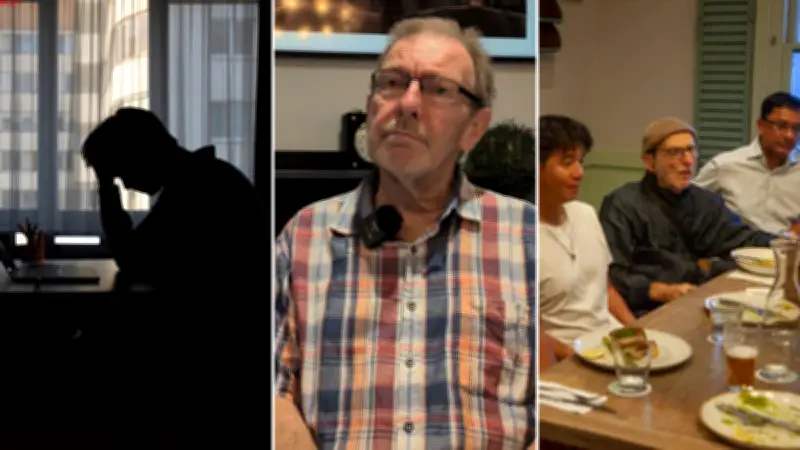
The so-called male loneliness epidemic has been rampant clickbait for years now. At the centre of online discourse sits the question: Who is to blame? Men, for emotional illiteracy, or women, for not supporting them enough? For The Men’s Table, a grassroots organisation that creates spaces for men to talk to each other on a deeper level — “not just about footy and s***” — this question is unproductive. Instead, it aims to address the reasons why nearly half of Australian men (43 per cent according to a survey conducted by Healthy Male) struggle with loneliness, and how men can help themselves.
Loneliness as an Epidemic
Loneliness as an epidemic has been a talking point since 2023, when the US Surgeon General’s Advisory declared the mortality impact of social isolation was similar to that caused by smoking up to 15 cigarettes a day. Meaningful social connections can help regulate the body’s stress responses and improve cardiovascular health. Inversely, chronic social isolation can increase the risk of heart disease or stroke. The Men’s Table has found a potentially life-saving cure is to organise, through local restaurants and businesses, catering and a private room where men can come together over a meal once a month and just talk.
The Rules of The Men’s Table
There are rules: “What is said at the Table stays at the Table”. Also, no getting drunk, and no “fixing” — only listening. It is similar to the unspoken rules which apply to ladies at brunch, as they vent to their friends’ sympathetic ears and leave the weight of their worries at the cafe with the bill. Could the cure to male loneliness be as simple?

‘You don’t notice’
Well, think of a man in your life older than 60, an age when the common catalysts for social isolation in men occur: Retirement, divorce, deaths of family or friends. Does this man in your life regularly share a social meal with his mates? Does he talk about what is bothering him to anyone other than his partner? Whether it be the knee he is refusing to get checked out, the declining health of his own ageing parents, or the persistent emptiness he has felt since retirement. Does he have meaningful friendships?
James Nelson, 71, is now a regular at The Men’s Table. He has never considered himself a lonely person. As a matter of fact, he categorises himself as a “joiner”. In 2017, both his parents were diagnosed with late-stage dementia, and James stepped into the role of their full-time carer. Social isolation came to a gradual boil around him, as it is prone to do according to RMIT’s Professor Bernardo Figueiredo. “Like a frog in boiling water, you don’t notice because the water heats slowly and then you’re cooked,” Figueiredo said. Upon realising their social situation is dire, many men will still not reach out for support. “Men and women report similar rates of loneliness, but how they handle that loneliness differs radically,” James said. “Women are much better at building up social networks, finding people who can help them whereas men are pretty hopeless at that. Suicide rates amongst men who are lonely are about three times the rates of women who are lonely.”
‘Simmering pot’
In his research on positive ageing, Figueiredo interviewed retired married women many of whom described their husbands as opting out of social outings. “(The men) stay at home, unable to connect, or don’t see purpose in connecting until it’s too late,” he said. This “outsourcing” of socialisation to their partners or, in some cases, relying on children for meaningful connection adds to the simmering pot. “With time, you lose the knowledge of what to say, how to make contact. You wonder if it would be weird to contact anyone,” Figueiredo said. “That’s where social norms really come into play. It’s not weird if you contact them to go to the footy. It’s not weird if you have a purpose … but if it’s just to sit down and chat? That’s very different.”

James, an effusive bachelor, does not fit this mould for male loneliness. Somewhere in between leaving his friendly Middle Park neighbourhood to move into his parents’ Kew home — organising physical therapy for his father and music therapy for his mother — he was becoming socially isolated in a house full of people. Help came in the form of an old neighbour from Middle Park: Barry. “He was worried about me,” James said. “He took me aside and said, ‘If you don’t have some time out, you’re going to go round the bend’.” Barry made James promise to share a meal every Wednesday and “just have a nice, social chat”. James pushed back at first, asking: “What will I do with Mum and Dad?” “He said, ‘Well, what would you do if you needed to go to the doctor or the dentist?’,” James said, adding he replied he would get someone to look after them. “There’s your answer,” he said Barry told him. “It might not be perfect, but you’ve got to survive, too. You’ve got to come out of this sane.” James smiles as he recounts the conversation and adds: “Which I did.” “He was a truly caring individual.” Sadly, Barry recently passed away, but James has been carrying on his friend’s ethos that “wherever we can help others, we should” every month at Men’s Table. “The Men’s Table is a chance for men who might otherwise be fairly isolated to really get some help and talk to people, and socialise, and build a network,” James said.
Figueiredo said the beauty of The Men’s Table is that it prioritises active listening. “If someone tries to share something and they feel that they are being ‘fixed’, that’s something research shows no one is happy with,” he says. “But if it’s just sharing stories and listening? That works quite well with men.”