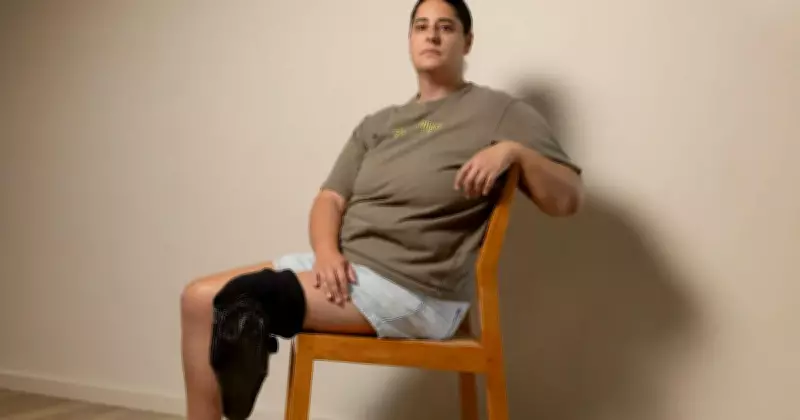
NDIS Rejects Custom Wheelchair for Amputee, Sparks Outrage Over Funding Logic
Megan Pascoe, a 35-year-old resident of Abermain in New South Wales, has expressed profound frustration after the National Disability Insurance Scheme (NDIS) declined her request for a custom wheelchair. The decision, which the NDIS attributed to insufficient evidence of need, has left Ms Pascoe questioning the agency's common sense and forward-thinking approach.
A Life-Altering Accident and Ongoing Struggles
Ms Pascoe lost her lower left limb in a tragic ride-on lawnmower accident just one week after her wedding to wife Stephanie Pascoe in late 2024. Since then, she has navigated the challenges of life as an amputee, including significant costs and emotional trauma. "The NDIS says there isn't enough evidence that I need a wheelchair as well as prosthetics," Megan stated. "I've got one leg, how much more of a disability do I need?"
Her situation is further complicated by family responsibilities. She has a three-year-old child and another due in May, which her wife is carrying. "Imagine it's the middle of the night and my newborn needs attention and is screaming," she said. "It can take a few minutes to put my prosthetic on." Additionally, there are times when she cannot wear her prosthetic due to injury, swelling, or pain, leaving her without independence if a wheelchair is unavailable.

Controversial Funding Decision and Financial Irony
An occupational therapist recommended a custom wheelchair for Ms Pascoe at an estimated cost of $20,000. However, the NDIS denied this request, instead approving $6,000 for a 12-month hire of a standard hospital-grade wheelchair. Ms Pascoe pointed out the financial absurdity of this decision: a standard wheelchair costs about $1,000 to purchase and $1,200 to hire for three months. "They said no because that funding is specifically for hiring. So I have to spend more money on this wheelchair than it costs to buy it," she explained. "It's absurd. When does common sense prevail?"
She estimates that in about three years, the cumulative cost of hiring would match the price of a custom wheelchair, highlighting a lack of long-term planning. "There did not appear to be much 'forward thinking' at the NDIS," she remarked.
NDIS Response and Appeal Process
When questioned about the case, a National Disability Insurance Agency spokesperson stated that funding decisions for assistive technology are based on evidence of assessed need. "Where a participant may have changing needs, the NDIS may fund the short-term hire of assistive technology to address their immediate needs," the spokesperson said, adding that this could occur while further assessments on long-term needs are completed.
Ms Pascoe was astounded by this explanation, responding sarcastically: "Oh my gosh ... changing needs? Hopefully my leg grows back." She appealed the initial decision, but after a couple of months of review, it was declined again. The next step is an external review, another lengthy process she must now undertake.
Broader Implications and Expert Insights
Ms Pascoe noted that every lower limb amputee she knows has at least one wheelchair, with some having two or three alongside custom prosthetics. Her physiotherapist, who specialises in amputee recovery with over 20 years of experience, told her he had never seen an amputee be declined a wheelchair before.
In addition to the wheelchair issue, the NDIS declined to cover Megan's psychology and physiotherapy treatment. It did approve her prosthetics—one for everyday use and one for the shower—as well as handrails in the shower, though only a small amount of funding was provided for the latter. "There's not enough funding for me to get a bench or a seat," she said. "If I have to wear this prosthetic every single time I shower, it means I can never wash my lower leg, which makes no sense."
The NDIS did cover the $5,000 cost of two occupational therapist reports for her wheelchair applications, adding another layer to the bureaucratic complexity. Ms Pascoe believes the issue stems from the NDIS reining in spending and trying to cut costs, a move she finds counterproductive given the financial inefficiencies highlighted in her case.