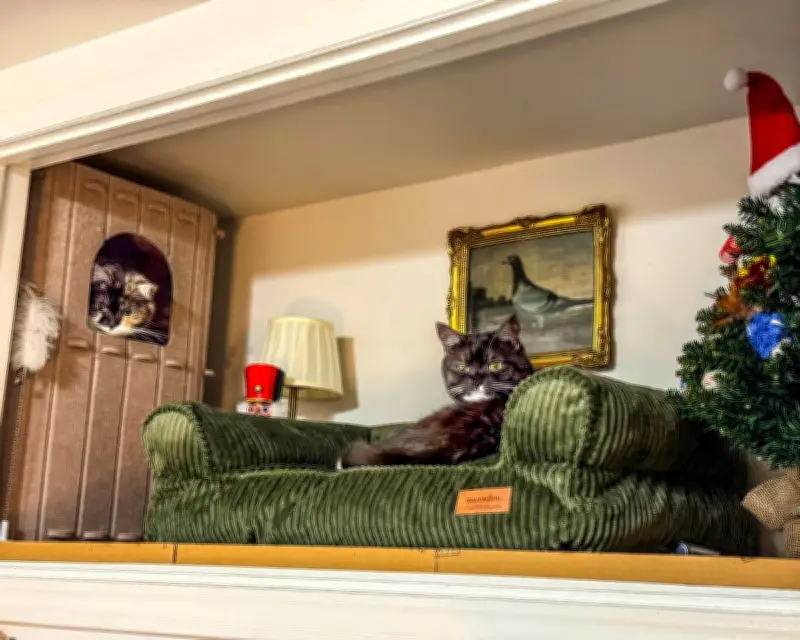
Lox is sprawled out on a green sofa, bathed in warm light from a standing lamp, framed art on the wall behind him. This may sound like a relatively ordinary description of someone in their living room – except that Lox is a cat, not a human, and the “living room” he shares with another cat, Lottie, is a converted cupboard in a New York apartment.
Lox and Lottie’s owners, married couple Derek and Sarah, are fans of the cat behaviourist Jackson Galaxy, who advocates for creating a “superhighway” for indoor cats that gives them a vertical pathway around a room. Derek, 33, says that was “our inspiration”. He set about converting a high cupboard into a little nook the cats could access via scratching posts and perches. The idea was to make something whimsical – a cat-sized replica of a human living room. The whole thing cost $200 (£150) – and, after being featured online, made them all Instagram celebrities. “A lot of people ask where we got the cat tree,” he says – or the pigeon picture, which is a fan favourite. Most importantly, the cats themselves love spending time in their room. Lox and Lottie are “up there every single day”.
These elaborate pet setups are becoming increasingly common. Recent research commissioned by the paint brand Dulux revealed that 81% of UK pet owners are now designing dedicated spaces for their pets.

Kiki Rowley, 38, from Gloucestershire, created an under-the-stairs nook for her two chihuahua-crosses Bella and Ruby. “Under the stairs is quite a dead zone,” she says, so she decided to make her dogs a “tiny little room”. She sourced miniature furniture for the space, and decorated it “Mexican-themed in honour of their heritage”. The whole thing cost her under £100. Though Bella is sadly no longer with us, Ruby and Dimitri (Rowley’s new dog, a Russian toy), often make use of their nook. “While I’m chilling in the living room, they just go in there and have a little snooze.”
Lauren Meyer, 39, a cosmetologist who lives in California, has built a Prince-themed “cat bathroom” in her home. The project, she says, began as a solution to a practical problem – she needed somewhere to put the food bowls and litter tray for her two cats that her dog couldn’t access. At first, she simply put a baby gate on her bathroom door, but then she realised that if she ripped out the bathroom’s built-in hamper, there would be enough space to tuck the litter box in there and make it into a feature. “Prince holds a very special place in mine and my husband’s hearts, so we decided to go for a Purple Rain Prince,” she says – and it’s been a hit with her friends and family. “Our guests love going in there,” she says. “Every time I talk to my nieces on the phone, they’re always like, can we see the cat bathroom?”
And Meyer isn’t stopping there – for her next project she’s planning to make a gothic library-themed cat nook above her fridge. “Projects like this make my life a little happier,” she says. “I enjoy the process of putting time and energy into something supercreative and fun for two little furballs I adore so much.”
Architect Jonty Hallett, based in the Cotswolds, says an image of a built-in cat cubby he designed for his former home is his company’s “most liked photo on Instagram”. A number of his clients have asked for design features in their homes to accommodate pets. “People are really on board with pet-led design,” he says. Tom Howley, who runs a Manchester-based kitchen design company, says he has had a lot of business from the boom in popularity of in-built pet nooks, which he thinks, like “nearly everything that we do nowadays”, is driven by social media. People treat their pets “like humans” he says, so his company is now frequently asked to “integrate practical pet features like built-in feeding stations, integrated bed nooks and low-level storage for treats or toys” into kitchens. It even engraves pet names into the furniture.

Some influencers have taken things to the extreme. Last year, Jasmine Easton posted a video on her Instagram account that provocatively begins: “I spent over £8,000 on my rabbit setup.” The Surrey-based “countryside pet mum of six” goes on to show her followers round her two rabbit sheds, which connect, via green tunnels, to outdoor play pens. Everything is decorated in pastel hues, complete with cutesy heart-shaped pet beds and patterned rugs.
“I know it’s a lot of money, but I would do it again in a heartbeat,” says Easton, 32, at the end of the video. “This is what rabbits deserve … they are complex, intelligent animals that deserve more than just a cage in the corner.”
Easton, who works in dentistry alongside content creation, has also dedicated a room in her property to her two Bengal cats. When I speak to her, she admits the amount she has spent on her pet areas is “over the top”. But creating such elaborate setups for her pets has been beneficial for the influencer: “People like watching animal routines and peaceful environments online.”
Like Easton, Katherine Saballos, a 37-year-old pet influencer, has dedicated a whole room in her home in Tampa, Florida, to her pet: a labrador called Leia. “I grew up not wanting children and I always wanted a dog, so when my fiance and I got together and bought our house, I knew that I wanted to have a space just for her,” she says. She didn’t anticipate that the space “would get to what it is now” though: Leia’s “girly” room is furnished with her own single bed and a clothing rail with different coloured collars and neatly hung harnesses.
According to Saballos, Leia has always been very independent. She noticed her dog would take herself off for naps in the room, and enjoyed having her own space. “That’s what made me want to make it comfortable for her,” she says. Once she started thinking about how she might do that, “the creativity started” and she began transforming the room. Like the other pet owners I speak to, Saballos recognises that what she’s done might be seen as a bit “extra”. But her dog loves it, and she has taken a lot of joy from making the space, too, she says. “It’s fun!”