Japan is renowned for its hot springs, known as onsen, with nearly 30,000 scattered across the country. These thermal baths are an integral part of the ryokan experience, and some accommodations even feature rooms with private outdoor baths called rotemburo. Onsen are divided into male and female sections for obvious reasons: guests must be fully naked. Etiquette dictates no bathing suits, no G-strings, and no bath towels. Instead, a small, thin cloth or hand towel may be used to maintain modesty while entering the water; it is small and thin enough to fold and place on your head while immersed, allowing immediate use upon exiting.
Etiquette and Rules
Oh, and no phones or tattoos are allowed. Sometimes, stickers may be provided to cover tattoos, but this only works for small areas of the body. My small group stayed at Hoshino Resorts Kai Kaga in Yamashiro Onsen, a traditional hot-spring resort town in the foothills of Mt Hakusan, Ishikawa Prefecture. The bath halls there are decorated with traditional gold and silver leaf and ceramic panels. A faint smell of sulphur outside my room confirmed it was the real deal. My colleague, who is fully covered in tattoos, was reserved a private time for a dip.
Public Bathhouse Experience
There is also a replica 19th-century public bathhouse across the road, which I visited, timing it carefully to avoid peak hours. It is free for Kai Kaga guests; otherwise, you buy a ticket from the vending machine at the front, which also allows towel rentals. Lucky for me, there was just one person inside, and neither of us made eye contact. She discreetly left as I fumbled about at the cubby hole storage area where I left my things. It is customary to shower first or, at the very least, wash down your lower body before soaking. I watched my step as I walked towards the bath because it was slippery. Once I slither in, pure bliss: warm and steamy. The water reached about my shoulders and was pleasantly hot, maybe 40 degrees Celsius, give or take, and hotter still at the spout where it trickled in. The idea is to relax, so no splashing and no swimming.

Health Benefits of Onsen
Hot spring water originates deep underground and is full of therapeutic minerals, which vary depending on the source, and are purported to relieve all manner of aches and pains. At Yamashiro Onsen, the water contains sodium, calcium, sulfate, and chloride. I spent about 20 minutes at the bathhouse, wiped down, and put on my yukata (provided by Kai Kaga), mindful of wrapping it correctly after getting it wrong the first time. The correct way is to fold the right side first, then the left side over the top. Putting the right side over the left side is only done on dead bodies. Obviously, I looked a bit too flushed for comfort coming out, because the bathhouse attendant ushered me upstairs — no excuses, no mercy — for a glass of water, which I obediently poured and drank, then headed straight to dinner at Kai Kaga wearing my yukata. It is comfortable, elegant, and accepted onsen ryokan attire that takes the angst out of the eternal question: what am I going to wear?
Public Foot Bath
Walking through town the next morning, there is a public foot bath with a fountain encrusted in mineral salts. I took off my shoes and socks and let the water do its work — I hoped.
Private Onsen Experience: Takimotokan Yuki no Sato
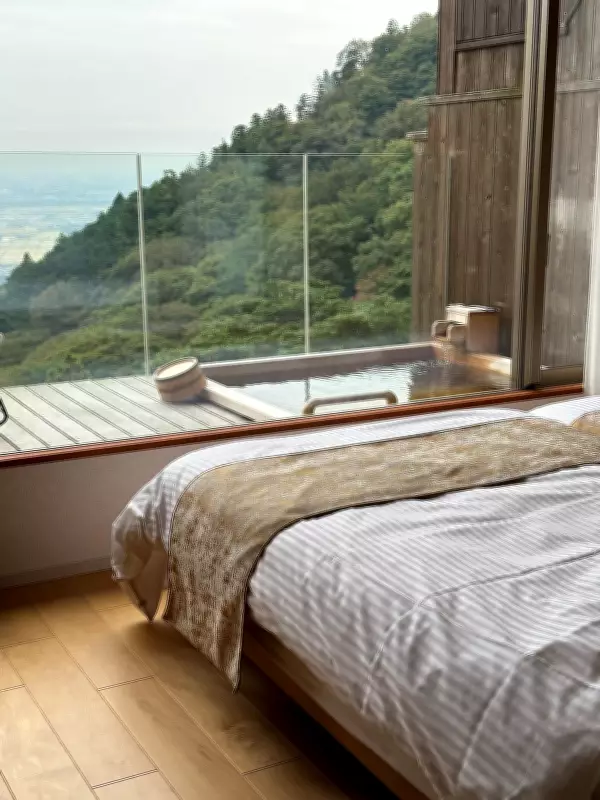
My preferred onsen experience is private, and Takimotokan Yuki no Sato hotel in the mountains near Yoro Falls, Gifu Prefecture, offers just that. With Japanese and Japanese-Western style accommodation, my room opened to a balcony with an open-air bath called a rotemburo. It is quiet, isolated, and luxe, surrounded by forest overlooking the Nobi Plain, with just 11 rooms — perfect for anyone who wants to get away from it all. The best memory is sitting in the rotemburo at night in light rain, stars twinkling, feeling warm and relaxed, then going straight to bed. It was one of the best night's sleep I have had.

Health Claims and Legend
Hot spring water here contains sodium and calcium chloride. It is claimed to benefit neuralgia, muscular pain, frozen shoulders, paralysis, stiff joints, bruises, sprains, chronic digestive diseases, cuts, burns, and skin diseases. It sounds too good to be true, but there is a miraculous story buried deep in time that a loyal son with a sick father once went to Yoro Falls only to find the water turned to sake, curing his father's illness. Legend has it that drinking it today will rejuvenate you — and it is within easy walking distance of the hotel. My room cost $600 a night for one person, though rates differ depending on season, and includes a traditional Japanese kaiseki breakfast and dinner with local ingredients harvested in the mountains.
Olga de Moeller was a guest of Ishikawa Prefecture and Gifu Prefecture. They have not seen, influenced, or approved this story.