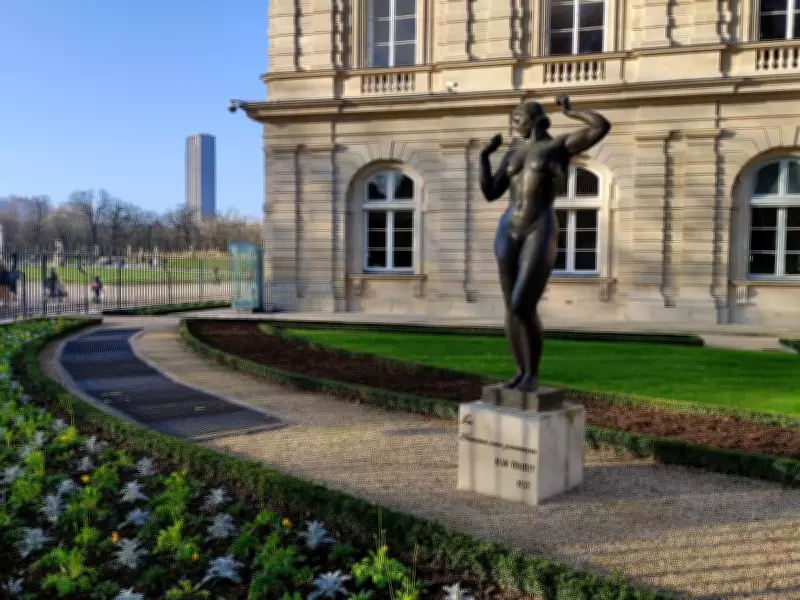
Camera IconTour Montparnasse rises to the south-west of the Jardin du Luxembourg. Credit: Steve McKenna/
There are places I’ll remember, all my life, though some have changed, some forever but not for better, some have gone and some remain. It’s perhaps a strange song to be humming to myself as I walk around Paris, a city I didn’t visit until I was 13 and where Beatlemania didn’t quite hit as hard as it did elsewhere, despite the band playing an 18-day residency at the city’s Olympia Theatre before their breakthrough tour in the United States in 1964. But there are definitely places in Paris that I’ll now remember all my life, including some that have changed and continue to change with every trip.
In my three decades of visiting France’s capital, the Jardin du Luxembourg has long exerted its spell. That’s partly because of the hotels I often stay at on the Left Bank of the River Seine, within walking distance of this 25-hectare park bordering the Latin Quarter and Saint-Germain-des-Pres enclaves. But even when I’m based elsewhere on the Right Bank, or in La Defense, the business district west of Paris, I usually seem to gravitate to the Jardin du Luxembourg.

A Haven of Beauty and Heritage
It’s a haven of beauty and heritage in the 6th arrondissement, and one that changes appearance and ambience with the seasons. More than 3000 trees soar within the boundaries of its ornate iron gates, including oaks, horse chestnuts, gingkos, elms, planes, beech, mulberry, sequoias and cedars. An orchard contains more than 500 varieties of pear and apple trees, and greenhouses shelter a prized orchid collection. Budding beekeepers attend an apiary school, and horticultural classes run regularly.
When I last visited the park in the northern summer, the 5000 square metres of flower beds were radiant, greenery was everywhere, and visitors were in T-shirts, shorts, skirts and dresses. It’s winter now, everyone is wrapped up in thick coats, hats, scarves and gloves, and vegetation is sparse. Some leaves have gone and some remain. The park’s orangery is protecting the citrus, pomegranate and palm trees from the frost, but in the warmer months that space will showcase art exhibitions.
Seasonal Charms
Spring, with blooming magnolia and roses, and autumn, with burnished hues, bring their own charms, colours, scents and vibes to the Jardin du Luxembourg, which is fed not just by natural rainfall but by an underground aqueduct linked to the Seine. This park is an enduring favourite with tourists and Parisians alike. Some come to play chess or read a book. Kids like to ride the wooden animals of the carousel designed in 1879 by Charles Garnier, architect of the Opera Garnier.
In the 1920s, Ernest Hemingway used to walk through the park on his way to visit fellow American expat writers living and socialising on the Left Bank, including Gertrude Stein, who had a studio nearby. In TV, the titular character of the hit series Emily In Paris lives locally and goes jogging in the park. You may also recognise the Jardin du Luxembourg from scenes in Lupin, a Netflix crime caper about a French gentleman thief.
Activities and Attractions
It would be criminal not to slow down and savour the park’s many parts and parterres. Although it attracts approximately six million visitors annually, you’ll always find quieter spots away from the crowds. The bicycles and scooters that now proliferate elsewhere in Paris are banned. Strolling on the gravel paths by the lawns and trees, you may see or hear people playing petanque or tennis as tai chi practitioners silently go through their moves. Listen out for musicians playing at the park’s bandstand and pause to examine some of the 100 or so statues variously depicting French writers, saints, royals and other luminaries.

Among those portrayed is Queen Marie de Medici, the second wife of King Henry IV of France and the mother of Louis XIII. After her husband’s death in 1610, she commissioned a new royal palace and gardens, inspired by her birthplace, the Pitti Palace in Florence, and its neighbouring Boboli Gardens. Adorned with paintings by Peter Paul Rubens, the Palais du Luxembourg was enlarged over the following centuries under successive rulers and is now home to the senate, the upper house of the French parliament. Admire its majestic facade as you walk past or view it while resting on one of the hundreds of green metal chairs sprinkled around the park. Many are placed around the central octagonal pond, upon which model boats can be sailed when it isn’t iced over, like it partially is on this December visit.
An even more extravagant water feature is the Medicis Fountain, which the queen had built in the 1630s, influenced by the fountains of her Tuscan childhood. In 1862, as part of Baron Haussmann’s urban renewal of Paris, which altered the layout of this park, the fountain was moved to its present location, 30 metres closer to the palace and embellished with an adjoining 50-metre-long basin.
Surroundings and Practicalities
If you turn around and look in the opposite direction, you’ll notice the view is slightly tarnished by an eyesore a kilometre to the south-west. That’s the Tour Montparnasse, a 210-metre skyscraper regularly voted Paris’ ugliest building since its unveiling in the 15th arrondissement in 1973. There are far more elegant and aesthetically pleasing buildings closer to the Jardin du Luxembourg, however. Look east and you should glimpse the Pantheon, a domed hilltop neoclassical landmark where French icons like Voltaire, Emile Zola and Victor Hugo are laid to rest.
The surrounding streets are full of cafes and bistros with outdoor terraces, and right beside the park, by Musee du Luxembourg, a gallery space in the former orangery, you’ll find Mademoiselle Angelina, a branch of the fairly pricey French tea house and cafe. Depending on the season, you may be in the mood for hot chocolate and patisserie treats or a champagne-fuelled brunch. Whatever you order, there’s a great place right next door to walk it all off.
Fact File
The Jardin du Luxembourg adjusts its opening hours every two weeks depending on the sunrise and sunset. Typical winter opening hours are 8.15am to 4.30pm, while in mid-June it’s 7.30am to 9.30pm. The closest Metro station is Odeon, on Boulevard Saint-Germain, a six-minute walk from the gate by the Palais du Luxembourg. The park is about 15 minutes on foot from Notre-Dame Cathedral. For more information on visiting, see jardin.senat.fr. To help plan a trip to Paris and France, see parisjetaime.com and france.fr.
Camera IconThe Palais du Luxembourg is one of the architectural beauties of the park. Credit: Steve McKenna/
Camera IconThe orangery of the Jardin du Luxembourg houses art exhibitions in the warmer months. Credit: Steve McKenna/
Camera IconThe Medicis Fountain at the Jardin du Luxembourg. Credit: Steve McKenna/
Camera IconThe Jardin du Luxembourg oozes leafy charms in the warmer months. Credit: Steve McKenna/
Camera IconThe Jardin du Luxembourg oozes leafy charms in the warmer months. Credit: Steve McKenna/
Camera IconThe Jardin du Luxembourg oozes leafy charms in the warmer months. Credit: Steve McKenna/
Camera IconThe French tricolour flutters from atop the Palais du Luxembourg. Credit: Steve McKenna/
Camera IconMore than 100 statues pepper the Jardin du Luxembourg. Credit: Steve McKenna/
Camera IconModel boats sail on the pond of the Jardin du Luxembourg. Credit: Steve McKenna/
Camera IconJardin du Luxembourg has a more spartan look in winter. Credit: Steve McKenna/