I kill the engine, get out of the car, and crane my neck. My heart skips a beat. I can't recall seeing a sky like that for years, maybe ever, and definitely not in the northern hemisphere. Hundreds, probably thousands, of stars are visible and radiant. The constellations are different, of course, but the dazzling clarity takes me back to one night, in 2009, in the Atacama Desert of northern Chile, where the stargazing is consistently and famously incredible.
Northumberland, in the far north of England, doesn't have the same international renown or pedigree as that southern-hemisphere sensation, but if you happen to be here on a clear night, like I am, you'll be spellbound. We're in what is touted as Europe's largest gold-tier international dark sky park. Low light pollution — aided by this being the least-populated part of England — means you can often see loads with the naked eye. But the telescope-blessed observatories scattered across the park provide even more awe-inspiring moments, with expert astronomers on hand to reveal fascinating snippets about the celestial majesty.
A Night at Kielder Observatory
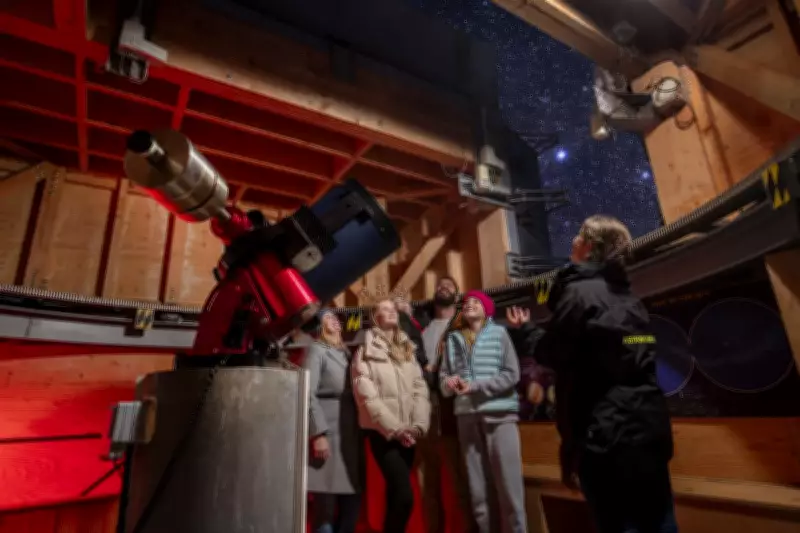
It's a crisp March evening and I've come — in my big coat and woolly hat — for one of the stargazing events at Kielder Observatory, a 2008-built off-grid visitor attraction and educational facility hidden in Kielder Forest, accessible via a bumpy off-road trail from the nearby main road. “Everything you'll be seeing tonight has already happened,” astronomer Liam Reid says, explaining that because of the time it takes for light to travel across the vast distances of space, we're glimpsing stars and planets as they appeared in the past.

Some are relatively close, like Proxima Centauri, the nearest star to earth after our Sun, which is just over four light-years away. Others are so remote it's hard to fathom. Take the Andromeda Galaxy, an extraordinary 2.5 million light-years away. Considering that's our nearest galaxy — and might smash into the Milky Way in about 4.5 billion years time — it really hints at the mind-boggling enormity of our universe.
Stargazing Highlights
Over three engrossing hours, we're regularly stunned and humbled by the information shared by Liam and his fellow astronomers and enthusiastic volunteers as we take turns to star-hop through the observatory's high-tech telescopes. They're set in rotating turrets named after legendary astronomers Sir Patrick Moore and Caroline Herschel. We gaze at key markers like Polaris, the “north star”, and peruse seasonal treats like Orion, an especially prominent constellation during the northern winter. We also admire the four Galilean moons of Jupiter, currently high up in Gemini, and Mizar and Alcor, a double star gleaming like diamonds in The Plough, part of the mighty Ursa Major constellation. “Just” 83 light-years away, this double star was, we're told, used in ancient eye tests. Apparently, one of the qualifications for a would-be Persian warrior was to be able to see it with the naked eye.
We occasionally spot stuff racing across the sky. They're not planes, UFOs or shooting stars, but mostly satellites, says astronomer Ciara Guy, who has a Master's degree in Space Law, with her research focusing on the governance and protection of the planet's dark sky zones from space-based light pollution. As another satellite darts above, Ciara shares her concerns that the increase in these man-made objects orbiting the earth — currently estimated to be almost 15,000 — could threaten our window into the cosmos. But that's some way off, we hope.
Weather and Preparation
We can see plenty tonight, which is a relief for me as last year, not far from here — just across the border in south-west Scotland — I had a less-than-satisfactory experience in the Galloway International Dark Sky Park, when thick, stubborn clouds scuppered proceedings. The British weather is not quite as reliable as, say, that of the Atacama Desert, so luck certainly plays a part. And you should definitely wrap up and bring layers if you're coming in the peak stargazing season between October and March, when Northumberland's skies are at their darkest for the longest, as night-time temperatures can drop to zero (or below). We're thankful for the warming mug of hot chocolate included in our ticket price.

A Memorable Conclusion
After more tales of distant exploding stars, meteorites, colliding galaxies, exoplanets and the search for extraterrestrial life, we return to the cosy main cabin, heated by a wood-burning stove, for the last chapter of this memorable saga. An engaging presence all evening, with stories cheerfully delivered in his distinctive north-east English accent, Liam is rounding things off with a lecture on another of his passions, the aurora. He explains the science and mythology behind this awe-inspiring natural phenomenon, and it's evident from the stunning time-lapse videos and photographs — captured by himself and others over the years — that Northumberland is not just a stargazer's delight, but potentially, if conditions play ball, a great place to catch the northern lights as well.
Steve McKenna was a guest of Visit Britain and Visit Northumberland. They have not influenced this story, or read it before publication.
Fact File
- Themed stargazing experiences run throughout the year at the Kielder Observatory, priced from £39 ($74) for adults, with concessions £33 ($62). kielderobservatory.org
- To help plan a trip to Northumberland and Britain, see visitnorthumberland.com and visitbritain.com