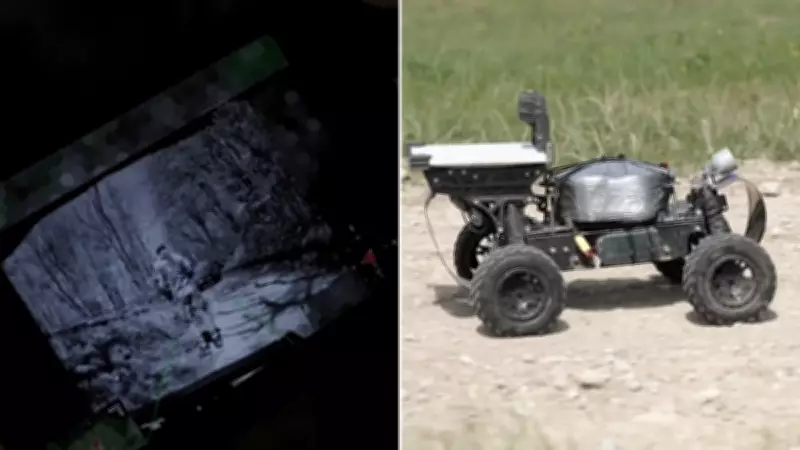
Four highlighted figures appear on the LED screen of a handheld controller gripped by a Latvian soldier. It’s a sight Private First-Class Janis always believed would come: an invading unit making its way into the forests of his home country. But for much of his life he expected to witness it through binoculars or the scope of a weapon.
Know the news with the 7NEWS app: Download today. Not a drone, much less a new uncrewed ground vehicle (UGV). Effectively silent whilst stationary unlike the uncrewed aerial vehicles (UAVs) ubiquitous on modern battlefields, his sight through the UGV helps his defending unit draw first blood. The equivalent, at least. Because this is a war game: NATO’s Exercise Crystal Arrow on the alliance’s eastern flank that borders Russia.
“We are soldiers,” he tells 7NEWS. “We join the army with the one thought: to protect our home, to protect our families, to protect our people.” The opposing unit, like his own, is a mixture of NATO’s multinational brigade and Latvia’s Mechanized Infantry Brigade. But as much as this battlefield is a learning opportunity, it’s also a race.

Be the first to know: Add 7NEWS as your preferred news source on Google. “We need to not get with the times but get ahead of the times,” says Sergeant Cody Baltzer. The exercise is not just a learning opportunity, but a race. “These drones are going ahead, scouting for obstacles, maybe drawing out machine gun fire, maybe there’s an armoured vehicle they can engage to save lives on the ground.” They’re capabilities Sgt Baltzer and everyone in NATO’s multinational brigade here has seen deployed in Ukraine for years. Only now do they have their hands on them in a live exercise.
“Yeah, we’re playing catch-up, there’s no question about that,” says Colonel Kristopher Reeves, commander of NATO’s Multinational Brigade in Latvia. “I think we’ll be able to generate some momentum here so when the fight comes here, we’re ahead of it.” Latvia has long lived in fear of a Russian invasion.
But that fight is evolving more rapidly than even Russia can keep up with. Last month Ukrainian President Volodomyr Zelensky boasted an entirely remote-controlled unit forced Russia to concede a position in Kharkiv, at the cost of no Ukrainian casualties. If true, it would be the first time such a feat has been achieved in a war that has now entered its fifth year. It’s a remarkable reversal of roles. In 2014 when NATO’s Multinational Brigade was first deployed to its eastern flank following Russia’s annexation of Crimea, it played teacher to Ukrainian students.
“Learning to use the technology and evolve it and innovate it and experiment that has to be our number one priority at the moment,” Reeves said. “What you see in Ukraine right now is battle labs and technology and experimentation.” Latvia experienced the effects of that experimentation just two days before Exercise Crystal Arrow began. Two explosive drones launched from Ukraine were reportedly taken over by Russia before striking a Latvian oil storage plant. The attack forced the resignation of Latvia’s Defence Minister, and later Prime Minister Evika Silina. The drone incidents “clearly demonstrated that the political leadership of the defence sector has failed to fulfil its promise of safe skies over our country,” Silina said.
But the threat from external pressure upon NATO is now rivalled by the pressure that comes from internal divisions. US President Donald Trump has announced the withdrawal of 5000 troops from Germany without any plan to redeploy them on the continent. “I think this is a really difficult crisis for NATO, I mean America is the core of NATO, although Europe has a lot of capability and a lot of fight, all of our security is fundamentally based on the US security umbrella,” says Dr Emma Salisbury, a senior fellow of the National Security Program at the Foreign Policy Institute in the US.

She says this is a problem not only for the 32 NATO member nations... but every American ally. “Australia’s alliance with the US has been very deep for a long time and now the US is being unreliable to Australia just as they are being unreliable to Europe,” she said. “So I think we’re in a really similar place right now.” It underscores the need for Australia — like Europe — to become more self-sufficient and learn these asymmetrical ways of fighting with drones, that Ukraine has proven can turn the tide against a greater enemy. “Because if America’s not going to come and help us then we need to stick together,” Dr Salisbury says.