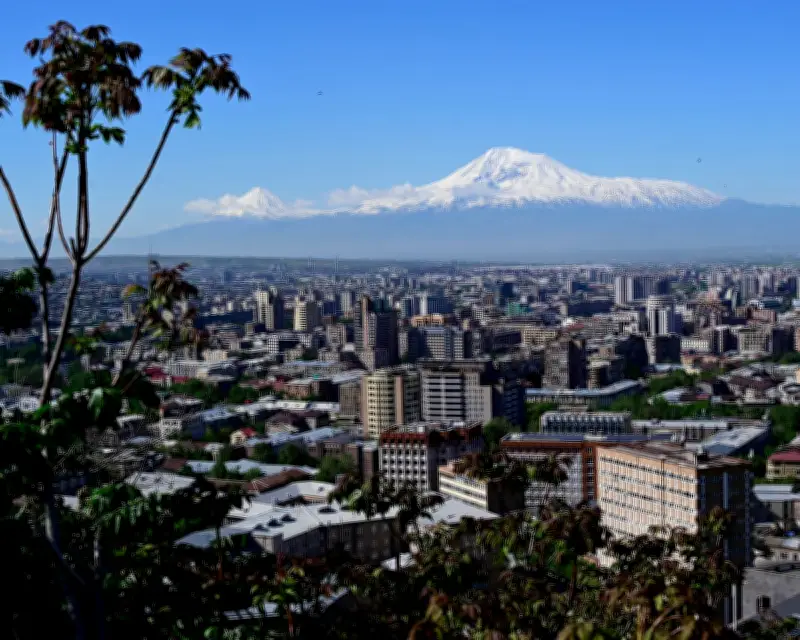
Armenia heads to parliamentary elections on Sunday amid mounting pressure from Russia, which has imposed trade restrictions and warned of a 'Ukrainian scenario' if the country continues its westward tilt. The relationship between Moscow and its traditional ally has slowly unravelled under Prime Minister Nikol Pashinyan, who came to power in 2018 on a wave of popular revolution.
Trade Restrictions as Political Leverage
At the Abovyan cognac factory on the outskirts of Yerevan, the bottling line runs at full capacity. Workers in white coats and hairnets label, stack, and load pallets with speed, racing to fill a truck destined for Russia. But the shipment may never reach its destination. Last month, Moscow banned imports from Abovyan and two other leading Armenian cognac producers, citing sanitary concerns. The move is widely seen as political pressure ahead of the elections.
The ban is the latest in a series of trade restrictions targeting Armenian exports, including flowers, fish, fruit, and brandy. Russia, a nation of 3 million people, sends roughly 40% of its exports to Russia, making it highly vulnerable to such measures. 'We just hope this all blows over,' said Samvel Goroyan, Abovyan's director. 'All our cognac is sold in Russia, 7 million bottles a year. We have nowhere else to go.'

A Historical Alliance Under Strain
For most of its post-Soviet existence, Armenia was Moscow's closest ally in the South Caucasus, hosting Russian troops, buying Russian weapons, and integrating with Kremlin-led political and economic structures. However, Pashinyan's push to reorient Armenia towards Europe represents the most significant foreign policy shift since independence. Sunday's vote will test this policy, which Pashinyan pursues despite deep economic dependence on Russia.
'Moscow feels it is losing Armenia, that the country has got a bit too big for its boots,' said Thomas de Waal, a senior fellow at Carnegie Europe. 'So Moscow is trying to force Pashinyan to make a choice – for Russia.'
Russian Warnings and Threats
Last month, President Vladimir Putin warned that Armenia could face a 'Ukrainian scenario' if it continued European integration. Dmitry Medvedev, deputy chair of Russia's Security Council, hinted that Pashinyan could suffer the fate of Leon Trotsky, whom Joseph Stalin had killed with an ice pick. Ties first nosedived after Azerbaijan seized Nagorno-Karabakh in 2023, triggering an exodus of over 100,000 ethnic Armenians. Despite a security alliance and peacekeepers in the region, Moscow stood aside, exposing the limits of Russian guarantees.
The loss prompted Yerevan to question the Collective Security Treaty Organisation (CSTO), the Moscow-led military alliance. Last year, Pashinyan suspended Armenia's participation. The country further angered Moscow in April by hosting a European Political Community summit with Ukrainian President Volodymyr Zelenskyy in attendance. Pashinyan has spoken about EU aspirations and made inroads with Washington, with Donald Trump endorsing him and Vice President JD Vance and Secretary of State Marco Rubio visiting Yerevan.
Moscow's Playbook in Armenia
For Moscow, Armenia's drift comes at a sensitive time, four years into the war in Ukraine. Analysts say the Kremlin is deploying familiar tactics: disinformation campaigns and covert influence operations to bolster friendly political forces. Kremlin backing has flowed to Pashinyan's main challenger, Samvel Karapetyan, a Russian-Armenian billionaire whose Stronger Armenia party advocates closer ties with Moscow. Karapetyan is under house arrest on charges linked to calls for seizing power.
Despite Moscow's pressure, opinion polls suggest Pashinyan's party will win about 30% of the vote, while Karapetyan trails at roughly 10%. 'What's interesting is this Russian campaign has backfired. It's only strengthened Pashinyan at home,' said Richard Giragosian, director of the Regional Studies Center in Yerevan. De Waal added that the opposition has discredited itself through perceived closeness to Russia. 'Pashinyan's Civil Contract party is likely to win the elections more or less by default,' he said. 'Not because the prime minister is still popular – he isn't – but because Armenia's opposition is even less competent and too associated with Russia.'

Careful Pressure and Economic Leverage
Analysts say Moscow has been careful not to push too hard, aware that excessive pressure could fuel anti-Russian sentiment. Hovhannes Nikoghosyan, an Armenian political scientist, said: 'No one can confidently predict how far Moscow will continue pressure if Pashinyan is re-elected, but if he remains in power, Russia will still have to find some modus operandi with the existing political landscape.'
Pashinyan has centred his campaign on the 'crossroads of peace' – a vision of Armenia as a regional transit hub reconnecting borders with Azerbaijan and Turkey. He seeks diversification rather than divorce from Russia, stressing that Moscow will keep its large military base and that he will meet Putin after the elections. Giragosian noted: 'Russia has such dominance that the west is not a peer competitor. Nobody is talking about replacing Russia with France, Europe, or the United States overnight.'
European Support and Concerns
European leaders have made no secret of their preference for a Pashinyan victory. He has cultivated close ties with French President Emmanuel Macron, and the two performed a musical act together during Macron's visit. However, concerns about Pashinyan's democratic record persist, with dozens of opposition activists detained before the election. The EU, eager to support Armenia's drift away from Moscow, announced an initial €50 million economic support package to help weather Russian trade pressure. Ukraine has also begun importing Armenian roses after Russia's flower ban.
But Moscow still holds powerful levers. Russian officials have hinted that Armenia may lose subsidised gas, which underpins much of its economy. 'When Russia demands to renegotiate the price of subsidised gas, that tells you Armenia has gone too far, too fast,' said Giragosian. 'Then there will be a real crisis.'