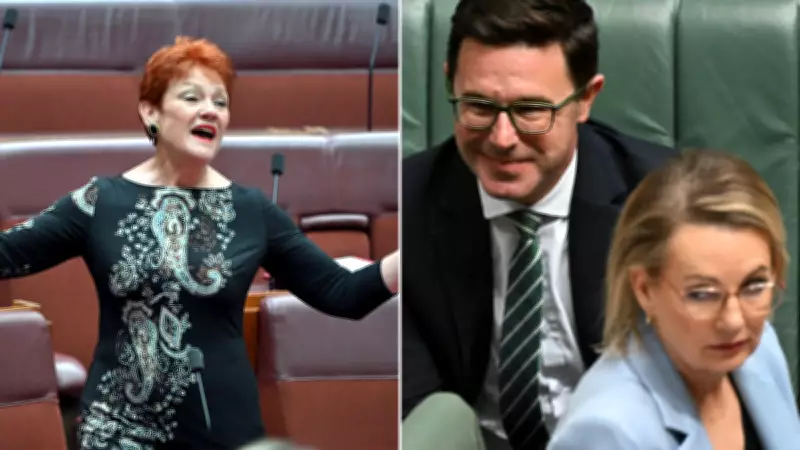
Pauline Hanson has declared that forming a coalition between One Nation and the Liberal and National parties is the "only way" to beat Labor in an upcoming election. This bold statement comes as recent polling data from DemosAU indicates a significant shift in Australia's political landscape.
Polling Reveals One Nation's Surge
According to the DemosAU poll of 1933 Australians, One Nation is projected to overpower the Liberals and Nationals as the main opposition party if an election were held today. The poll suggests Labor would retain a majority in the House of Representatives, winning between 87 and 95 seats, while One Nation would secure between 29 and 36 seats.
In contrast, the Liberal Party is tipped to take between 9 and 18 seats, and the National Party between 1 and 5 seats. George Hasanakos, Head of Research at DemosAU, commented, "These projections demonstrate the dominance of Labor, given the current fragmentation on the right of Australian politics." He added that with a primary vote of 30 percent, the ALP would be on track for a similar majority to their current hold.

Hanson's Conditions for Cooperation
Despite her call for unity, Hanson expressed reservations about the current state of the Coalition. "Would I join up to the rabble that they are at the moment? No way in the wide world," she told Sky News. She cited threats of leadership spills and potential defections of members to One Nation as reasons for her hesitation.
However, Hanson emphasized her willingness to work with the Coalition to provide supply, stating, "I would work with them to give them supply." She believes that without a unified conservative vote, neither One Nation nor the Coalition will be in government, leaving Labor with a massive majority.
Preferred Prime Minister Rankings
The polling also revealed interesting insights into voter preferences for prime minister. Pauline Hanson has surpassed Liberal leader Sussan Ley as the second-highest choice for preferred prime minister, with 26 percent support. This is despite Hanson being ineligible for the position as a senator.
Prime Minister Anthony Albanese leads with 39 percent, while Sussan Ley's support has slumped to 16 percent, even falling behind the 19 percent of respondents who answered "don't know." This decline highlights the challenges facing the Liberal Party under her leadership.
Political Implications and Future Outlook
The rise of One Nation and the fragmentation of the right-wing vote could have profound implications for Australian politics. Hanson's proposal for a coalition aims to consolidate conservative forces to challenge Labor's dominance. As the political landscape continues to evolve, voters and analysts will be watching closely to see if such alliances can materialize and impact future election outcomes.