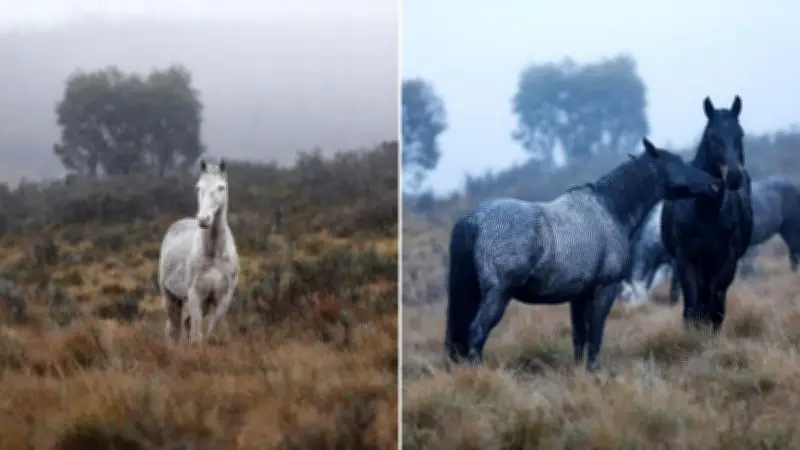
A fresh round of aerial culling will kick off in the Snowy Mountains next week, reigniting one of Australia's most divisive environmental fights — the future of the nation's iconic brumbies. The NSW government says the population in Kosciuszko National Park has surged again, with new estimates showing anywhere between 6,000 and 16,000 wild horses roaming the fragile alpine landscape. The numbers represent a dramatic rebound from 2024, when counts suggested as few as 2,131 horses remained.
Population estimates under scrutiny
The NSW Government's 2025 wild horse survey — prepared and peer-reviewed by independent experts — estimates 6,476 to 16,411 horses remain. It's understood this estimation was not a headcount but rather done by NSW government "independent observers" who surveyed parts of Kosciuszko National Park from helicopters, recording horse sightings along predetermined flight paths. Statisticians then used those observations to estimate the total population across the park. The survey's best estimate is 10,309 horses — which still means about 6,000 horses are expected to be culled.
However advocates for the protection of brumbies say a cull should not begin until a count in the national park is finished. "Australians deserve a formal, independent count… before a single further horse is killed," Brumby Action Group spokesperson Sarah Michaels said. Michaels questions the government's figures. "If there were 23,535 horses in 2022, and only 9,000 were formally removed, and the 2024 survey found fewer than 3,000 — where did 11,000 horses go?" she said. "And if the answer is that the original numbers were wrong then every cull conducted on the basis of those numbers was conducted without verified justification."

Environmental damage vs heritage
Environmental groups and the NSW Government argue the horses cause widespread damage — trampling waterways, destroying native habitat and threatening species like the broad-toothed rat and corroboree frog. The Invasive Species Council says the latest population surge has "big consequences for the wildlife, for the rivers," describing large herds as "trashing, trampling and polluting" the park. Horses and feral cattle do cause soil compaction, but brumby advocates claim the damage could be mitigated with better population management of the animals.
The government is legally required to reduce the population to 3,000 horses by mid-2027, a target set under its brumby management plan. Based on the government's own numbers, 3,000 to 10,000 horses could be shot within the first week of July. The plan still allows for trapping and rehoming of some brumbies, however, the Kosciuszko park's terrain is both remote and rough country to travel on, making trapping horses dangerous for both humans and horses alike.
Aerial culling resumes
The return of helicopter shooting has sparked fury among brumby advocates. On pro-brumby forums, some have slammed the new population counts as implausible, arguing the numbers could not have jumped from fewer than 3,000 to more than 16,000. Photographer Brumby Trails has documented several herds leaving the national park, showing herds in good condition with mares and foals. Animal Justice Party MP Emma Hurst said the government should be trialling fertility control, not "another bloodbath". Hurst said NSW authorities have repeatedly agreed to run trials using one-dart contraceptive technology used in the US — but none have begun. The NSW government said a report into contraceptive methods proved it wouldn't work on the population in the park, due to the large amount of horses, with the method only working for smaller herds in smaller areas.
Since aerial shooting began in late 2023 after a ban on culling was lifted, 6,686 horses have been removed — 6,041 through aerial shooting. NSW had banned aerial shooting of wild horses after the Guy Fawkes River National Park cull in 2000, when public concern followed reports of wounded horses, including one found alive days after the operation. Although an independent review found the cull was generally carried out humanely, the incident prompted a statewide ban that remained in place for more than two decades before aerial shooting resumed in Kosciuszko National Park under updated protocols.

Opposition to the cull
Federal Opposition Leader Angus Taylor has become the most high-profile political figure to oppose the cull of the Snowy Mountains brumbies. Speaking on Radio 2GB, he said he grew up riding through the region and developed a strong appreciation for the landscape and its brumbies. "I learnt that the locals cared for it deeply," he said. Taylor argued brumbies have been managed by local communities for generations, and criticised National Parks authorities for failing to control population numbers. "It has failed. It has failed abysmally, and we end up in this dismal situation we're in right now," he said. "They're conducting these culls which are not only inhumane but absolutely unnecessary." He also questioned official population estimates. "I don't think they have any real handle on the numbers," he said.
Foundation Franz Weber (FFW), an international conservation group, said its campaign to protect Australia's wild horses began almost four decades ago after learning of helicopter shootings of brumbies. "The large-scale slaughter of wild horses shocked the foundation, which launched an international campaign and brought the issue to the attention of the European public," it said. The campaign ultimately led the Swiss-based organisation to purchase Bonrook Station in the Northern Territory in 1989, creating what it describes as Australia's only protected reserve for brumbies. Viktoria Kirchhoff, the Australian representative and project manager for horse sanctuaries for FFW, said the 495sqm property gave brumbies a second chance. "Bonrook is the only protected reserve in Australia where a significant population of brumbies can live safely and freely in their family groups, undisturbed and unhandled," Kirchhoff said.
Scientific and cultural clash
The Invasive Species Council (ISC) has condemned what it calls a growing misinformation campaign surrounding feral horse management. "This debate has become detached from reality. A national park is being damaged by an invasive species and somehow the controversy is about whether we should stop it," CEO Jack Gough said. He said support for reducing horse numbers spanned political lines. "This is not a left versus right issue. It is a practical environmental management issue," he said. Wiradjuri man and ISC Indigenous Ambassador Richard Swain said the horses do cause extensive damage to the national park. "Kosciuszko is not just a postcard and it is not just a playground. It is living Country," he said in a statement via the ISC. "When the headwaters are trampled and the wetlands are smashed, that damage flows all the way down Country." He said heritage arguments often ignored the continent's First Nations people. "People talk about heritage, but they ignore the oldest heritage on this continent," he said.
NSW environment minister Penny Sharpe has strongly supported the cull in order to protect the famous alpine landscape. "Kosciuszko National Park remains one of NSW's most precious locations… there is more work to be done to protect its fragile alpine and sub-alpine environments," Sharpe said. "No one wants to have to kill horses. But there are still too many in Kosciuszko National Park."
Alternatives and future
Kirchhoff said the foundation believed brumbies held an important place in Australia's history and identity. "Brumbies are living descendants of Australia's colonial and pastoral history," she said. "For many Australians, brumbies represent resilience, freedom and a unique connection to the country's history and identity." The organisation remains strongly opposed to the NSW Government's wild horse management program in Kosciuszko National Park. "It is absolutely heartbreaking," Kirchhoff said. "For nearly 40 years, Fondation Franz Weber has demonstrated that humane alternatives to aerial shooting exist, yet governments continue to rely on one of the cruellest methods of wildlife management." She said the organisation believed money spent on aerial shooting could instead be directed towards "humane management measures such as relocation". Asked whether aerial shooting was ever acceptable, Kirchhoff said she was against any killing of horses. "No. Shooting horses from helicopters is inherently inhumane," she said. "When humane and practical alternatives exist, there is simply no justification for resorting to aerial shooting."
The cull is expected to begin Monday. Those interested in rehoming a wild horse can apply through the NSW government's website or contact the NPWS Wild Horse Team. Applicants need to satisfy NPWS that they have relevant experience in managing and handling wild horses, have no animal welfare convictions and have suitable land and facilities to hold them.