

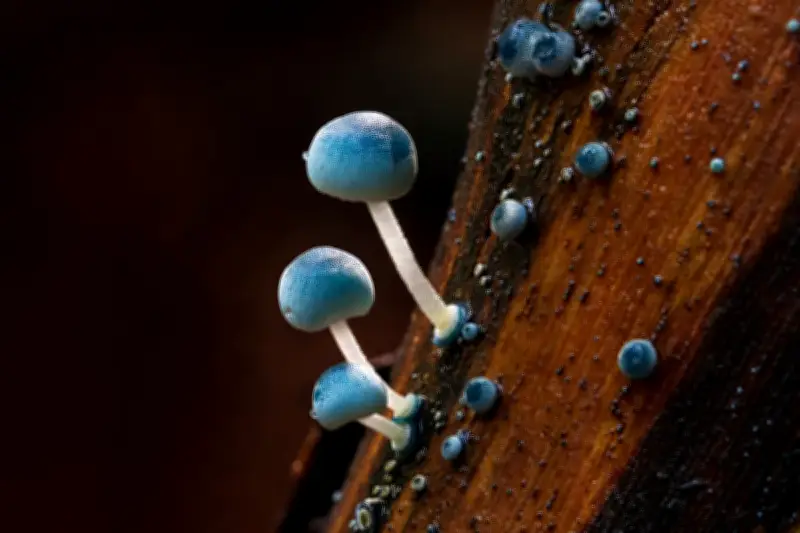
The Beaker Street Science Photography prize has announced its 12 finalists, featuring stunning images of blue mushrooms, glowing seas, shy trees, and more. The exhibition will be held at the Tasmanian Museum and Art Gallery (TMAG) during the Beaker Street festival from 6 to 17 August.
Blue Mushrooms and Shy Trees
One of the finalists, Ryan Shan, captured the mushroom species Mycena interrupta growing on decaying wood. As a saprotrophic fungus, it plays a vital role in breaking down organic matter and returning nutrients to the ecosystem.
Nathan Waterhouse's photograph titled "Shy" showcases crown shyness, the pattern of gaps that forms between neighbouring tree crowns. One hypothesis is that these gaps result from mechanical abrasion: as adjacent branches collide in the wind, it damages sensitive growing tips and limits further outward growth. The image shows a myrtle (Nothofagus cunninghamii) canopy.

Bioluminescence and Native Wasps
Deni Cupit's "Just Another Bioluminescent Tantrum" depicts bioluminescence from a large bloom of Noctiluca scintillans. These lazy microscopic organisms multiply in the millions and when agitated they glow blue, creating a vast shimmering coastline.
Keith Martin-Smith's "Absolute Precision" features a Darwin wasp using her sensitive antennae to detect the movements of a beetle larva deep in its tunnel in a tree trunk. Tasmania is home to more than 1,000 species of native wasp.
Alpine Transitions and Fungi
Chelsea Bell's "Alpine Overture" captures the "turning of the fagus" in Tasmania's alpine regions, one of the most spectacular seasonal events. The leaves of the deciduous beech (Nothofagus gunnii) transform from green to a vibrant tapestry of red, yellow and orange in autumn.
Amber Summers' "Trust Fall" shows fallen leaves of Nothofagus gunnii nestling in a cradle of wood in Mount Field National Park. Their vibrant copper hues are due to seasonal senescence: not just the process of ageing, but of chlorophyll degradation and nutrient resorption by the tree ahead of winter.
Charlie Chadwick's "Hygrocybe Firma" presents Hygrocybe firma, a fungus whose very small, red sporing bodies appear in Tasmanian forests in autumn. It has a biotrophic relationship with surrounding vegetation, where the mycelium lives inside or in close contact with plant roots.
Marine Life and Endangered Species
Alison McNeice's "Underwater Bouquet" features magnificent hydroids (Ralpharia magnifica) that look like a bouquet of underwater flowers but are related to jellyfish. They have tentacles with stinging cells that catch prey as it drifts past.
Francisco Albergoli's "My Home Is Being Eaten" shows a red handfish (Thymichthys politus), one of Australia's rarest endemic fishes, resting among algae being eaten by a short-spined sea urchin. With fewer than 250 individuals remaining in the wild, the species is on the edge of extinction.
Armando Ochoa Aguilar's "First Day" depicts one-day-old red handfish hatchlings still displaying a substantial yolk sac. This structure contains nutrients that provide the fish with a secure food source during its development and first days after emerging.
Insects and Chimaeras
Lucy Marwood's "Death Of Essence" captures the untimely death of an orange-rimmed satin moth (Thalaina selenaea) in Tasmania's Queenstown. The hydrophobic wing scales undergo disaggregation, giving the wing edges a visually frayed quality as the pigmented scales separate and drift slowly away.
Daniel van Duinkerken's "A Ghostly Chimaera" shows an Australian ghostshark (Callorhinchus milii) scouring the seagrass beds of the River Derwent. This is not actually a shark but a chimaera, a group of cartilaginous fish that branched off from sharks and rays nearly 400 million years ago.
Lunar Eclipses and Platypuses
Bronwen Gunning's "Lunar Spiral" depicts 24 separate photographs showing the progression of a total lunar eclipse through its many phases. The eclipse was designated a "blood moon" due to the reddish hue cast from Earth's shadow and atmosphere, and also a supermoon.

Alex Wheeler's "A Natural Wetsuit" features a platypus (Ornithorhynchus anatinus) with its two-layered fur for maintaining thermal homeostasis in Tasmania's cold freshwater environments. The outer coat consists of tightly packed guard hairs rich in natural oils, while beneath lies a layer of fine, wool-like underfur.
Pipefish and Satellite Trails
Nicolas Horniblow's "Pipe Dream" shows a spotted pipefish (Stigmatopora argus) photographed in the shallow seagrass beds of Trial Bay. Pipefish share the family Syngnathidae with seahorses, seadragons and pipehorses, all possessing tubular jaws and limited swimming ability.
David Nolan's "Satellite Trails Over Hobart Skies" highlights satellite trails as an increasingly visible sign of human impact on the night sky. As large constellations of satellites expand, long streaks of reflected sunlight appear in astronomical images, interfering with observations and altering the natural darkness of space.