

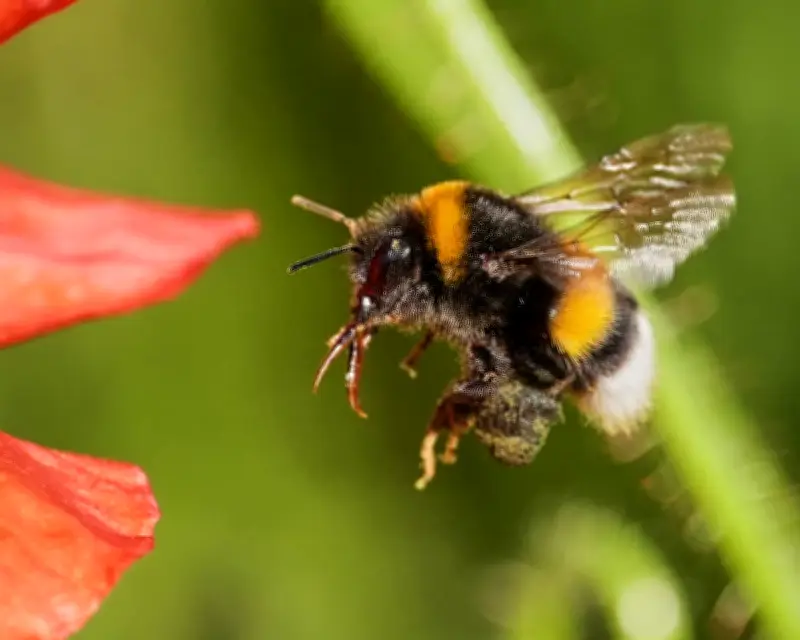
New research has revealed that bumblebees are capable of using tools to solve problems, demonstrating cognitive abilities far beyond what was previously believed. In a series of experiments, bees successfully rolled a polystyrene ball to a specific location and climbed onto it to access an artificial flower, a task that required planning and insight.
Challenging Assumptions About Insect Intelligence
For decades, scientists assumed that insects operated purely on instinct and simple trial-and-error learning. However, this study, published in the journal Science, challenges that view. Dr. Olli Loukola, a behavioral ecologist at the University of Oulu in Finland and senior author of the study, said, “Most people think insects are reflex-based machines. That they can’t have any emotional states or feel pain. Some people don’t even realize that they have brains. I hope that these results change the worldview about that.”
The Experiment: An Insect Version of the Box-and-Banana Problem
The bees, only a few weeks old, were first trained to associate a blue artificial flower with a reward of sugar water. During the test, the flower was moved to the ceiling of a transparent petri dish-style chamber, too high for the bees to reach but with insufficient space for them to hover. A small polystyrene ball was also placed in the chamber. To reach the flower, the bee had to roll the ball under it and climb on top—a behavior they had never encountered or been trained to perform. In the most basic version of the test, 75% of the bees successfully reached the flower.

“This is essentially an insect version of the classic ‘box-and-banana’ problem,” said Loukola. “The animal must realize that an object can be repositioned and then used as a tool to reach an otherwise inaccessible goal. What stands out about the result is that this kind of spontaneous problem solving is now demonstrated in an insect.”
Testing True Understanding
To ensure the bees were not simply enjoying rolling the ball or being attracted to the blue dot, the researchers designed more complex versions of the challenge. In the final setup, bees were allowed to explore two chambers—one with the artificial flower and one without—before the ball was introduced. The chamber was then illuminated with red light, preventing the bees from seeing the blue flower. To complete the task, the bees had to recall the location of the flower and position the ball beneath it. Remarkably, 23 out of 30 bees succeeded.
“We are not claiming that bees think like humans,” said Loukola. “But our findings show that miniature brains can generate flexible solutions to novel problems in ways we are only beginning to understand.”
Expert Reactions
Professor Lars Chittka, a behavioral ecologist at Queen Mary University of London and author of The Mind of a Bee, who was not involved in the research, said, “We’ve seen bees do all kinds of remarkable things in our lab: counting, impressive object manipulation—but they surprise me every time. This is the clearest demonstration yet of some kind of comprehension of what’s at stake.”
Chittka added, “There’s a general perception that intelligent behavior requires big brains because we are big-brained and relatively intelligent among animals. Bees are a model of how much intelligence you can squeeze into a small nervous system. It’s a good reminder of there being a motivation to pay some respect to these other beings.”
The findings add bees to the elite list of species—including primates, elephants, and crows—capable of solving the classic box-and-banana problem, demonstrating that even tiny brains can exhibit remarkable cognitive flexibility.