The 2026 World Cup has seen an unusually high number of red cards, with eight players sent off in the first week, matching the total from the previous two tournaments combined. The most recent dismissal came when Paraguay's Miguel Almirón was shown a straight red for covering his mouth while speaking to an opponent in a confrontational situation, a rare offence that has sparked debate.
Record-Breaking Red Cards in the Opening Match
In the opening match between Mexico and South Africa, two South African players—Sphephelo Sithole and Themba Zwane—were sent off, making South Africa the 15th team to have two players dismissed in the same World Cup match. Mexico's César Montes also saw red in stoppage time, following in the footsteps of his manager Javier Aguirre, who was sent off while playing for Mexico in the 1986 quarter-final against West Germany. This match was the seventh World Cup game to feature more than two red cards.
Belgium's Nathan Ngoy was sent off in a goalless draw with Iran, becoming the eighth player dismissed at the 2026 tournament, matching the combined total from Russia 2018 (four) and Qatar 2022 (four).

The Netherlands: A History of Aggression
The Netherlands have been at the centre of several red-card controversies. In the 2006 'Battle of Nuremberg' against Portugal, four red cards were shown—the only World Cup match with that many. The match featured 16 yellow cards, with Mark van Bommel fouling Cristiano Ronaldo in the second minute. Khalid Boulahrouz also targeted Ronaldo, who left the pitch in tears before half-time after Maniche scored the only goal. Costinha received the first red card for deliberate handball, and Petit was booked minutes after coming on as a substitute. Luís Figo was fortunate to receive only a yellow for head-butting Van Bommel.
In the 2022 quarter-final against Argentina, the referee issued 18 yellow cards (16 to players and two to coaching staff) in a physical match that Argentina won on penalties. Argentina players celebrated in the faces of the Dutch after the shootout.
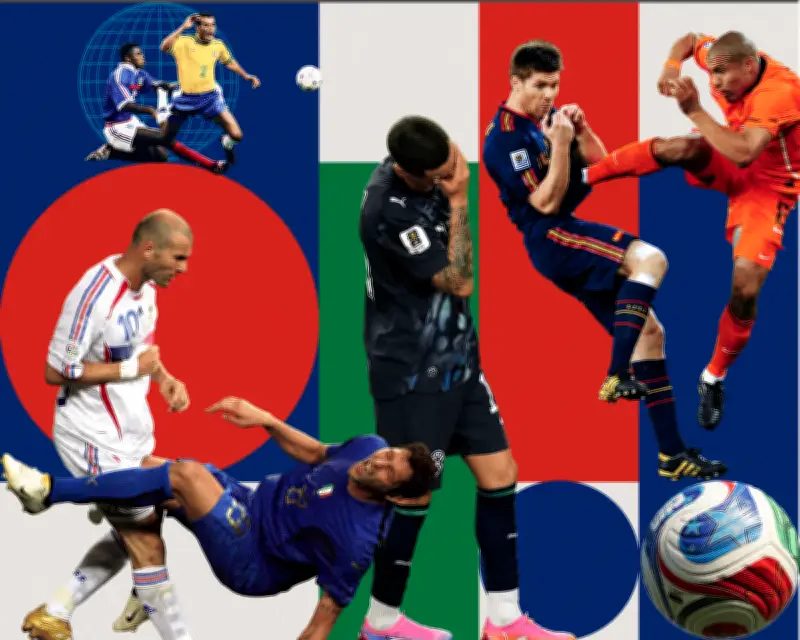
The 2010 final against Spain saw 14 yellow cards, with eight of the Netherlands' starting XI booked. John Heitinga was sent off for two bookable offences, but Nigel de Jong escaped a red card for planting his studs on Xabi Alonso's chest. Referee Howard Webb later admitted: 'One of the things I would change is the colour of the card for De Jong's tackle. Having seen it again from my armchair several times in slow motion and from different angles I can see that it was a red-card offence.'
Red Cards in World Cup Finals
Heitinga is one of five players sent off in a World Cup final. The first dismissal in a final came in 1990, when Argentina's Pedro Monzón was sent off 20 minutes after coming on as a substitute, followed by Gustavo Dezotti. In the 1998 final, Marcel Desailly was sent off for a second yellow after tripping Cafu, but France still won 3-0 against Brazil.
Zinedine Zidane scored twice in that 1998 final and won the Ballon d'Or that year. Earlier in the tournament, he was sent off for stamping on a Saudi player. Eight years later, in the 2006 final, he head-butted Italy's Marco Materazzi (who had been sent off earlier in the tournament), becoming the second Frenchman dismissed in a final. Zidane is one of two players sent off twice at World Cups, along with Cameroon's Rigobert Song (1994 and 1998).
The First World Cup Red Card
The first sending off at a World Cup occurred on the second day of the inaugural 1930 tournament in Montevideo. Peru captain Plácido Galindo was dismissed in a 3-1 defeat to Romania, a match littered with fights that required police intervention. Red cards were not introduced until 1970.
Nearly a century later, Miguel Almirón made history with his red card for covering his mouth while speaking to an opponent. This article is by Richard Foster, who presents the It Started With A Kick podcast and writes a daily World Cup quiz on the Seventh Heaven app.