
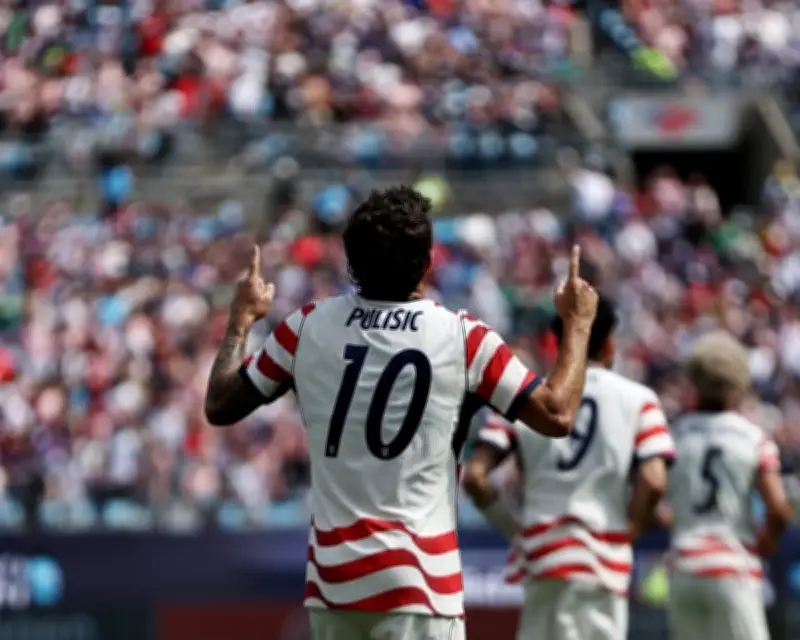
Christian Pulisic’s bible study is an important part of his spiritual life. In the third episode of his nine-part docuseries, Pulisic sits at a dining table with pink orchids behind him. A friend asks, 'It is what time?' Pulisic answers, 'Bible time,' as he thumbs through the Bible with a pencil between his fingers and a notepad ready. A cross dangles from his necklace.
Pulisic’s faith is no secret. He has posted underlined Bible passages on Instagram. Fellow USMNT star Weston McKennie’s Instagram bio reads, 'All glory to God.' His profile picture shows him pointing two fingers to the sky, with cross-shaped diamond earrings. Defender Chris Richards is also outspoken about his faith, sharing that he and about 10 Crystal Palace teammates pray together before games and hold Bible study. Goalkeeper Matt Freese, a devout Catholic, mentioned meeting Pulisic in a Bible study session.
Head coach Mauricio Pochettino, a Catholic, wears a bracelet depicting a patron saint. When he took over Espanyol in 2009, he hiked 7.5 miles to the Montserrat shrine to pray for the club’s survival from relegation—and it worked. At the last World Cup, the USMNT roster included Walker Zimmerman, a pastor’s son who proclaimed his faith; Yunus Musah, a Muslim who fasted during Ramadan even on match days; and DeAndre Yedlin, a Buddhist who led teammates in post-match meditations in Qatar.

This marks a radical change in the team’s public engagement with religion. Historically, few USMNT stars were vocal about their beliefs. Clint Dempsey gave one interview about his faith to Sports Spectrum around the 2014 World Cup. Tim Howard was in the Fellowship of Christian Athletes but rarely spoke publicly. Jozy Altidore said he was 'raised as a Jehovah’s Witness' but didn’t elaborate. Landon Donovan appears to be an atheist. We still don’t know the beliefs of Cobi Jones, Tab Ramos, Alexi Lalas, Marcelo Balboa, Michael Bradley, or DaMarcus Beasley.
The contrast is remarkable. The USMNT’s openness about religion comes against the backdrop of a governing party that trades on demonstrative religiosity. The Trump administration has empowered Christian nationalists and seeks to remake the nation as overtly Christian. The players’ proclamations seem sincere, but they also signal a generational shift where professional athletes feel freer to express views than their predecessors.
Professional athletes making religion visible is not new, but it is a departure for the national team, where public engagement rules differ. US Soccer once banned kneeling during the national anthem, then scrapped the ban three years later, arguing that protesting in national colors is different than under a franchise banner. Leveraging World Cup visibility to evangelize muddies national sporting neutrality. This has gone wrong before, like when Team USA’s militarism at the World Baseball Classic made them the only un-fun team in the tournament.
However, the team’s stars feeling confident to be their fullest selves in the spotlight may be positive. This generation of US players has been largely indifferent to media, but when the nation gets to know them better, it will learn more about their convictions than any previous incarnation. Leander Schaerlaeckens, author of The Long Game: U.S. Men’s Soccer and Its Savage, Four-Decade Journey to the Top, teaches at Marist University.