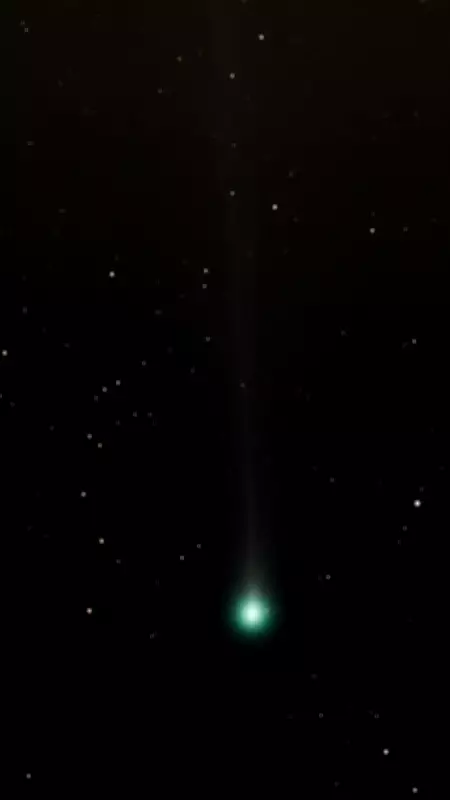
A rare comet has appeared in Western Australian skies, offering a unique opportunity to witness a piece of space history this week. Comet C2025-R3 PanSTARRS was first discovered in Hawaiian skies in September, when the celestial body was traversing the northern hemisphere.
Researchers from the Haleakala Observatory revealed that the icy body originated from the Oort Cloud, on the outskirts of the solar system, and has likely existed for hundreds of thousands of years. Since its discovery, the blue-and-green comet has slingshot around the sun and is now touring Earth's southern hemisphere, with WA locals fortunate enough to be in a prime viewing location.
Rare Phenomenon
Perth Observatory tour administrator Matt Woods told PerthNow that this is a rare phenomenon, with the PanSTARRS comet not likely to return to Perth for hundreds of thousands of years — if ever — due to its extremely long orbit.

"This comet is a relic from the birth of the solar system, a frozen archive of cosmic history, and for a brief moment, it's visible from right here in WA," Mr Woods said. "These comets are often one-time visitors because gravitational interactions with planets, particularly Jupiter, can eject comets from the solar system entirely. So when you look up and spot this comet, you may be witnessing something that has not passed this way since long before human civilisation, and may never return again."
How to See the Comet
The comet is the first to cross WA skies so far in 2026, and many space enthusiasts have already caught a glimpse of it. David Nicolson, amateur astronomer and former head of the Gingin Observatory, told PerthNow he was able to capture images of the rare phenomenon at Watermans Bay using a telescope.
"The comet is not 'naked eye' visible but fairly easy to see as a dull blob using binoculars or even a small telescope," he said. "You will need a camera with a time exposure of at least 30 seconds, however, to see the tail."
Viewing Tips
The PanSTARRS comet will be visible in the WA sky after sunset for the next week. For the best chance to see the comet:
- Head outside around 6:30 pm
- Look low toward the western horizon
- Choose a location with a clear view, such as a beach or open coastline
- Use a pair of binoculars, a telescope, or a camera with a telephoto lens
Camera IconComet C/2025 R3 pictured after sunset in Perth. Credit: Perth Observatory/Facebook