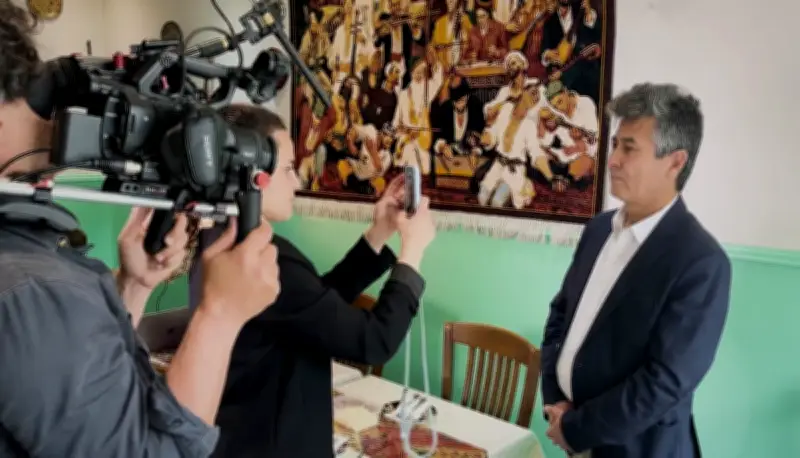
Restaurateur Ablikim Rahman was photographed before the creation of his AI avatar for the film Synthetic Sincerity. The image shows him smiling, unaware of his digital transformation.
One Director’s Audacious Fightback Against AI
Marc Isaacs’ latest film, Synthetic Sincerity, may appear to be a documentary, but its fictional premise—a lab that scrapes movies to harvest human emotions—shines a harsh light on the capabilities of artificial intelligence. Isaacs, known for his subversive documentaries, reveals in the film that an AI research laboratory licensed his entire body of work, spanning 25 years of studies on ordinary British life. These include Lift, about a London tower block; The Curious World of Frinton-on-Sea, set in a retirement town; and Philip and His Seven Wives, featuring a furniture dealer claiming to be a Hebrew king.
Isaacs agreed to let data analysts at the University of Southern England feed his documentaries into their system to extract authentic human emotions for creating AI characters. However, the University of Southern England is entirely fictional, as Isaacs admits over lunch at Etles, a Uyghur restaurant near his London home. The chef and owner, Ablikim Rahman, appears in the film being photographed and turned into an avatar. Rahman, making his film debut, has not yet seen the movie.

The film’s writer, Adam Ganz, explains that inventing a fictitious university meant they didn’t need anyone’s permission. Isaacs has not actually been approached to license his work for AI, but he has heard of others who have.
Blurring Reality and Fiction
Isaacs and Ganz use artificiality to explore places that straightforward documentaries cannot reach. Their previous films, The Filmmaker’s House and This Blessed Plot, also departed from documentary convention, featuring non-actors performing scripted scenarios. This technique, popular in Iran with films like Abbas Kiarostami’s Close-Up, is less common in the UK, where scripted reality is often associated with TV shows like Made in Chelsea.
Isaacs, admired by Louis Theroux, has always rejected the idea of pure documentary. In his 2014 film Outsiders, he filmed conversations at a roadside van without revealing that customers were pre-cast. When TV channels demanded sensationalist “docbusters,” Isaacs ventured into hybrid forms to wake himself up from industry complacency.
He remains pessimistic about mainstream documentary, criticizing Netflix productions like Beckham. Ganz adds that British documentaries once showcased diverse lives, but now ordinary people are being erased. They both cringe at Sofia Coppola’s Marc by Sofia, calling it “like watching AI.”
Synthetic Sincerity as an Antidote
Synthetic Sincerity addresses the AI revolution, democratization of images, and authenticity, while touching on Israel’s bombing of Lebanon, the displacement of Uyghur people, and pro-China censorship in UK universities. The film features a comic double-act between Isaacs, appearing in his own film for the first time, and a female AI avatar who flatters and provokes him. The avatar is played by Ilinca Manolache, who used an AI filter in Radu Jude’s Do Not Expect Too Much From the End of the World and is now shooting Martin Scorsese’s What Happens at Night.
Isaacs filmed Manolache on Snapchat and fed the results through AI. He is surprised that not everyone realizes the film’s premise is a put-on. At a festival in Thessaloniki, a viewer complained that the film made him doubt what he saw. Isaacs notes that truth has always been complicated in documentaries.
The film’s form and content are harmoniously matched, with anxieties about AI mirrored in viewers’ suspicions about what is real. Isaacs incorporates footage from an unaired BBC documentary about a fake Iraq war veteran, highlighting that inauthenticity is not unique to AI.
Isaacs believes that raising questions is the point, not providing answers. He and Ganz are cautiously practical about AI, suggesting it could be used for fight sequences. Isaacs did not want to make a dystopian film; instead, he highlights scenes where AI gives Rahman a voice to say things he cannot say himself. He awaits an auteur doing something extraordinary with AI, but doubts it will create a new industry.

When asked how AI has impacted his work, Isaacs admits to running script ideas past ChatGPT during preparations for their next film, set among London’s Romanian community. Some suggestions were not bad, but his co-writer’s response was blunt: “Fuck off.” Synthetic Sincerity is in UK cinemas from 17 July.