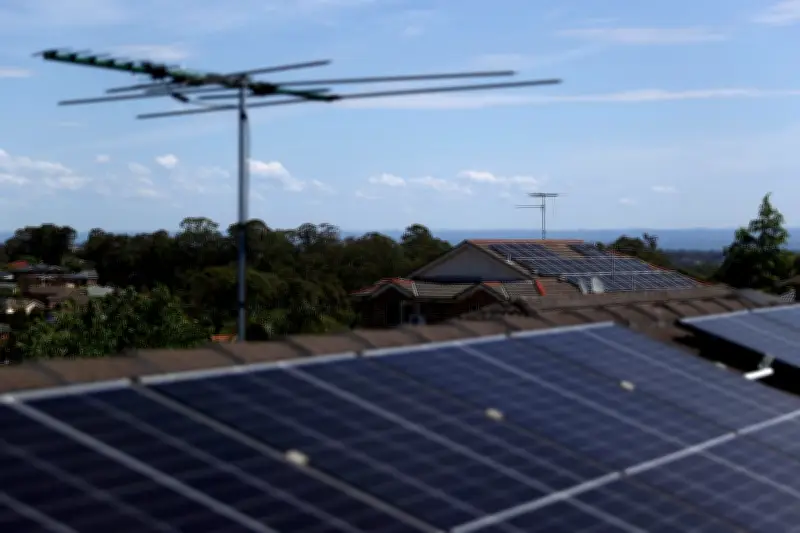
A new report from the Institute for Energy Economics and Financial Analysis (IEEFA) reveals that Australia's rooftop solar revolution has largely bypassed commercial and industrial buildings, with installations lagging significantly behind homes. Australia leads the world in residential solar per capita, with 22 gigawatts (GW) installed as of last December. However, businesses have installed only about a quarter of that—5.6 GW—despite consuming more electricity than households.
The report's authors argue that helping Australian businesses fill roof spaces with solar panels could play a major role in adding power generation as coal plants close. The commercial and industrial sector must "play a far larger role in accelerating Australia's energy transition… if the country is to meet its renewable energy targets," the authors wrote.
Commercial and Industrial Solar Potential
Commercial and industrial solar can be deployed faster than utility-scale alternatives because it generally does not require extensive planning and environmental approval processes, nor new transmission build that can add several years to rollout. The analysis defines commercial and industrial solar as non-residential, non-utility energy users such as manufacturers, retailers, farms, hospitals, and schools.

Co-author Johanna Bowyer, lead Australian electricity analyst at IEEFA, noted that the power-generating capacity installed on household roofs in Australia is "roughly equal to that of the coal plants in our grids." However, she added, "We have not seen the same scale of action within Australia's commercial and industrial buildings, even though they consume substantially more electricity than the household sector."
Forecast Capacity and Barriers
The forecast capacity of the sector is between 17 and 31 GW by 2050. "Storage deployment is well behind households, though demand is increasing quickly," the report noted. "The technical rooftop potential could be higher than that," Bowyer said. "If you also include agricultural areas, it could be above 80 GW of technical potential."
Commercial loads in the national electricity market are higher in the middle of the day, which is well-suited to solar generation. The IEEFA analysis identified four key barriers to uptake: businesses often rent their premises, making investment in long-lived assets complex; inconsistent network tariff structures; and slow, often unpredictable grid connection processes.
"Tenants might want upgrades because that will reduce their energy bills, but the landlord is the final decision-maker," Bowyer said, adding that business owners may not have confidence that their lease will be long enough for the upgrades to be paid back.
Policy Recommendations
The report also suggests business premises are the "missing middle" because systems are typically too large for residential incentives, such as the Cheaper Home Batteries Program, but too small for the utility-scale Capacity Investment Scheme. "We've recommended that governments look at incentive schemes that can support this missing middle," Bowyer said, suggesting an increase to the instant asset write-off for systems and batteries over a certain size.
The report also recommends review and standardisation of network tariffs, and reform of the economic regulation of distribution services. In Victoria, the opposition has proposed creating "urban solar parks" to encourage solar and battery installations on commercial and industrial rooftops in greater Melbourne, arguing it would reduce the need for additional transmission lines.
"There are thousands of hectares of roof space on warehouses, factories, buildings in urban areas where we can be putting up solar farms with battery power and using the energy closer to where it's stored," state Nationals leader Danny O'Brien said last month. However, experts have said increasing rooftop solar is not a viable replacement for building transmission lines. "Victoria's already got pretty good incentives for commercial and industrial solar," Bowyer added.