Seventy years ago, Earth had only one natural satellite: the Moon. Today, it hosts more than 15,000 artificial satellites, with roughly 10,000 owned by Elon Musk's SpaceX. The world's first trillionaire plans to launch one million more satellites, each about 70 metres long and 20 metres wide, forming a data centre megaconstellation. However, more satellites mean more space junk, already threatening critical infrastructure. Addressing this requires work across technology, policy, and philosophy.
13 million cane toads worth of space junk
Space junk encompasses everything in Earth orbit without a purpose: discarded rocket bodies, defunct satellites, and fragments down to nanoparticle size. Currently, there are 36,000 pieces larger than ten centimetres and tens of millions of smaller pieces. The total estimated weight is 13,486 tonnes, equivalent to 13 million adult cane toads. The United States, Russia (including the former USSR), and China are the biggest contributors.
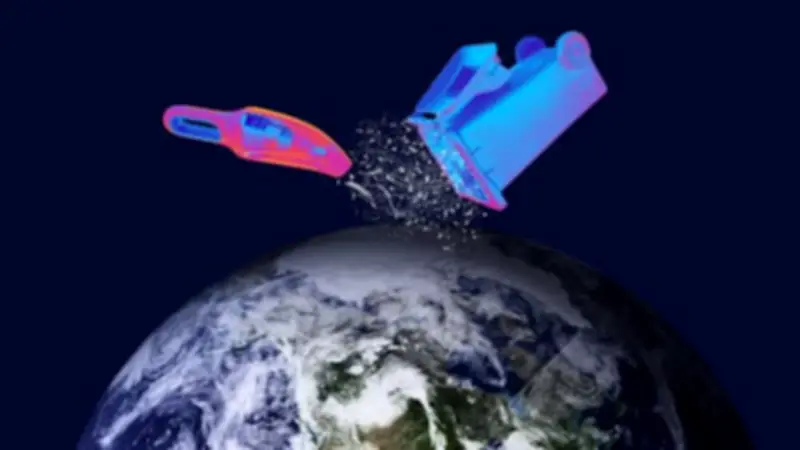
Space junk travels at average speeds of 7 kilometres per second in low Earth orbit. A collision can shatter a satellite, creating more debris. The worst-case scenario, Kessler syndrome, involves a cascade of collisions that could render regions of orbit unusable or even cut Earth off from space. Human spaceflight is already at risk; the International Space Station manoeuvres to avoid collisions at least once a year.

The default solution is letting space junk burn up in the atmosphere. At least one Starlink satellite incinerates daily, but this produces soot and alumina particles that harm the ozone layer, which shields us from ultraviolet radiation.
New technology can help
Technological solutions include active debris removal and strategic satellite design. Active removal tips old spacecraft into the atmosphere or pushes them into a graveyard orbit. A hit list of the 50 most dangerous spacecraft—mainly abandoned rocket bodies—guides removal efforts. Technologies under development include nets, magnets, tethers, sails, slingshots, and harpoons, though few have been successfully tested in space.
New satellites can be made from more durable materials to last longer, or more disposable for quick de-orbiting. Japan is testing wood as a spacecraft material. Refuelling spacecraft to extend their life is another option.
Better policies
Policies now focus on satellite end-of-life disposal. The old standard allowed spacecraft to remain in orbit for up to 25 years after mission end; the new standard is five years. However, this increases atmospheric burn-up. The European Space Agency leads a zero debris policy, and the Inter-Agency Debris Co-ordination Committee issues mitigation guidelines. An international standard for space debris mitigation also exists.
Space traffic management could establish road rules for orbit, limiting debris creation, coordinating activities, and sharing information. Yet no globally agreed system exists. Satellite operators are beginning to take environmental responsibilities seriously, but questions remain about sufficiency.
Rethinking space
Old ideologies—competition for prestige and orbital resources, and a belief that space has no moral obligations—drive the junk problem. Orbital space is often not seen as an environment because it lacks life. This mindset pervades the techbro space, where billionaires compete to launch megaconstellations. Research indicates that caring for the environment is not viewed as masculine.
Earth and space are no longer separate. Space junk should be managed as a more-than-planetary system extending from the ocean floor spacecraft cemetery, through the atmosphere, to all orbits and the Moon. The Moon's surface is also affected. Philosopher Val Plumwood's co-participation approach suggests giving the environment what it needs to flourish, rather than depleting it to collapse.
Whether Kessler syndrome will eventually cut us off from space remains uncertain. New myths and stories may arise around space junk burning through the atmosphere. Watching for cultural meteorites is becoming part of the shared human experience.