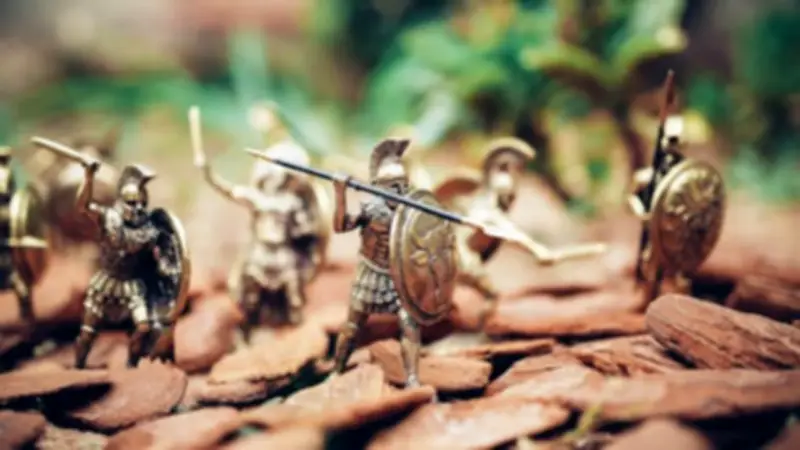
In 1880, in the village of Chaironeia in central Greece, Greek archaeologists made a remarkable find: a largely undisturbed mass grave of 254 ancient soldiers, some of whom are buried arm in arm. The men in this grave were clearly a special group, and it has generally been assumed that they were the dead of the Theban Sacred Band (hieros lochos) – an elite fighting unit made up of 150 pairs of male lovers, fighting side by side.
Origins and Purpose of the Sacred Band
The Sacred Band had been set up in about 378 BCE, after the people of Thebes (in central Greece, north of Athens) had freed themselves from a brief period of rule by the regional superpower of that era, the Spartans. This elite unit was a professional force of 300 heavily armed infantrymen who fought in Thebes’ wars, in central Greece, north into Thessaly, and south into the Peloponnese, used either as shock troops or as a bulwark of defence.
Historical Evidence: Plutarch and Plato
As always in Greek history, the evidence is problematic. Much of it comes from Greek-Roman philosopher Plutarch, writing 500 years later but using earlier sources now lost to us. And even Plutarch is cautious. In his text Life of Pelopidas 18.1–2, he relies on vague language, writing: “Some say that this band was composed of lovers and beloved […] since the lovers are ashamed to play the coward before their beloved, and the beloved before their lovers, and both stand firm in danger to protect each other.”

The philosopher Plato, writing many hundreds of years earlier – possibly a little before the Sacred Band was formed in about 378 BCE – wrote in his famous Symposium 178e–179a of how good a military force composed of lovers would be. They would, one of the speakers in the dialogue claims, fight for each other and to avoid disgrace in each other’s eyes: “Therefore, if it could be arranged that a city or an army be composed of lovers and their beloveds, what better way might they organise their affairs than by abstaining from all shameful actions and prizing honour in one another’s eyes? And if such people were to fight alongside one another, even a few of them might, to coin a phrase, conquer the whole human race. For a man in love who was breaking rank or throwing away his weapons, would of course much rather be seen by anyone else at all than by his beloved. Instead of that he would choose to die many times. As for abandoning his favourite or not assisting him in the hour of danger, well there is none so base that Eros could not inspire him towards excellence, to be equal by nature to the very best.”
Social Context: Lovers and Beloveds
The distinction made in these passages between “lovers” (erastai or agapontes) and “beloved” (eromenoi or paidika) reflects the fact that in ancient Greece sexual relationships were rarely between people of the same age. In Athens, first marriages were usually between a man in his late 20s and a girl of about 14. Similarly, homoerotic relationships, which were very common, were typically between an older man and an adolescent youth, anywhere from maybe around 12 (based on vase paintings) to whenever the adolescent started to grow a beard. Erastai (lovers) were not exclusively homosexual: they would normally also marry and have children (as, one day, would their eromenoi, or beloved). These were sexual relationships but this hasn’t always been openly acknowledged by historians. 19th-century Classicists mostly sought to shield the Greeks from the imputation that they had engaged in gay sex. Today, the worry is more about under-age sex. The erastes–eromenos relationship had an aspect of mentoring but, within social demands of the time for a certain modesty, it was also clearly sexual.

Age and Combat Readiness
The problem with the Theban Sacred Band is that the eromenoi would need to be old enough to face the enormous physical challenges of battle, normally reserved for men over about 20. That implies different social mores in Thebes from those at Athens. In Athens, there were lifelong gay couples, including two of the characters in Plato’s Symposium, but they could often be the target of mockery. Athenians especially thought there was something shameful in an adult man being the “passive partner” in gay sex. But possibly attitudes were different at Thebes, where gay couples seem to have pledged their love to each other at the tomb of Iolaos, the eromenos, or beloved, of Herakles (sometimes known by his Roman name Hercules). The couples who made up the Sacred Band may have come together when the younger one was an adolescent and simply continued into adulthood. Were they still sexual partners? Well, a passage in Greek writer Xenophon’s own text (also called Symposium, possibly written in answer to Plato’s work of the same name) explicitly and critically refers to soldiers who fought together and were also sleeping with each other. So, probably yes.
Legacy and Final Battle
Although some ancient historians remain sceptical, since the 19th century the story itself – whether true or not – has been inspirational to many. The Theban Sacred Band came to be known for their strength, discipline, and ferocity. Among their most famous successes was the important role they played in defeating the once powerful Spartans at the Battle of Leuctra in 371 BCE, which ended Spartan supremacy. The men of the Sacred Band of Thebes died in the Battle of Chaironeia in 338 BCE, when Philip of Macedon and his son Alexander (later known to the world as Alexander the Great) defeated Greek forces led by the cities of Thebes and Athens. Maybe these soldiers, discovered arm in arm in a mass grave in central Greece more than 2,000 years later, really were lovers who died together in the Band’s final defeat. Today, the site is marked with a statue of a lion – symbolic of this elite fighting unit’s pride and strength.