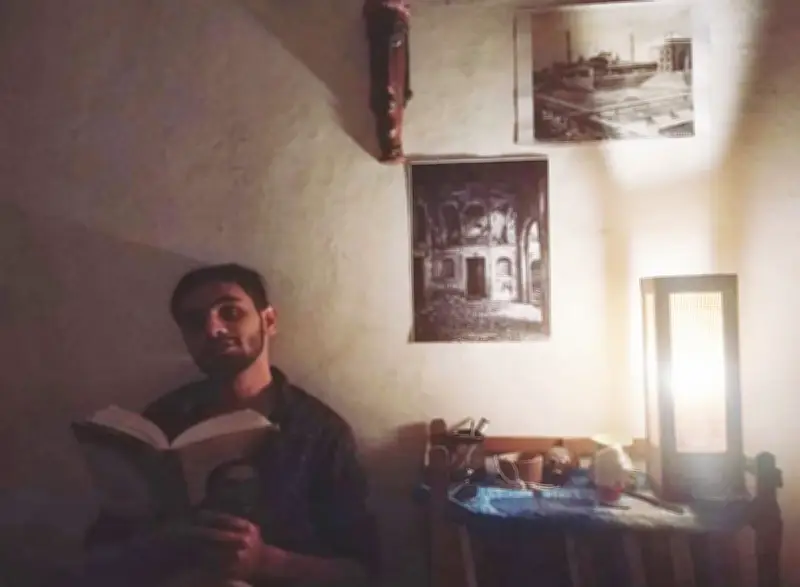
Prison is hardest at sunset. As thousands of prisoners in Delhi's most infamous jail are cast into the dank yard until darkness falls, inmate number 626714 feels the punishing dread rise. Yet the inmate—better known as Umar Khalid—recently discovered that another political prisoner, exiled thousands of miles from India more than 150 years ago, wrote of the same feeling. 'Even Dostoevsky refers to this state of mind at sunset in his prison memoir,' Khalid said in his first interview since being jailed in 2020. 'I guess maybe it is because it starts sinking in that another day of your life has been spent in captivity.'
A Symbol of Crackdown on Dissent
Outside Tihar prison, few in India do not know Khalid's name. He rose to prominence as a student rights activist and then the face of the 2019 anti-government protests—the first major challenge to Narendra Modi's government. By September 2020, he was arrested on terror charges, accused of being a 'key conspirator' in Delhi's deadly religious riots and conspiring to bring about 'violent regime change.' TV anchors call him a Muslim terrorist and anti-national; leftwing activists wear T-shirts bearing his face. For rights groups, Khalid epitomises the crackdown on dissent under Modi's Bharatiya Janata Party (BJP), which has ruled for 12 years and stands accused of weaponising the judicial system against opponents.
Khalid, a Muslim and leftwing rights activist, is a fierce critic of the BJP's Hindu nationalist agenda, which seeks to turn India from a secular country into a Hindu nation. He accuses the Modi government of fuelling harassment and persecution of India's 200 million Muslims and other minorities. The BJP denies all allegations of religious discrimination. International human rights groups have condemned Khalid's nearly six years in jail without trial as unjust. New York Mayor Zohran Mamdani sent him a handwritten note of solidarity, prompting an enraged response from the Indian government. The BJP maintains India's judicial system is independent and that Khalid's prosecution is not political.

The Toll of Incarceration
Due to prison conditions, the Guardian could not meet Khalid; questions and answers were conveyed via family and friends. After years facing allegations he denies and a propaganda machine beyond his control, the 38-year-old admits it has been hard not to unravel completely. 'When you are reduced to just an image, either negative or positive, it becomes difficult to maintain not just your humanity but even your sanity at times,' he said. 'Even those who sympathise with you, or portray you as someone larger than yourself, forget that I am a human being with my own share of vulnerabilities, fears and imperfections. And that these long years in prison have wreaked havoc on my mind and body and exacerbated all these anxieties within me.'
His years in jail have not softened his position on the Modi government. As Hindu nationalism has become dominant, Khalid describes his horror at the 'normalisation and glorification of hate speech and genocidal language.' Today, he said, 'the process of India becoming a post-truth society is near complete.' We agreed not to discuss his legal case or conditions in Tihar, but Khalid made clear that staying silent was not an option. 'You even hear murmurs about yourself from fellow prisoners you shared meals with, calling you a terrorist behind your back. This propaganda dehumanises me in people's eyes. Humanity is a privilege that is not granted to people like me.'

From Student Activist to Political Prisoner
Growing up in the Muslim-majority neighbourhood of Jamia Nagar in south-east Delhi, Khalid witnessed first-hand how Hindu nationalist politics fractured society along religious lines and stripped Muslims of their rights. 'I grew up in a Muslim ghetto at a time when Muslims were increasingly oppressed, marginalised and demonised,' he said. 'For any sensitive person, it is simply not possible to remain unaffected.' While studying for his PhD at Jawaharlal Nehru University (JNU), Khalid embraced student politics. He was catapulted to prominence when the university found itself in the cross-hairs of rightwing ideologues seeking to tear down a bastion of leftwing activism. After participating in a political event at JNU in 2016, he was arrested for sedition as polarised media condemned him as an 'anti-national' threat. 'My life was never the same,' he said. The university tried to prevent him submitting his PhD thesis, which he successfully challenged in high court; it will be published this month as his first book, Fractured Communities.
Khalid's collision with the BJP government peaked in 2019 after the government passed a citizenship law seen as discriminating against Muslims. JNU became a focal point for protests; hundreds of thousands marched in Indian cities in one of the first significant political challenges to the Modi regime. Khalid was a key rallying figure. 'We won't respond to violence with violence. We won't respond to hate with hate,' he told crowds in a now-famous speech. 'If they spread hate, we will respond to it with love.'
The Delhi Riots and Arrest
The state was unforgiving. Protests were met with deadly police violence; BJP-linked figures voiced inflammatory anti-Muslim rhetoric. Sectarian riots erupted in Delhi in February 2020. Hindu mobs rampaged through the capital, targeting mosques and those with Muslim names or circumcised; some Muslims retaliated. The violence lasted three days; of 53 dead, the majority were Muslim. But Delhi police charge sheets accused no BJP figures and very few Hindu rioters. Instead, Khalid—1,000 miles away at the time—was accused of 'masterminding' the riots. He and over a dozen other human rights defenders and student activists were accused of 'engineering communal riots' to coordinate a 'pre-planned attack on the nation' through 'armed rebellion.' Khalid described the charges as 'dystopian.' Police arrested him at his family home seven months later under India's most punishing terrorism laws. Since then, Delhi police have faced accusations of fabricating evidence and forging witness statements in Delhi riots cases; they have not responded.
While others named in the same case have been granted bail, Khalid's case remains a poisoned chalice. Judges tasked with ruling on his bail have repeatedly delayed, adjourned, and recused themselves; all have denied his applications. The BJP denies any involvement in his case but has openly welcomed rejections of his bail requests. The endlessly dashed hopes for freedom have been 'quite heartbreaking,' Khalid said. 'Slowly hope started dying out. And without having hope to hang on to, surviving prison becomes exceptionally difficult—it takes a huge toll on you emotionally, mentally, and physically.' He remains in jail while the police investigation continues with no clear end and no trial date in sight.
Frustration with Silence
Khalid does not hold back his frustration at the failures of the diminishing opposition to Modi to stand up for rights of the growing number of political prisoners incarcerated since the BJP came to power. Some, including activist Father Stan Swamy, have died behind bars. 'Six years down the line, I must say that I am really disappointed and even feel isolated,' he said. 'This silence—of opposition parties, of civil society groups, of celebrity activists who have made a career out of piggy-backing on people's movements—emboldens this regime to go after further dissidents.' Nights are when Khalid finds peace. Once back in his cell, as the jangle of the warden's keys fades to quiet, words scribbled on his wall—quotes from his journal—give him solace. Next to a picture of anti-colonial revolutionary Bhagat Singh, Khalid has scrawled his famous words: 'I am that mad soul who is free even in captivity.'