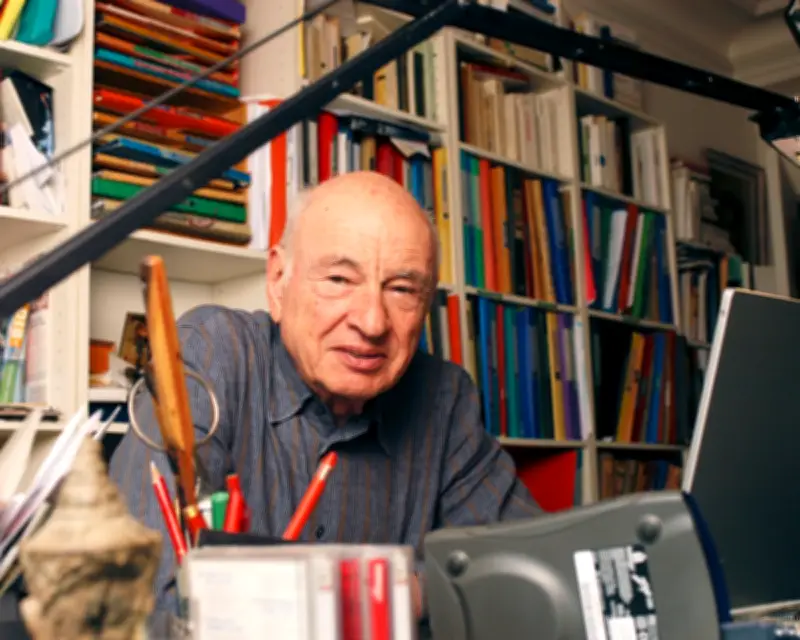
Edgar Morin, the French sociologist and philosopher who developed a transdisciplinary approach to the big questions of our time, has died aged 104. A free spirit who followed no 'ism,' he continued to speak out against populism, totalitarianism, nationalism, colonialism, and inequality until the end of his life.
Only two years ago, the former resistance fighter wrote in Libération: 'The time for a new resistance has come! [We must resist] the lies, the illusions, the collective hysterias of the extreme right.'
Morin was more than an old man who kept his wits about him. Too little known in the anglophone world, he was above all an intellectual oracle whose prophetic tenor was particularly to French taste. He called himself a 'humanologist' who fused elements of philosophy, psychology, ethnography and biology to understand humanity.

Although he lived through the adventure of French philosophy, from Sartre to Derrida, Morin was a free spirit. He developed a holistic, transdisciplinary approach to the big questions of our time, becoming known as the founder of 'transdisciplinarity.'
Two concepts lie at the heart of his philosophy – polycrisis and complexity. The former, set out in his six-volume masterpiece La Méthode (1977-2004), contended that crises interact dynamically, creating feedback loops. His notion of complexity counselled a Socratic dialogical thinking.
Morin also applied his ideas to practical policy. He believed education should foster interdisciplinary knowledge and critical thinking. 'What does it mean to be human? What is globalisation? What is life? These questions require us to connect knowledge scattered across fields,' he said.
He is perhaps best known outside France for his 1961 documentary Chronique d'un Été with Jean Rouch, which asked young Parisians 'Are you happy?' and provoked unscripted discussions about class, race and colonialism.
Born Edgar Nahoum in Paris to a secular Jewish family, his mother died when he was nine, which he called an 'inner Hiroshima.' He resolved to 'live by death, die by life.' By 1936 he was a member of the socialist organisation Solidarité Internationale Antifascist, and later joined the French resistance.
He adopted the name Morin due to a miscommunication during a resistance meeting. He graduated in history/geography and law, and studied at the Sorbonne. In 1946 he served as head of propaganda in Germany. His first book was L'An Zéro de l'Allemagne (1946).
In 1950 he joined CNRS. He co-founded the Marxist review Arguments in 1956. The French Communist party expelled him in 1951 for not toeing the party line, leaving him wary of herd-like thinking.
Morin had a vexed relationship with his Jewish identity. He declined to be defined by it, but was acute about French antisemitism. In 1969 he published La Rumeur d'Orléans, investigating baseless antisemitic claims. He was also denounced for writing critically of Israel's treatment of Palestinians.
He was married four times. He is survived by his fourth wife, Sabah Abouessalam, and two daughters from his first marriage.
Morin remained elegant, sporting a silk scarf and hat, and undimmed by negativity. He told one interviewer: 'In Paris or in Marrakech, I have never ceased to be curious about the world of which I am an atom.'