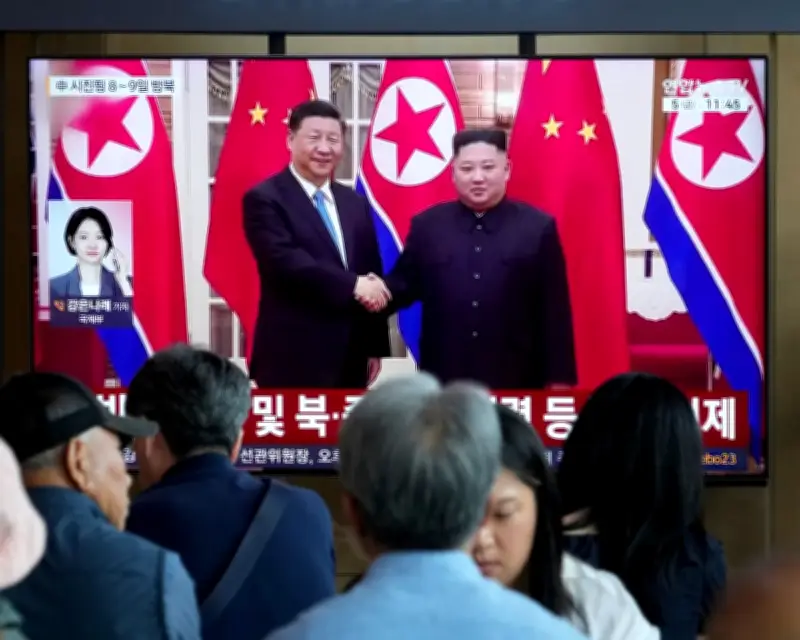
Chinese President Xi Jinping is set to visit North Korea on Monday for a two-day trip, his first in nearly seven years, as he seeks to revitalize ties with his country's only formal treaty ally. Xi is expected to meet North Korean leader Kim Jong-un in Pyongyang.
Strained Relationship
The China-North Korea relationship has been strained by a virtual freeze in trade during the Covid-19 pandemic and Pyongyang's increasingly close relationship with Russia. North Korea is China's only formal treaty ally, but the alliance has faced challenges in recent years.
Historical and Recent Context
Xi's trip comes ahead of the 65th anniversary of the signing of the friendship and mutual assistance treaty between China and North Korea, a pact that remains China's only defense agreement with another country. Chinese and North Korean troops fought alongside each other against South Korea in the Korean War in the early 1950s. However, North Korea and Russia have a much more recent history of military cooperation, with North Korea sending more than 10,000 soldiers to fight for Russia in the Ukraine war and signing a mutual defense pact in 2024.

John Delury, a senior fellow at the Asia Society, noted that within North Korean propaganda, there are overly effusive praises for the closeness with Russia forged in fighting a war together, while the relationship with China is viewed nostalgically. He added that North Korea does not want its closeness with Russia to outpace ties with China too much.
Balancing Act
Xi, Kim, and Russian President Vladimir Putin stood side by side at a massive military parade in Beijing in September last year, projecting a show of strength from the would-be leaders of a new, autocrat-led world order. However, behind the scenes, the leaders navigate a delicate balancing act to preserve their self-interests. China also wants to maintain a strategic relationship with the United States, at least in terms of trade.
Xi's visit to Pyongyang comes less than one month after U.S. President Donald Trump visited Beijing for a highly anticipated summit aimed at re-stabilizing the fraught U.S.-China relationship. Although the Trump-Xi summit was low on tangible deliverables, Trump later said he discussed North Korea with Xi, sparking speculation that he may have asked Xi to pass a message to Kim. Trump has repeatedly expressed a desire to meet Kim again.
Nuclear Issues
In recent years, Beijing and Washington have departed from their previously united front opposing North Korea's nuclear build-up. When Xi and Kim met in Beijing last year, their official readouts omitted any mention of denuclearization of the Korean Peninsula for the first time. Although the White House said Trump and Xi confirmed their shared goal to denuclearize North Korea after their meeting in May, Beijing did not confirm this statement.
On Sunday, Kim Yo-jong, Kim's sister who wields considerable power within the regime, called claims that Xi and Trump discussed denuclearization false. Last week, North Korea unveiled a new nuclear material production factory, and Kim called for an exponential expansion of the country's atomic arsenal.
Security Concerns
A bigger priority for Xi than nuclear talks will be defending China's own security interests in northeast Asia, most likely the threat he sees from Japan. Xi is understood to have become unusually animated when discussing Japan's increasing militarism with Trump and with UK Prime Minister Keir Starmer, who visited Beijing in January. Japan rejects the claim that its more proactive defense policy amounts to the new militarism described by China.
Delury said any cooperation between Beijing and Pyongyang on Japan is likely to be rhetorical rather than practical.
Rare Overseas Trip
The visit is also notable for being a rare trip abroad for Xi. In recent months, he has hosted a flurry of world leaders and now travels internationally less frequently than before the pandemic. That he is willing to travel to North Korea reflects both the proximity of China's ally and the importance of the bilateral relationship.

William Yang, a senior analyst at the Crisis Group, said: In light of North Korea's recent waves of missile tests, including the announcement of successfully testing AI-guided missiles, Xi likely sees the need to show up in Pyongyang in person to prevent tension on the Korean Peninsula from escalating. Xi's goal is to not let North Korea spin off too far out of the Chinese orbit, which is always something that Beijing would worry about, Delury added.