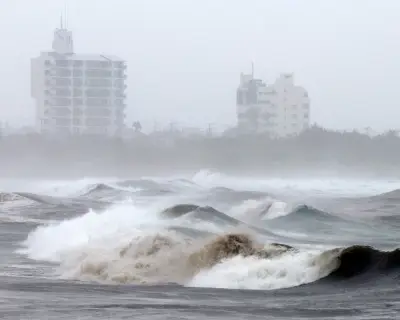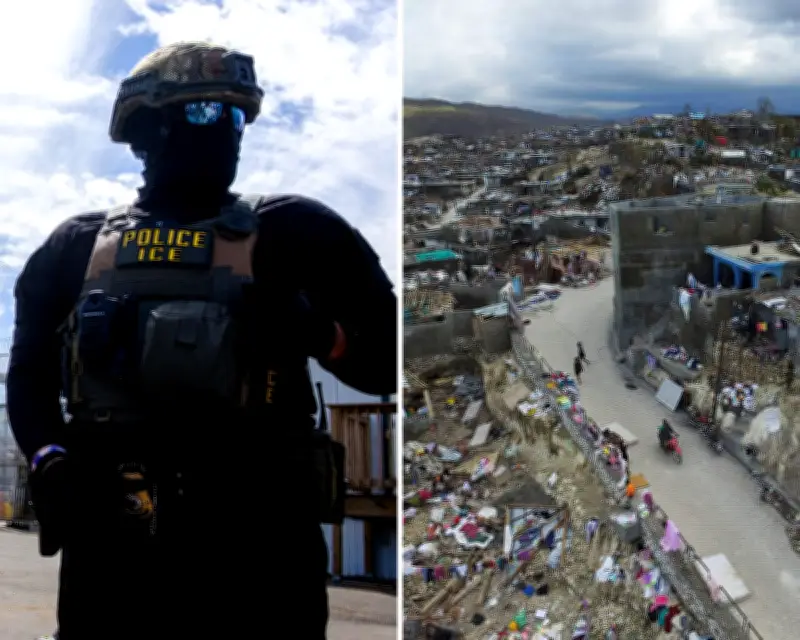
A Guardian analysis has revealed that Donald Trump's immigration crackdown is disproportionately targeting people from countries most vulnerable to displacement from climate-driven disasters. As the Trump administration pushes policies to boost fossil fuels, millions are forced to flee due to storms, floods, and droughts worsened by the climate crisis.
Of the 39 countries from which the Trump administration has fully or partly restricted entry to the US, 22 are ranked within the most vulnerable quarter of nations to climate impacts, according to the Notre Dame Global Adaptation Initiative. 'Nearly all of the most vulnerable countries are on a ban or visa pause,' said Danielle Wood, an associate professor at Notre Dame. Immigrants from Chad and Niger, the two most climate-vulnerable countries, are now fully barred, along with people from Sudan, Somalia, and Sierra Leone.
Climate Displacement and US Barriers
Among the most vulnerable half of countries is Honduras, which has experienced stronger rainstorms, droughts, floods, and coastal erosion. When Hurricane Mitch hit in 1998, killing 7,000 people, one affected family decided to move to the US. Evelyn, who was a teenager at the time, recalled the devastation: 'There were bodies and dead animals floating in the water, the house was messed up, all furniture gone. It was so sad.' Her relatives in New York pleaded with her mother to bring her and her sister to the US.

Storms like Mitch are even more likely today due to rapidly heating oceans and atmosphere from burning fossil fuels. Yet Trump's curbing of immigration and asylum has made it far harder for people like Evelyn to flee. 'Every day it's more barriers,' said Evelyn, who now lives in New York. 'It's sad to know that people will not be able to apply for a status to help their situation.'
TPS Revocations and Supreme Court Case
The administration has also sought to terminate Temporary Protected Status (TPS) for people from Honduras and 12 other countries, nearly half of which are among the most climate-vulnerable. The US Supreme Court is considering an appeal to TPS revocation for Syria and Haiti, which have suffered droughts and hurricanes. Environmental perils were cited when granting TPS, but Trump says the bans will 'keep radical Islamic terrorists out' and resolve vetting deficiencies.
Most banned countries are at the epicenter of a climate displacement crisis. The UN estimates severe weather has uprooted 250 million people globally over the past decade, equivalent to 70,000 displacements daily. In 2025, nearly 30 million were forced to move internally due to disasters, with wildfires like those in Los Angeles being a major cause.
No Official Pathways for Climate Refugees
Experts agree there is a growing cohort of 'climate refugees' fleeing as the planet overheats, but no official pathways exist. US law and the UN's 1951 refugee convention do not recognize environmental disasters as grounds for protection. 'People are being displaced by climate change, the number grows every year, and displacements are increasingly permanent,' said Jocelyn Perry of Refugees International. Developing countries now blacklisted struggle with crop loss, sea level rise, and other upheavals.
Advocates note that climate disasters often lead to secondary misfortunes like violence, which can be used for asylum claims. 'Climate change is not necessarily the first issue raised, but if crops fail for three years and families move to dangerous urban areas, climate change has played a key role,' Perry added.
US Role and Policy Contradictions
The US is the world's largest historical emitter of planet-heating pollution. Trump has dismissed climate action, calling it a 'hoax,' and demanded continued fossil fuel use. Meanwhile, his administration has shut down the refugee program (except for white South Africans) and dismantled overseas aid. Cuts to USAID are forecast to result in 4.5 million child deaths in sub-Saharan Africa over five years.
'All these actions will increase displacement, and the Trump administration will try to dissuade people from coming through cruel policies,' Perry said. 'But people will still make that journey if the alternative is death. Political decisions in the US and Europe will leave more people stuck in vulnerable places.'

TPS as a Climate Consideration
The one part of US immigration that factors in climate is TPS, granting renewable stays for war or natural disasters. Syrians received TPS in 2024 partly due to drought-like conditions affecting wheat production. Ethiopia's TPS cited severe drought and flooding displacing over 4 million. Haiti's TPS extension noted it is one of the countries 'most affected by extreme weather events.'
However, Trump has terminated TPS for many countries, with courts deciding on several, including the Supreme Court case for Syria and Haiti. 'There are tens of thousands who fled because of natural disasters,' said Geoffrey Pipoly, a lawyer for Haitian plaintiffs. 'Haiti has been in the middle of this for decades.'
A doctor from Sudan, who left after drought accelerated conflict, said: 'It's too dry, not enough water, lands left uncultivated, millions fled. Conflicts are affected by climate change. I saw no hope.' Sudan's TPS lasts only until October. 'It would be very tough to go back,' he said. 'People come to the US thinking there is law and equality, but that's no longer the case.'
Efforts to Update Immigration Law
The 1952 Immigration and Nationality Act defines refugees based on persecution, not environmental degradation. In 2021 and 2023, Democratic lawmakers proposed the Climate Displaced Persons Act to amend the INA. 'As disasters supercharged by climate change cause devastation, the Trump administration wants to destroy resilience programs and make it impossible for those without recourse to seek refuge,' said Senator Ed Markey.
The bill would also mandate data collection on climate displacement. 'There's vast data on internal displacement but virtually none on international displacement,' said Hannah Flamm of IRAP. 'Whether or not it passes, it is critical to mobilize advocacy.'
Given the current political environment, a new climate migration framework seems unlikely. 'There's not a lot of optimism that any change can occur soon,' Perry said. Amid mass deportations, 'climate has been put on the back burner to safeguard regular migration.'
A future administration might implement a climate visa, but it's more likely to focus on adaptation funding to help people stay, according to Yael Schacher of Refugees International. 'We have our own displacement in the US. Right now, sympathy for immigrants is nil. It's hard to see any expansive opening, even if that's what people need.'