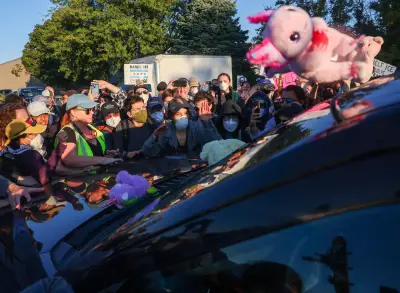
The first day of school in Los Angeles, California, on 14 August 2025. Photograph: Marcio José Sánchez/AP
California parents sue i-Ready maker over student data collection. Lawsuit against education software company fuels wider debate over privacy, screen time and learning.
Two California parents are suing Curriculum Associates, whose online education program i-Ready is used by thousands of schools for diagnostic testing, tracking student progress and online assessments. The lawsuit claims the program violates privacy laws, sparking a debate over whether i-Ready is actually beneficial to students.

The lawsuit alleges that Curriculum Associates collects student data and shares it with third parties for commercial purposes without adequate consent from parents and students. The plaintiffs further accuse the company of unjust enrichment, or wrongfully profiting off the collection and sale of student data. Curriculum Associates denies all claims detailed in the lawsuit.
This lawsuit represents just one in a series of recent allegations against education technology companies, nicknamed edtech, a $187 billion industry that is growing. Curriculum Associates has a $20 million contract with the Los Angeles Unified School District that began in 2023. The company boasts more than $750 million in annual revenue, primarily from contracts with school districts across the country.
The lawsuit cites Curriculum Associates terms-of-service policy, which details that the company will collect data including a student's race and gender, grade level, responses to i-Ready assessment questions, time spent answering each question and more. The company also collects students' IP addresses, school name, disability status and eligibility for school lunches.
Lila Byock, who has two children in LAUSD schools, and Nicki Petrossi, whose children formerly went to public school in the Fullerton school district, are plaintiffs in the case on behalf of their children. They say that Curriculum Associates gave them no notice about its data practices.
Parents do not know that this is happening. We trust that our kids are protected, and that includes their data, Petrossi said. Us checking off a box, giving permission for them to use the internet at school should not entail this level of data farming on them.
Some of this data is used by the company to adjust its adaptive products, like the i-Ready assessment, to provide usage reports to schools and districts, and more. Curriculum Associates details these practices in company policies but denies the allegation that they constitute unnecessary data collection without consent.
Curriculum Associates discloses information to school and district customers about this data collection and obtains consent through them. The plaintiffs allege that this is not adequate consent under the Children's Online Privacy Protection Rule, which requires a company to provide parents with a clear notice of its data practices when their children will be using its products.
In LAUSD schools, i-Ready is used for diagnostic testing for two days, in three separate sessions over the course of a school year. Students complete English and math testing, and their scores are reported back to their schools and the district. Time spent on i-Ready lessons varies from school to school, but many students report being required to use i-Ready for 45 minutes each on English and math lessons each week.
Parent group calls on districts to examine tech policies
Byock and Petrossi are not alone in their concerns. The lawsuit comes as parents have increasingly expressed their doubts about edtech, leading to the founding of Schools Beyond Screens, a parent group calling for less tech in schools.
Jodi Carreon, the national director of Schools Beyond Screens, of which Byock is a founding member, said she first became concerned with tech use when her child was in kindergarten on Zoom during the Covid-19 pandemic in the San Marcos Unified School District. She thought that platforms like i-Ready would be a temporary measure, but once her son went back to school and continued to use it, she became concerned.

Right now, it has been a very sort of optimistic approach. We are assuming that technology is going to help the learning process. What we are asking is to take a little bit more of a critical look at technology, examine has it actually helped learning, has it harmed learning, just determine what the evidence is showing, Carreon said of Schools Beyond Screens mission to encourage districts to change their tech policies.
Edtech uses class time and district funds
The LAUSD teachers union, United Teachers Los Angeles (UTLA), has concerns about edtech usage in the district as well. Julie Van Winkle, vice-president of the American Federation of Teachers branch of the union, said she has noticed a significant uptick in private contracts since LAUSD superintendent Alberto Carvalho took office in 2022. Carvalho was placed on leave in February 2026 after the FBI raided his home and LAUSD headquarters. The search was reportedly tied to an investigation of edtech company AllHere, which was paid $3 million to develop a chatbot for the district in 2024. Carvalho was reportedly a major proponent of the company and its product.
Since 2022, LAUSD has committed more than $6.7 billion to private contracts, $1.6 billion of which go to edtech companies, according to the union.
Though i-Ready lessons are not technically required by the district, Van Winkle said she has heard from union teachers that some principals recommend it as a tool for struggling students or choose to require it on their campuses.
LAUSD maintains that i-Ready is a useful tool for educators to personalize their lessons for students based on test results.
The District continues to review implementation practices and feedback from students, families and educators to ensure digital tools are being used appropriately, effectively and in ways that support student learning and well-being, an LAUSD spokesperson said in an email statement.
Ciaran Duff, a senior at Hamilton High School in West LA, said their peers have at times missed rehearsals or even English classes to finish required i-Ready testing. Duff said the program only tests math levels up to algebra 2, and some pre-calculus. Students in higher math levels struggle to complete tests that cover math they learned years previously. Several of Duffs peers skip through questions without trying to answer them.
Marcela Chagoya is a special education teacher at Stevenson Middle School in Boyle Heights and the union board director for UTLA East LA. Chagoya said her sixth-graders have difficulty scoring well on i-Ready assessments and lessons, routinely testing significantly below grade level. For many of them, Chagoya says i-Ready just is not accessible.
What our students need, particularly, and all students, really, is that human face-to-face interaction, Chagoya said. The increase of screen time is very concerning to us as educators, because we came into this because we like to teach and teaching is not putting our students in front of a screen. For special education students specifically, the i-Ready program does not reach all of them.
Chagoya added she has had to scramble to help her students keep up with i-Ready testing that does not meet their needs.
The edtech debate hits home for LAUSD
Since 2023, LAUSD has increasingly relied on edtech platforms like i-Ready. Students use Chromebooks or iPads in all of their classes and complete activities on other platforms such as IXL and Khan Academy. The district maintains that i-Ready is a useful diagnostic tool for educators.
However, LAUSD is currently overhauling its tech policies, and the school board approved a measure to limit student screen time for the next school year back in April. Board members say they hope to recalibrate screen time, which went largely unregulated post-Covid-19.
Van Winkle said when she was first teaching in the early 2000s, educators worried about access to tech for low-income students. Now, she says the script has flipped.
Limitation on technology is a privilege only to people who have the means to be very involved in that way in their kids lives, and meanwhile a lot of our students, but particularly the ones in lower socio-economic areas and situations, they are the guinea pigs for all these tech companies that Carvalho has just opened the gates to at our schools, Van Winkle said.