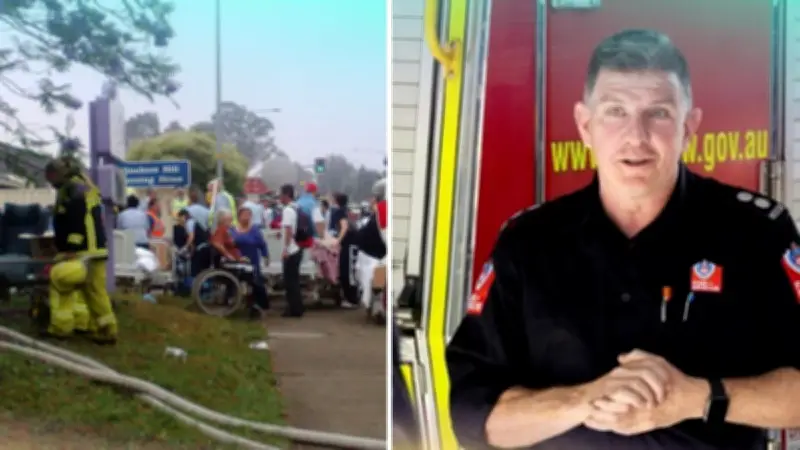
It was just before 5am on November 18, 2011, when Brett Johnson attended a job that would stick with him forever. He and his crew were called to a nursing home in Quakers Hill, Sydney, by an automatic emergency alarm, unaware that in just moments they would be battling what was later described as "the most complex and intensive fire rescue operation" NSW teams had faced in years.
Firefighters arrived on Hambledon Rd to be told there was a blaze in an unoccupied room and initially thought it could have been sparked by an electrical fault. "When I opened the door I could clearly see a fire on the bed, and I could see that the room was completely empty," Johnson, the incident controller on the day, told 7NEWS.com.au. "I, at this point in time, believed it was going to be quite a routine extinguishment ... and I tasked the crew to go and grab the hose reel to extinguish the fire on the bed."
A Daunting Scene
As he walked back into the foyer to relay a message via radio, he noticed black smoke coming from closed entry-point doors to the opposite wing. "The smoke was pushing out of the seams of these doors and that's when I knew, because I must have been 50m away from the original fire, that we had a serious problem."

Crews battled dense smoke to move residents, including some who had sheltered under beds or behind furniture, to safety, and bring the separate fires under control. Coupled with a ceiling collapse and a warning system that made it difficult to communicate, Fire and Rescue NSW described the emergency as the "most complex and intensive fire rescue operation undertaken by FRNSW in many years."
"There was just so many people injured and so many people displaced, and you can imagine — not just from the fire but people who are frail and get moved out at that time of the morning very quickly — there's injuries that are sustained as well, and it was just quite a daunting scene," Johnson said.
Fourteen elderly residents died, either in the fire or later in hospital. The fires were deliberately lit by Roger Dean, a registered nurse employed at the home where 80 people lived, to cover up evidence he was stealing prescription drugs. He was sentenced to life in jail without parole for the murders of 11 residents.
Thanks to first responders, dozens of lives were saved. "It's a tragic situation that sits really heavily with the emergency service workers, obviously with the families, with the staff, with the people on scene," Johnson, now 52, said. "But also people should be proud that they have given their all to be able to remove people from that danger."
The Toll on First Responders
Johnson spoke to 7NEWS.com.au ahead of Thank a First Responder Day on June 10, an event previously supported by the Duke and Duchess of Cambridge. Fortem Australia, a not-for-profit organisation that supports first responders and their families, said "unprecedented pressure" was being placed on emergency services with more than 14 million triple-0 calls made in 2025 alone.
"First responders don't just attend emergencies, they absorb them," Fortem Australia chief executive Mick Willing said. "Whether it's police arriving first at a violent incident, paramedics treating life-threatening injuries, or firefighters responding to disasters, they are stepping into the rawest moments most people will never witness. These aren't one-off experiences. It's the cumulative exposure to trauma, shift after shift, that takes a real toll."
Across his almost three decades on the job, Johnson has been called to fires, hazardous material spills, structural damage, car accidents, self-harm incidents, bomb threats, floods, search and rescues, and emergency medical responses. The Fortem campaigner and participant said he had leant on family — including his father, a former firefighter — colleagues, and industry support services over the years.
"I've been in the rescue department for 25 of my 27 years and there are so many incidents that I've been to that have a high impact on myself or my crew," he said. The experienced emergency services worker — who has worked all over Sydney, including Castle Hill for the past 11 years — said high-profile incidents that make national headlines and "really private" situations sting all the same.

"Whether it be police, fire, ambulance, whoever it is, the one thing you just generally should not ask is 'what's the worst event you've seen', because it's going to be far worse than you can imagine," Johnson said. "And they would, even in describing it, have to muffle it in one way or another, or avoid detail, because they would be afraid that it would not sit. It's not something that you would generally speak about."
The second-generation firefighter said Fortem's work was vital for first responders and their loved ones. "It is so critical that the people who are prepared to put their lives on the line to assist the community have a solid support when they have completed that risk, that task, that job, that incident, because it's very important to be able to return and do it over and over and over again," he said.
Fortem hopes Thank a First Responder Day 2026 can "transform gratitude into meaningful action." "Whether that's leaving a message, shouting a coffee, supporting a local initiative or donating to vital programs," Willing said. "Collective community support plays a critical role in ensuring first responders and their families don't face these challenges alone. If we want first responders to continue showing up for us, we need to show up for them too."
The 2011 aged care fire led to legislative change, with the NSW Government making it mandatory for all nursing homes to be fitted with automatic fire sprinkler systems.