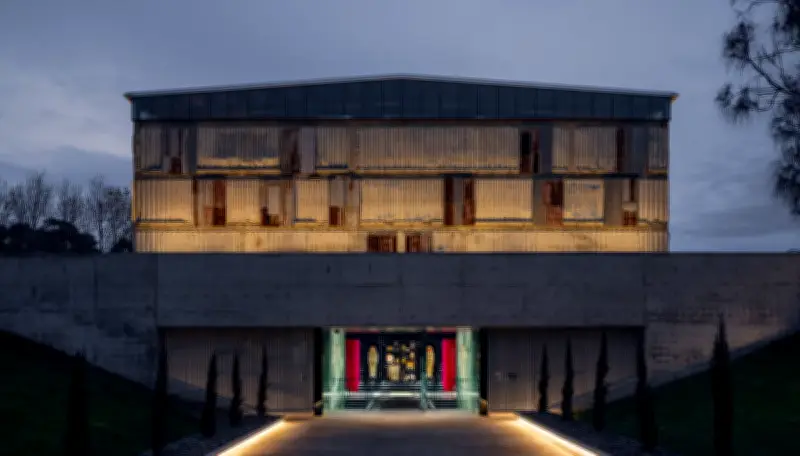
David Walsh is nervous. It is the day before the public opening of his Hobart museum's new library and wing, Phrontisterion, and he is accidentally still there when the media arrive. "I didn't sleep much," he says. "When I opened Mona, I was 15 years younger, a lot more bulletproof. But also, I had nothing to prove, because no one cared. It was a big hole in the ground. I just, you know, filled it in. But this is somewhat inhabiting an expectation that the community has. I feel more pressure than I did, even though it's obviously not at the same scale. So there's some stress, some tension … butterflies."
A decade in the making
After 10 years of planning, four years of construction, and a budget that blew out from $11 million to more than $100 million, Phrontisterion is finally open. The wing comprises Walsh's most personal collection, spread over two levels at Mona, Australia's largest privately owned museum. There is more of Walsh on display here than ever before.
The first item he shows is not a book but a thin piece of paper with the original handwritten lyrics to David Bowie's 1972 hit Starman. There is a complete set of Bowie's LPs and a collection of colourful books about the singer. A record player disguised within a bench is ready to play at Walsh's whim. "There's a lot of stuff here that's sort of growing out of the history of my life," he explains. "I'm a Bowie fan, so this is a bit of a Bowie shrine." There is also a collection of Bowie's own favourite books, which is "98% complete," Walsh says.

Personal treasures and rare books
Walsh points out a Greek history textbook that belonged to his brother Tim, who died in 1991. There are hardcovers from their childhood – "these are the first two books that were ever on our bookshelf at home. It's astonishing to me that we've still got them" – and framed documents written by Einstein, Newton and Darwin. "There are a lot of things that I've never shown … I haven't actually done a calculation but I've probably spent more money on books and maps and stuff than I have on art," Walsh says.
The most expensive book in the library is the Shakespeare First Folio, worth about $6-8 million. "This is the book, in English," says Walsh. "It's probably a sacred object, really." Of about 750 copies printed, 235 are known to remain. Mona's library manager Mary Lijnzaad recalls bringing it back from London in a "bombproof, bulletproof, waterproof Pelican carry case". "It was quite a relief to land in Hobart and it's a wonderful thing to see it on display here now," she says.
Innovative digital duplication
Next to the folio is a remarkably realistic digital duplicate. By twisting a knob, visitors can turn each page at their own speed. This innovation by Art Processors, the design agency that developed Mona's app The O, animates 60 rare books from Walsh's collection, including a Picasso sketchbook. "We've never seen anything like this," says Nic Whyte of Art Processors. "We can essentially render, one-to-one, any book, any dimension, any number of pages … the way that the pages turn and fold, we tried to get it as real as we can."
Elsewhere on the shelves are signed classics, books about Mona artists, books about sex and death, a set of Lonely Planets that look like they could have come from an op shop, and a kids' section with books from Walsh's daughters' collections. In total, 30,000 books – and none of them are labelled. There are no library cards. Books must stay in the room but do not need to be put back in their original spot. If a visitor thinks a book belongs elsewhere, they can file it there.
No fixed order, tracked by cameras
For visitors looking for a particular title, The O app tracks it down. Cameras repeatedly take images of shelves over the course of a day to locate books. This replaces the Dewey Decimal system, which Walsh wanted gone due to its Eurocentric bias. "David's brief was simple: let us put a book anywhere and still find it," says Whyte. "So we've built a library with no fixed order that stays completely navigable. As far as we know, that doesn't exist anywhere else."

Lijnzaad, the librarian, laughs when asked how she copes. "It's been a real challenge … Dewey has almost become second nature after a few decades," she says. "Dewey's a good classification scheme that gives you a number to put on the shelf. But the subject headings are all heavily weighted towards Christianity and masculinity." For instance, the 200s are for religion, but most of that is taken up by Christianity. "They're working to change that, but not quickly enough for us."
An accessible 'thinkery'
The name Phrontisterion comes from Greek playwright Aristophanes' comedy The Clouds, a satire mocking the educated upper class. Mona wants their "thinkery" to be accessible to everyone. "We don't want people to come in and feel that they need to be educated," Lijnzaad says. "We want people to enjoy the space, look at a book, be intrigued, pick it up – or ignore it – or sit down and read it. You can spend as much time here as you like."
On Mona's blog, Walsh wrote a homage to library access. At age seven, "Glenorchy library was my best friend's best friend," he writes. "I made a serious attempt to take home every book in the library." Later, he found Richard Epstein's The Theory of Gambling and Statistical Logic at the State Library of Tasmania, without which "there's a good chance that there'd be no Mona, and no library," writes Walsh, who makes much of his money through a gambling syndicate. "From libraries I came, and to libraries I return." Phrontisterion entry is included in a ticket to Mona.