
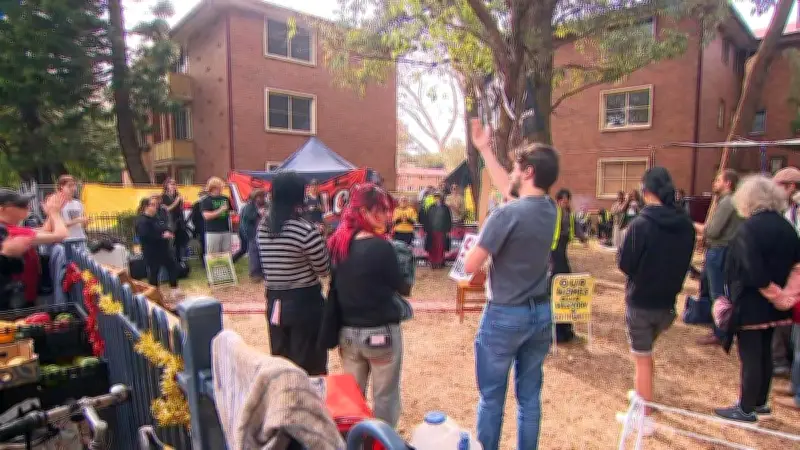
The riot squad has intervened on the 26th day of protests against the demolition of a public housing block in Sydney. Thousands of demonstrators have been opposing the removal of flats in Cope Street, Waterloo, which are set to make way for a mixed public-private development. An encampment had been established in the yard. Around 60 police officers moved in at approximately 6:30am on Friday, resulting in the arrest of a 22-year-old woman from Ashfield.
Fences Erected as Government Pushes Forward
Fences have now been installed around the site, and the government states it is proceeding with the plan to demolish 750 public housing units and replace them with 3,300 new homes. Housing and Homelessness Minister Rose Jackson told 7NEWS.com.au that “at least half would be delivered as social or affordable housing, which is more than double the number currently on the site.”
Protesting tenants label the process as eviction, while the government refers to it as relocation. Long-time Waterloo public housing tenant and protester Karyn Brown said, “They don’t like it if I say eviction because they call it relocation, but it is forced nevertheless. I believed when I moved here that it was my forever-home because that’s what public housing has always been — secure and affordable housing for as long as you need it.”

Relocation Progress and New Developments
Jackson noted that Homes NSW has been supporting tenants through relocations first proposed in early 2023, and that “to date, 130 residents have been relocated.” Some low-income households have been offered reduced rent in 74 apartments within the new $66 million Boronia Apartments development at Waterloo, funded by three levels of government.
Jackson added that other residents from the soon-to-be-demolished Waterloo flats have “been relocated elsewhere in the community or to an area of their choice. There are two tenants remaining and both are being supported intensively by Homes NSW to be relocated appropriately. Any resident required to relocate for the redevelopment will be able to return when the new buildings are complete, if they choose.”
However, the completion timeline for the new homes remains unclear. Demolition is scheduled to start later this month and will occur in stages over the next nine months, according to 7NEWS.com.au.
Community Concerns and Broader Housing Crisis
Waterloo public housing tenant representative Grant Donohue pointed to a still-vacant lot where 18 public housing dwellings were demolished in 2013, highlighting the history of such projects. Action for Public Housing member Damien Nguyen told 7NEWS.com.au that the protests “are not just about Waterloo public housing, it’s about public housing across the country.” He argued that the government has failed to address the housing crisis, stating, “There are empty homes across the state that are incredibly expensive, yet the government is trying to fix the problem by demolishing public housing.”
More than 1,000 people are on the social housing waitlist in Sydney’s inner city, and over 60,000 are on the waitlist statewide. Jackson defends the government’s “street-by-street, suburb-by-suburb” strategy to demolish and rebuild hundreds of public housing units, saying, “The homes in Waterloo are past their use-by-date and are in desperate need of renewing.”
Brown, however, contends that her home of three decades only requires minor repairs and believes the government should focus on sustainability-focused retrofits that allow communities to remain intact. “These are really solid buildings. There’s not that much wrong with them,” she said.
Donohue also emphasized that protesters are fighting for more than just the physical structures. “It’s not just the housing, you’re gonna rip the community to shreds and upend their lives,” he said.
Jackson countered that the protesters do not represent the entire community, noting that some relocated tenants have expressed satisfaction with their new homes. She said, “The protestors have been trespassing for the last 24 days and trying to stop us from building more homes for those who desperately need them.”

Critics of current housing policy argue the situation is worsening as the government struggles to meet housing targets. Chandler-Mather, executive director of The Green Institute, told a select committee on Intergenerational Housing Inequity that if the federal government built public housing at the same rate as in the past, it would have constructed nearly 200,000 public homes over the last five years, eliminating the waitlist.
Nguyen predicts that public housing protests will continue to grow in line with the nation’s housing crisis.