The Panama Canal: Engineering Marvel That Redefined Global Shipping
The Panama Canal represents one of humanity's most ambitious engineering achievements—a remarkable 77-kilometre artificial waterway that carves through the Central American isthmus, connecting the Atlantic and Pacific oceans. This monumental shortcut has fundamentally transformed global shipping routes since its completion over a century ago.
A Shortcut Through Geological History
This extraordinary passage effectively reverses what nature accomplished over millions of years. The narrow land bridge separating North and South America gradually emerged through geological processes, finally separating the two great oceans approximately three million years ago. The canal's creation undid this natural barrier, providing vessels with an alternative to the perilous 22,000-kilometre journey around South America's Cape Horn.
Before the canal opened in 1914, ships traveling from America's east coast to its west coast faced that daunting southern route. The Panama Canal dramatically reduced this distance to approximately 9,000 kilometres, revolutionizing maritime commerce and naval strategy.

Turbulent Construction History
The canal's construction came at tremendous human cost, with thousands of workers perishing during its creation, primarily from yellow fever and typhoid outbreaks. French engineers first attempted the project during the 1880s, but their efforts collapsed financially by 1889, leaving the ambitious undertaking incomplete.
The United States subsequently intervened, capitalizing on Panama's independence aspirations. Historical records reveal fascinating political maneuvering, including political cartoons depicting President Theodore Roosevelt poised with a pickaxe, ready to breach the isthmus with ships awaiting passage on both sides.
In 1903, Panama declared independence from Gran Colombia during meetings at New York's Waldorf Hotel. With American naval support ensuring this new sovereignty, the U.S. Army Corps of Engineers commenced construction within twelve months, completing the monumental project eleven years later.
Engineering Innovation: Gatun Lake and Lock Systems
The canal's operational heart is Gatun Lake, an expansive 423-square-kilometre reservoir created by damming the Chagres River in 1913. This artificial lake sits 26 metres above both ocean levels, serving as the canal's central water bridge.
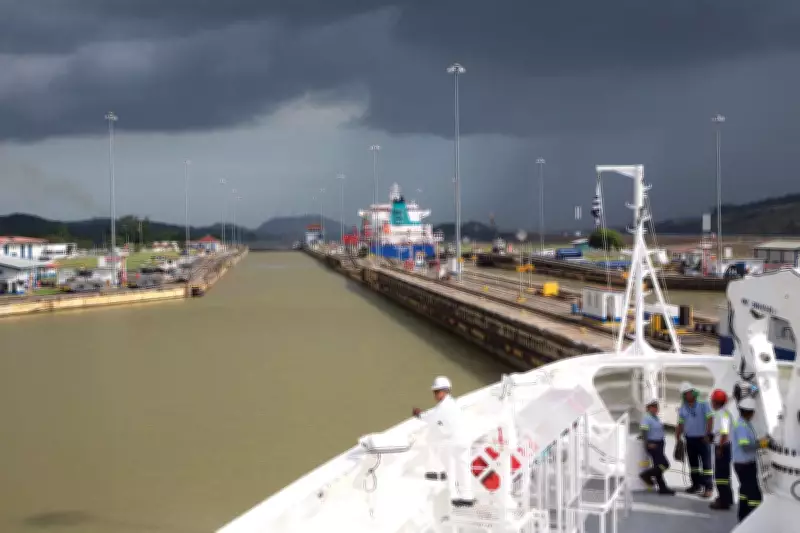
Three sophisticated lock systems manage the dramatic elevation changes. The Gatun Locks on the Atlantic side feature three chambers that raise and lower vessels approximately 8 metres each. On the Pacific approach, the Pedro Miguel and Miraflores locks perform similar functions. During transit, ships connect to specialized $2.5 million locomotives that maintain precise positioning within the narrow lock chambers.
The canal's central section actually comprises a 24-kilometre crossing of Gatun Lake itself, demonstrating how engineers creatively utilized Panama's natural topography.
Modern Expansion and Economic Significance
American administration gradually transferred to Panamanian control, culminating in complete handover by 2000. The canal has since demonstrated remarkable economic performance, generating approximately $8.23 billion during the 2025 fiscal year—a substantial 14.4 percent increase from previous periods.
Transit statistics reveal growing importance, with 13,404 vessel passages recorded between October 2024 and September 2025, representing a 19.3 percent year-on-year increase.
The Neopanamax Expansion
A monumental $7.22 billion expansion project, completed in 2016, created parallel lock systems accommodating significantly larger vessels:
- The original 103-year-old locks measure 33 metres wide and 304 metres long
- New Panamax and Neopanamax locks expand to 55 metres width and 427 metres length
- Enhanced 18-metre depth accommodates massive container ships carrying up to 12,000 containers
These modern locks incorporate sophisticated water conservation systems, reusing 60 percent of the millions of litres required for each filling cycle while consuming 7 percent less water than their smaller predecessors.

The Panama Canal continues evolving as a critical global trade artery, demonstrating how human ingenuity can reshape geography and commerce across generations.